Steam Trap Troubles? Skip The Psychics
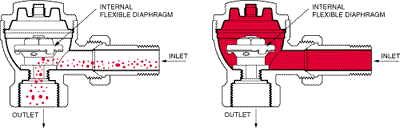
That is the goal of this two-part series: to solve some of the confusion and mystery surrounding steam traps.
With a little understanding of the purpose of a trap and how it works, you can eliminate much of the guesswork when deciding which type of trap to select, how to size it, and what will happen if it is not properly maintained.

Purpose of a Steam Trap
The first function of any steam trap is to remove air and noncondensable gases from the equipment to which it is assigned. If the air is not removed, steam will not be able to enter the equipment. Hence, heat transfer will not occur.Or, if air is not removed as designed, you may get uneven heating among different components and poor steam distribution.
The next job of the trap is to close in the presence of steam. There is a real good reason for this. For example, 1 lb of water at saturation conditions (15 psig and 250°F) contains 218 Btu; 1 lb of steam at the same pressure contains 1,163 Btu. Of that, 945 Btu are in the form of latent heat. That is to say, as the steam condenses into a liquid, it gives up its latent heat (945 Btu). So you can see that much more energy can be removed from 1 lb of steam than from 1 lb of water. You do not want steam to leave the system or process before it gives up its latent energy.
The last job of the trap is to drain condensate. As the steam gives up its latent heat, it changes phase from a vapor into a liquid. This liquid is called condensate.
This condensate must be removed from the heat transfer equipment. If it’s not removed, then you have less heat transfer area for the steam, and possible water hammer upstream of the trap. Consequently, that means less heat will be transferred.

So Many Traps, So Many Applications
Now you may be asking yourself, “If all traps do all three functions, then why are so many different types of traps available?”The reason is that different applications place a certain amount of importance on each of these functions. Therefore, different traps are better at different functions.
Looking for quick answers on air conditioning, heating and refrigeration topics? Try Ask ACHR NEWS, our new smart AI search tool. Ask ACHR NEWS
Suppose we have an application that requires a constant load that never shuts down once it starts. The only shutdown is for scheduled maintenance.
Now imagine the complete opposite, a load that shuts down often, such as a cyclical or a batch process. Take Gus in the local cafeteria; every afternoon he heats up some chili in a steam kettle for factory workers. But once the chili is consumed, the steam is not required again until the next day.
One trap rarely sees air and has a constant load. The other trap sees a lot of air, and repeatedly has a heavy warm-up load every time the process starts up.

Basic Types
There are several types of steam traps. We will look at a few, as the rest are some variation of the ones we are going to discuss. They are the thermostatic-, mechanical-, thermodisc-, and orifice-type traps.As we discuss the operation and characteristics of each, take note of what applications would work best for each trap, or better yet, which type of trap would be a poor selection for a certain application.
The operation of a thermostatic trap is simple once it is explained. However, there are a few details that are important to keep in mind.
The key component of the thermostatic trap is the thermostatic element inside. The element is generally filled with an alcohol-water mixture that will boil at a lower temperature than the temperature of saturated steam. Therefore, as steam reaches the element, the alcohol-water mixture boils.
As it boils, the bellows element that contains the mixture quickly expands. As it expands, it drives a pin into a seat to prevent steam from leaving before it gives up its latent heat.
To open, the element must cool down until the mixture condenses. Then the bellows will contract, pulling the pin from its seat and opening the trap to drain the condensate.
Based on this information, you notice that the condensate must cool down below saturation temperature to open. Therefore, you have to provide a way for the condensate to cool in addition to an area for it to cool. This place is known as a cooling leg. It’s usually a length of pipe long enough to meet the stated requirements. You need to ensure that the cooling leg is not accidentally insulated. If it is, subcooling cannot take effect and the trap will not open to drain condensate.
Another characteristic to note here is that this particular type of trap is pressure independent. By that, we mean it follows the saturation curve of steam. To explain it another way, the higher the pressure at which the process operates, the higher the temperature of the steam.
Along the same reasoning, the higher the pressure, the higher the temperature required to boil the alcohol-water mixture. This is not to say there is no limit to pressure. The trap body still has a pressure rating that must be followed.
Other things we can deduce about this type of trap is that the element is probably made of a thin material. Therefore, it is susceptible to water hammer. So if water hammer is a problem for your facility, you want to ensure that the thermostatic element has some type of protective case.
You may also opt for a thermostatic element that is filled with a heat-expanding solid, such as wax, instead of the liquid mixture. But if you do, remember that it will not follow the saturation curve, and it will be much slower acting.
Another thing we can deduce is that this type of trap quickly vents air.
Also, it is important to note that when this trap fails, it probably fails open from element damage or dirt. Therefore, you need to know how important it is to your system that when a trap fails, it fails a certain way. The other thing is that it will most likely fail a certain way, if it fails. But, depending on the circumstances following the failure, it may fail in a different position than what you anticipate.
A thermostatic trap could work well with tracer lines and heating equipment. What’s nice about those old, cast iron radiators is that they have a built-in cooling leg. It’s the bottom of the radiator. Not only does it provide an area for cooling, but the area is so small relative to the size of the radiator, it does not sacrifice much of the heat transfer area.
The next type of trap we will discuss is a mechanical trap. There are two popular types, the float style and the inverted bucket.
The float style has a float connected to a lever arm. On the lever arm is a pin. As condensate enters the trap, the float rises, pulling the pin from the seat and thus allowing the condensate to drain. When there is very little or no condensate present, gravity pulls the float down, keeping the trap closed.
In this position, there is little chance for air to escape, so to remove air, a thermostatic element is usually added to this particular style of traps. However, in this case, its only function is to remove air, not the condensate. The element is located above the waterline in the trap so that the water does not block its removal path. Now the trap is known as a float and thermostatic (F&T) trap.
These traps come with a seat pressure rating. Don’t confuse seat pressure rating with the pressure rating of the trap body. They are two completely different things.
The easiest way to explain this is to imagine the float is down and the pin is in the seat. Now imagine yourself on the other side of the seat. You have a straw connected to the seat. You create a differential pressure on the straw (you suck on the straw.). Can you suck hard enough on the straw to hold the pin in place?
The seat pressure rating is a measurement of, in this example, how hard you need to suck on the straw to keep the pin in the seat, even though the water is rising and trying to bring the float up with it. Now the water level is above the float and the pin is still in the seat.
Obviously, there is not going to be someone sucking on a straw to keep the pin in place. However, there may be a large enough difference in pressure from the inside of the trap to the outside to lock it shut in much the same way as in our straw example.
We need to ensure that the buoyant force of the ball is greater than the force locking the trap shut. Since force is pressure times area (F = p x a), if we decrease pressure of the steam or the area of the seat, we decrease the force necessary to lock the trap shut.
We’re not going to change the pressure of the steam, but we can change the seat area (size). That will change our seat pressure rating. Remember, that will also change our trap capacity.
Now I have one caution on this seat pressure-rating concept. It is not unusual to control pressure by using a temperature-sensing device. If we need more heat, a pilot increases the pressure. But by increasing the pressure, we may lock the trap shut.
This can happen with a new heat exchanger. As the heat exchanger becomes fouled, less heat is transferred across its surface. The temperature sensor detects this and increases the steam pressure. If we are not careful, the pressure differential may become enough to lock the trap shut. Next, the heat exchanger floods and there is even less heat transferred across its surface.
Now let’s see what characteristics we can deduce from what we know about the F&T trap. Since we are using a float, temperature has no effect on the float rising and falling. Therefore, we can drain condensate at saturation temperature without having to subcool it. Also, since the float operates based on condensate level, the trap must be plumb and level.
Along that same line of thinking, the rate of condensate drainage depends on the float level, so this trap modulates based on load. Therefore, a good application for this trap would be one where the load varies, such as heating water for a shower room.
Since the float is hollow, water hammer may damage the float. A damaged float probably causes the trap to fail closed.
Bucket Traps
Another popular type of mechanical trap is the inverted bucket trap. Instead of a float rising, we have an inverted bucket. Opposite the float, when the bucket is in the raised position, the trap is closed. When the bucket is down, the trap is open to drain the condensate.Here’s how the inverted bucket trap works. Steam enters from the bottom of the trap and into the inverted bucket. Being less dense than condensate, it causes the bucket to rise, closing the trap. As the steam condenses, the bucket falls, opening the trap to drain the condensate.
We still have to remove air. For that, the bucket has a small vent at the top. Air (and very small amounts of steam) escape through this vent and leave the trap. It doesn’t remove air rapidly, which isn’t a problem during normal operation. But on start-up, we have large amounts of air we would like to vent quickly. For this reason, some manufacturers have added another vent hole for start-up.
I know, that means we will trap less steam. To prevent too much steam from passing through the holes, the manufacturers have placed a bimetalic disc near the additional vent hole. During start-up, the air is vented rapidly through the two vent holes, but when steam hits the bimetalic disc, the heat of the steam warps the disc until it closes off the additional vent hole.
Once again, let’s figure out what characteristics this trap has based on what we know. Since this is not a hollow float but an open one, the possibility of water hammer damage is slight. For this trap to properly work, we need a small amount of condensate in the bottom, otherwise the steam may escape from under the bucket without lifting it.
There are two ways to prime this type of trap. One is to insert a removable plug in the trap. The other, and most likely, is to let the warm-up load do it naturally.
Since this is a trap that needs priming, not all of the condensate will drain. Therefore, make sure this trap is not exposed to freezing conditions, or it may be damaged.
If the trap fails, it probably fails with the bucket down and in the open position. Once again, imagine you have your straw. You can get enough pressure differential to lock the trap shut, even though gravity is trying to make the bucket fall. Since the trap rises and falls, its operation is cyclical and it is suitable for steady loads.
This inverted bucket trap differs from a bucket trap. The bucket trap is not as popular as the inverted bucket trap, so we will not discuss it. Just realize they are two different traps, and they operate differently.
To make matters more confusing, many people refer to an inverted bucket trap as a bucket trap. Nonetheless, if you can imagine it and go through the same analysis as we have done so far, you will be able to come up with its characteristics.
Thermodisc And Orifice Traps
Another very popular type of trap is the thermodisc trap, a rugged, simple, and easy-to-maintain trap. The only moving part is a disc.When condensate is present, it nudges the disc aside and drains. Because the downstream side of the trap is lower in pressure than the upstream side, some of the condensate will flash into steam as the condensate reaches saturation temperature. Flash steam will escape to the area above the disc.
After the condensate has drained, steam velocity across the trap will increase, causing a sudden drop in pressure under the disc and snapping it closed.
The pressure on both sides of the disc will be approximately equal. However, the disc is held closed because the area above the disc being acted on by the steam is larger than the area being acted on below the disc.
As the steam on the downstream side of the trap condenses, pressure will drop. When it drops low enough, the disc can be nudged off its seat and the process repeated. Pressure can also be relieved as air is removed via a micro-bleed path etched into the disc.
Based on how this trap operates, we can see that it is well suited for outdoor, high-pressure, and water-hammer-type applications. Because of its size and the design of the disc, you can see that this type is not as efficient at removing air. Also, the path is small and can easily become clogged. Therefore, a strainer should be used upstream of this trap.
The last type of trap we are going to discuss is an orifice trap. It is rather simple; there are no moving parts, just a plate with a small orifice.
Knowing just that, we can see that it can only be used in applications that operate continuously and have a constant load. It will not be able to handle air and condensate at the same time, and will allow some steam to pass. It may also back up condensate on start-up if the warm-up load is not considered.
Along that same line, if it is sized for the start-up load, it may be too small for the running load, so sizing is critical. This is a trap that can easily become plugged. It would not be the best choice for an hvac application or an application with a varying load.
Next Week: Capacity, sizing, failures, and maintenance.
Gerhardt gives numerous seminars on service and maintenance for hydronic and steam systems. Presently he is an instructor at the ITT Little Red Schoolhouse in Morton Grove, IL. Gerhardt can be reached at 847-966-3700 or mgerhardt@fluids.ittind.com (e-mail).
Looking for a reprint of this article?
From high-res PDFs to custom plaques, order your copy today!


