Planning, engineering essential with rooftop units
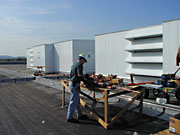
OK, that’s oversimplifying things just a wee bit; however, many just don’t think that installing a rooftop unit is that difficult most of the time. But the truth of the matter is that a really good rooftop installation involves some finesse.
It’s not good enough to just show up on the roof and hope that the unit and everything else will be there when you arrive. It takes forethought. It takes planning.
And let’s not forget the need for a properly engineered rooftop unit. Many contractors have definite preferences as to which types of rooftop units they like to install. They often appreciate those units that require little work in the field during installation and ease of accessibility to service the unit in the future.
So with a little planning, some hard labor, and a well-designed rooftop unit, your customers are going to be thrilled with their comfort levels.
A level proposition
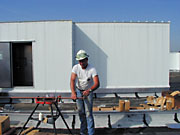
Robert Norton of Colonial Mechanical, Richmond, VA, has seen more rooftop units in his lifetime than he’d probably care to admit. As ceo of this $135 million/year company, Norton oversees about 1,000 employees who focus their attentions strictly on commercial-industrial applications in Virginia and a small part of North Carolina.Norton says that he and his service department have seen numerous cases in which rooftop units were not installed properly. Many times the problems stem from the unit not being leveled in the first place. The curb installation is critical to ensure a level installation.
If things aren’t level, “You end up with condensate not properly draining out of the pan, which can cause some humidity problems as well as environmental problems in the space. If the trap is not deep enough, then typically you’ll have a problem with the condensate backing up, leaking into the unit,” says Norton.
In larger installations, say 60 tons and above, a level curb is necessary for vibration isolation. “A vibration isolation rail has to be installed on a well-supported and level curb. If it’s not, the unit then will tilt one direction or the other and the weight will shift, and you don’t end up having any isolation.”
Looking for quick answers on air conditioning, heating and refrigeration topics? Try Ask ACHR NEWS, our new smart AI search tool. Ask ACHR NEWS
Norton believes that many rooftop installations are done incorrectly simply because contractors are not well prepared. “Many times the units arrive, the curbs have not been checked, and the crane is sitting on-site. So in an effort to get the unit set in a hurry, they take some shortcuts and set them, and they don’t properly check the curb to see if it is level.
“They don’t worry about the duct connections, they think they can work it up through the curb later on, so usually they’re not prepared. It’s just lack of planning on the contractor’s part.”
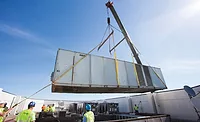
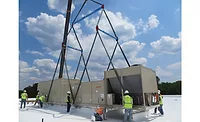
To ensure that doesn’t happen on any of their jobs, Colonial Mechanical’s crews make sure everything is planned well in advance. For example, they make sure a large enough crane will be available. They also make sure they have all the proper equipment to lift and install the unit properly. And their technicians are also well versed in vibration isolation.
“Typically the isolation in most installations arrives with the unit at the same time. We don’t allow that at our company. We get the curb and the isolation rails set in advance of the unit delivery. That way it’s installed, it’s prepared, the rails have already been assembled and installed. Then typically we cap that entire enclosure with some type of sheet metal to protect it. Then we wait for the unit to come in,” says Norton.
And when they’re done with the installation, employees in Colonial Mechanical’s service department go through a checklist to make sure it was done correctly
- They check the inside of the curb to see if there’s any problem with the sound batting.
- They check the slope of the curb.
- They check the slope of the pan.
- They check the drain connection for the condensate.
- They check the location of the duct in reference to the location of the duct connection on the unit.
- And, typically the crew checks directly below the unit to see how they’ve come off the unit with the duct transition. They want to see if they’ve increased or decreased the velocity, as in most cases, they’re looking to decrease the velocity coming off the unit.
Then there’s start-up — and a whole new checklist to work through. Items checked include amperage, speed of the fan, proper belt alignment, and just about everything else you’d see on a manufacturer’s start-up list.
Units could use some work
No matter how well an installation goes, there still can be problems with the rooftop unit itself. Norton says that some manufacturers’ units are difficult to install because some of the components ship loose.“Any time anything ships loose from a rooftop unit, that’s a problem for the contractor. Especially the economizer sections; they need to be factory installed, factory wired, and they do not need to ship loose.”
He says that many times parts that are shipped loose are lost altogether, which usually requires the crews to go back and do another service call after the equipment is installed. Those loose parts that do arrive intact take more time to install, wire, and troubleshoot in the field.
Norton says that some manufacturers also seem to be cutting corners on their rooftop units, which is causing Colonial Mechanical’s service department some trouble. “Manufacturers need to have better quality control checks on their refrigeration circuits. We’re seeing more and more units come out of the factory that have not been piped correctly. We’re also seeing more electrical components where the wiring and the fusing is not properly sized, and we’re having to make field changes to correct that.”
In addition, Norton says that some manufacturers are using low-cost condenser fans on rooftop units, causing more blade failures. “We’re seeing a tremendous amount of motor failure where the motors are undersized on the condenser fans, which is something we never used to see. Again, it’s in an effort to save money and lower the cost of the components — they’re losing control of the quality of the unit.”
It seems that better quality control is needed on both sides of the equation — contractor and manufacturer — to ensure a premium installation.
Sidebar: Service, manufacturing concerns
In addition to the concerns mentioned in the article about the quality of rooftop units, Robert Norton sees three problem areas:-
From a service standpoint, the pendulum has swung too far to the economy side and not enough toward the service side.
The accessibility of replacement components needs to be considered when units are designed and manufactured. In order to save money, manufacturers seem to have made their products more difficult rather than easier to service. “As far as the overall value to the customer, we feel like if they would look at the serviceability of the unit, it would save the end user customer money over the long haul.”
-
Manufacturers have done a good job with variable-frequency drive (vfd) applications on rooftop units, but instead of using an independent alliance partner, there needs to be more factory involvement in that selection.
“Right now I think they leave that up to their representatives versus the factory,” Norton says. “We’ve seen misapplications of vfd’s. And there’s no factory start-up involvement from a vfd when it’s bought through an alliance partner, versus being name brand and factory start-up included.”
-
Another other big problem with the units is vestibules, Norton says.
“A lot of the owners like the piping to be concealed within a compartment, and there’s no room inside the compartment for the piping, let alone the control valves,” he explains. “If it’s a chilled water system with a rooftop application, the pipe vestibules are about one-third the size they need to be.”
Sidebar: What to look for in a rooftop unit
Fully engineered, assembled, and tested at the factory: The manufacturer is responsible for the quality of the unit delivered to your jobsite and should back it up with a full factory run test of the complete unit. To do this, the manufacturer needs to engineer and assemble the entire rooftop system at the factory and not leave major components for field selection and installation. A factory-complete system that is tested before shipment will help avoid field issues, save time and money, and help you give your customer a quality project on time and within budget.Pre-engineered design flexibility: The more the design requirements for a project can be incorporated into the unit at the factory, the less field work you will face. Everyday needs, such as variable-frequency drives, economizers, and control valves, should come as part of the factory-tested package. However, some manufacturers allow you to incorporate additional requirements such as blenders, special filtration, sound attenuators, and other specialty equipment as part of the factory-tested package. While you may pay for this flexibility in initial equipment expense, you can make up the difference in reduced field coordination and installation costs while delivering a higher-quality installation to your customer.
Serviceability: Rooftop units are mechanical systems that require periodic maintenance and service to maximize their service life and maintain peak performance. Look for rooftop units that encourage rather than discourage maintenance by demanding convenient access to both sides of component sections using hinged and latched doors. Hinged doors are much easier to open/close than heavy and unwieldy panels that have to be physically removed by the service technician.
Looking for a reprint of this article?
From high-res PDFs to custom plaques, order your copy today!