Could Your Next HVAC Technician Come From Prison?
A Washington correctional facility is training inmates for careers in HVACR, producing certified graduates and unexpected workforce solutions
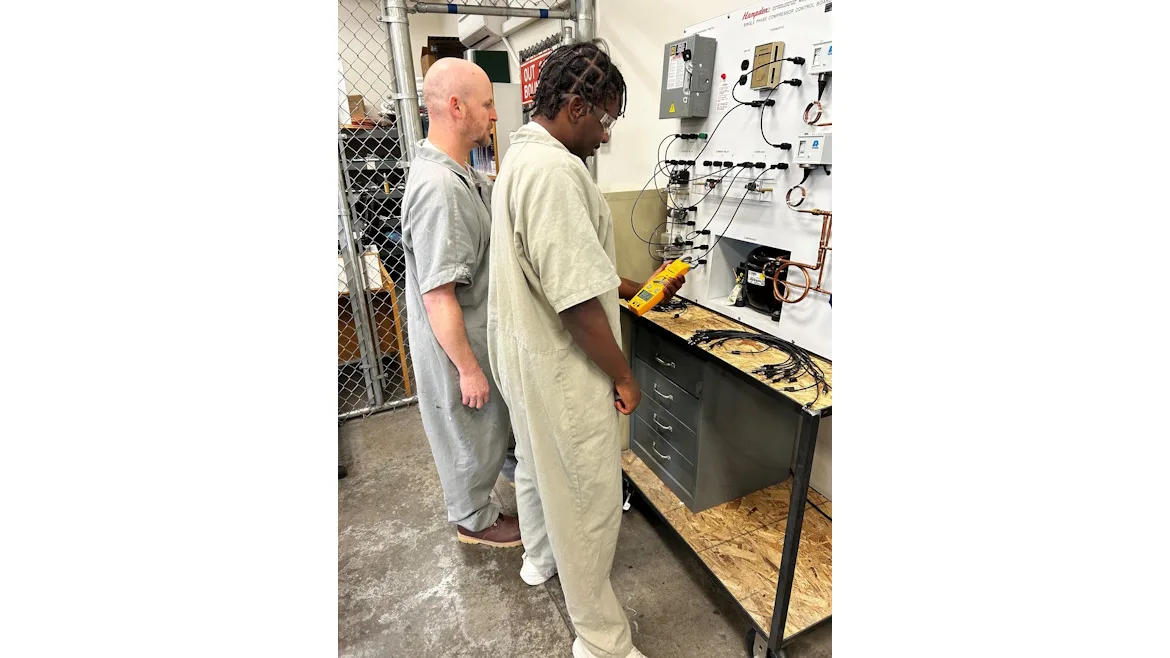
LIFE-CHANGING TRAINING: Students enrolled in the HVACR program at Coyote Ridge Corrections Center receive hands-on training while working toward industry certifications, college credits, and employment opportunities after release.
What if your next skilled HVACR hire came from prison?
It may sound unlikely, but it’s not.
The Washington Department of Corrections offers educational, vocational, and work opportunities at each of its prison facilities — including welding, drywall, roofing, cosmetology, and HVACR — and it’s one of only a few states doing so.
At the Coyote Ridge Corrections Center (CRCC) in eastern Washington, inmates are earning HVACR certifications through a state-backed program that’s producing skilled, motivated technicians. The program stands out as both a pathway to employment and a way to reduce recidivism, while also helping fill critical gaps in an industry facing a nationwide labor shortage.
And the stakes are high. According to 2018 data from the Bureau of Justice Statistics, 68% of prisoners were arrested again within three years of release, and 83% were arrested at least once within nine years. That rate has declined somewhat in more recent data, but the cycle of incarceration remains difficult to break, without education or employable skills. A person’s likelihood of recidivism declines significantly with each additional year of education a person has received.
Washington’s investment in correctional education also pays off financially, with the state reporting a return of approximately $40 for every $1 spent on vocational programs like HVACR.
But the real story isn’t just in the numbers. It’s inside the prison walls, in the classroom.
Looking for quick answers on air conditioning, heating and refrigeration topics? Try Ask ACHR NEWS, our new smart AI search tool. Ask ACHR NEWS
The Pathway To Certification
For the last few years, CRCC’s HVACR program has followed the Integrated Basic Education and Skills Training (I-BEST) model, which allows students to build academic skills while learning a trade. That means inmates without a high school diploma or GED can enroll, work toward that education, and earn HVACR credentials at the same time.
Paul Mingha and Jeff Arlington are HVACR instructors at CRCC. Working as industry experts and math and science educators, they help students build foundational academic skills while simultaneously learning the technical aspects of HVACR.
Students who complete the program earn EPA 608 certification, complete OSHA safety training, and undergo multiple employment-readiness tests through partnerships with organizations like ESCO Institute and HVAC Excellence.
The goal is simple: Prepare students for what they’ll face on the outside.
“Just doing everything we can to prepare them on what to expect on the outside — it does wonders for their self-confidence,” said Mingham.
Instructors also teach soft skills, including communication and customer interaction, even running mock sales calls.
“They don’t have to necessarily be a technician,” Mingham said. “There’s a whole gamut to be a part of. They could go into HVAC sales, work in a supply house, and work their way up.”
Graduates also leave with a significant head start toward licensure. In Washington, technicians must hold a specialty electrical license to work unsupervised on HVAC equipment. Recently, the program was approved to count 1,265 hours toward the 2,000 required for that license. Because technicians can work unsupervised after 1,000 hours, students leave with both certifications and real progress toward working independently.
Even with limitations, the program continues to evolve. For years, instructors worked without internet access, relying on fundamentals.
“If they can learn to do it old school, it really doesn't take them very long to pick up an easier and faster way to do it,” Mingham said. “I'm thinking that in some ways, some of the tools and technology are dumbing the industry down a little too much — you need to understand the system without all the electronics.”
The program also fosters leadership from within. After completing the program, students who still have time left to serve can increase their experience by taking on a teaching assistant role for a limited time.
Instructor Paul Mingham
At the center of the program is Mingham, a former contractor who traded the jobsite for the classroom.
His work goes far beyond teaching the refrigeration cycle or how to wire a thermostat. He’s also a mentor, teaching accountability, confidence, and how to function in a workplace environment.
Mingham began his career in the U.K. as a plumbing and boiler apprentice before moving to Southern California and eventually running his own business. After selling that business, he transitioned into teaching and later accepted a position within Washington’s prison system.
“It’s very rewarding … I probably have more face-to-face time with the prisoners than anyone else involved in the justice system,” Mingham said.
He spends more than 200 days a year in the classroom, often working with students who have never had a positive role model.
“When you hear things like that, and it’s coming from a 50-year-old man, it can be pretty humbling,” Mingham said. “I think as important as teaching them HVACR is teaching them how to get along in society.”
Mingham works to create an environment that feels less like a prison and more like a college classroom, using humor to break down barriers.
“It goes both ways,” Mingham said. “If I make a mistake or do something goofy, they give it to me right back.”
Before long, many of their walls start to come down.
“I tell students when you walk through the door into our building, you’re walking out of prison and into a community college,” Mingham said. “And sometimes people get a misconception of who's in prison, but there are individuals whose intelligence is far superior to mine. And if they get the HVAC bug — if they're interested and they want to learn, they turn out to be phenomenal students — way more so than when I was teaching on the outside.”
From Inmate To HVAC Manager
For Brian, that environment made all the difference.
After two decades serving in Combat Arms for the U.S. Army, Brian ended up in prison following a PTSD-related incident. When he first entered, he struggled to stay on track.
“Prison is the kind of place where you have to go along to get along,” Brian said.
About a month before joining the HVAC program, Brian had spent a year in solitary confinement following a gang-related riot. When he got out, he knew he needed a change and a way to stay on track while awaiting release.
He tried to get into a welding program, but the waitlist was years long. HVACR had an opening.
“So I thought, ‘What the hell?’ This seems like a good idea,” Brian said.
Brian wasn’t even supposed to be eligible due to prior infractions, but the program took a chance on him.
“I don’t know why, but they did,” he said.
That decision changed everything.
Brian was actually first taught by Chet Mills, instructor of the HVACR educational program at the Washington State Penitentiary in Walla Walla, Washington. He was then transferred to CRCC, where he completed his HVACR education with Mingham. Mingham remembers Brian as an angry student early on.
“I was worried about Brian,” Mingham said. “I didn’t know if he was ever going to succeed.”
But Brian did. He completed the program, earned his associate degree, and graduated on the dean’s list every semester.
“I entered that program knowing nothing about HVACR and left with a college degree,” Brian said. “I used it to get employed in a career that allows me to better myself each day and take care of my family.”
After his release, he immediately began applying to HVAC companies.
“I got a job offer from every single one,” he said. “Right away, I was employable.”
He started working in residential and commercial construction before eventually landing a position at a four-year college. From there, he worked his way up to managing the entire HVAC division.
More recently, Brian was promoted to maintenance supervisor, where he oversees all trades across the college, including electrical, carpentry, plumbing, locksmith services, and other skilled disciplines.
“My scope includes the comprehensive management of 12 campus buildings totaling more than 1.5 million square feet, ensuring that all facilities remain safe, functional, compliant, and operationally efficient,” Brian said.
Beyond facility oversight, Brian develops and oversees training programs, establishes operational priorities, and coordinates day-to-day activities for maintenance staff across the campus. He’s also just earned a bachelor’s degree in sustainable building sciences and technology with a minor in facilities management.
“The recidivism rate in this country is just insane,” Brian said. “And it isn’t just HVACR. It’s all types of vocational programs that can help fix this. … The two HVACR instructors that I had helped change my life.”
Looking for a reprint of this article?
From high-res PDFs to custom plaques, order your copy today!