Humidity, Not Heat, Is Driving Transaera’s New Approach to Commercial HVAC
Following a successful field trial with Amazon, the company’s rooftop technology highlights how manufacturers are rethinking humidity control and energy efficiency
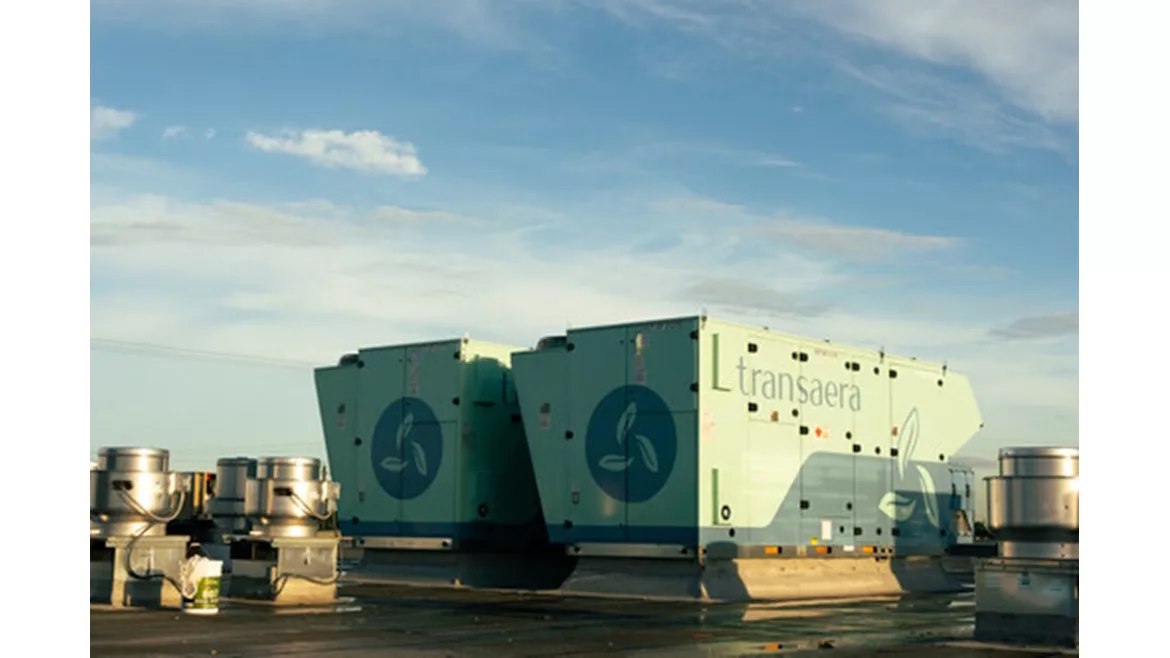
INNOVATION IN ACTION: Transaera’s dedicated outdoor air system.
The oldest problem in HVAC technology that many contractors already understand well is humidity control. A new solution is now taking its first steps toward large-scale adoption.
Transaera, a Boston-based company focused on next-generation cooling and dehumidification systems, has announced a new collaboration following a successful six-month field trial of its rooftop-based cooling technology at an Amazon logistics facility.
Transaera’s technology rethinks how commercial air conditioning systems handle humidity — and uses novel materials to develop advanced heat pump systems that dehumidify, cool, or heat air.
Instead of treating dehumidification as a secondary function of cooling and overcooling air to remove moisture — an energy-intensive process used by conventional rooftop systems — Transaera uses a new class of solid desiccant materials called metal-organic frameworks, or MOFs, to remove moisture before cooling.
A desiccant coats a 6-foot wheel that slowly spins inside each unit, based on a class of materials discovered by scientists Susumu Kitagawa, Richard Robson, and Omar Yaghi. These constructions, MOFs, can be “used to harvest water from desert air, capture carbon dioxide, store toxic gases or catalyze chemical reactions.”
“The unique structure of the material facilitates moisture capture. Once the water vapor enters the pores of the MOF, it becomes dense but does not form into liquid,” according to a September 2020 report published by CEP, a trade journal of the American Institute of Chemical Engineers.
The goal is to remove humidity before traditional cooling takes place, allowing systems to operate more efficiently without overcooling spaces simply to manage moisture.
Looking for quick answers on air conditioning, heating and refrigeration topics? Try Ask ACHR NEWS, our new smart AI search tool. Ask ACHR NEWS
The company said the technology is expected to deliver energy savings of up to 40% compared to conventional packaged direct expansion (DX) systems while maintaining a footprint compatible with existing rooftop designs.
According to Transaera and Amazon, the rooftop heat pump system demonstrated measurable energy savings in hot, humid operating conditions while maintaining ventilation performance. While the companies did not say where specifically the field test occurred, it noted the facility is “operating in hot and humid conditions.”
Ross Bonner, chief technology officer at Transaera, said the company worked with Amazon for several years before the pilot project.
“We worked really closely with them over a period of time, even prior to the pilot, to try to get to a solution that met their needs and also created the opportunities that we needed to see for other customers, and to serve that broader commercial building space,” he said.
Showing Promise For Both Energy Savings And Efficiency
The extended trial “demonstrated consistent energy savings exceeding traditional systems while maintaining performance in hot and humid conditions,” a news release stated. Results were validated through independent third-party analysis that confirmed the system’s efficiency benefits.
While much of the industry conversation around heat pumps focuses on electrification, refrigerants, or cold-climate performance, Transaera’s approach centers on reducing the energy demand tied to latent load, which can drive up operating costs in hot, humid climates.
“HVAC use accounts for over one-third of energy use in commercial buildings,” said Sorin Grama, CEO and co-founder of Transaera. “This technology has the potential to reduce operational cost while enhancing indoor air quality and occupant comfort across commercial and industrial facilities.”
The technology also points to where HVAC design may be heading.
“This announcement signals that high-performance HVAC is no longer a niche innovation—it's becoming the new standard,” Grama said. “We’re proud to work with Amazon to demonstrate a more energy-efficient technology that can deliver lasting economic returns.”
As electrification efforts increase and building owners push for lower energy use, manufacturers are placing greater focus on humidity management, ventilation efficiency, and dedicated outdoor air systems (DOAS), especially in commercial buildings with high ventilation loads.
Transaera’s technology reflects a broader industry shift toward treating moisture control as part of an overall efficiency strategy rather than simply a comfort feature.
“It’s a rare opportunity to do something good for the planet and for people at the same time, saving people money, offering people better indoor air quality and better comfort with lower energy to reduce the effect of climate change,” said Bonner.
Scaling And Replacing DOAS Moves Into Its Next Phase
Founded in 2017 by MIT engineers and materials scientists, Transaera says it is focused on scalable solutions for commercial buildings worldwide.
Bonner said his desire to “do something good for the planet,” along with co-founders Grama and Mircea Dinca, helped shape the company’s use of MOFs in its pilot DOAS.
The simplicity of the design ensures maintenance follows standard HVAC protocols, allowing existing service technicians to maintain the units without specialized training.
“One of the benefits of our system and the way that we've designed it, is we make changing out the wheel segments very simple and very easy. It’s as simple as the filter change and can be completed by any licensed commercial HVAC technician,” Bonner said.
Its systems are drop-in replacements, engineered to the same footprint and weight as legacy HVAC units, allowing installation without structural modifications or expensive roof retrofits.
Regardless of season, the system’s promise lies in its use of MOFs, with the lifespan of the wheel about two to three years.
“Our system is a heat pump, and so all the same conditioning equipment that's used for cooling and dehumidification, then can be switched over and used for high efficiency, fully electrified heating as well,” Bonner said.
The advantage of the architecture is how easily it integrates into existing commercial applications. “If you look at the outside of the unit, it looks just like any other system of this kind … same size, same weight, drops directly a same curve that you’d use for any other DOAS,” he said. “The building interfaces are also the same, so installation goes very smoothly.”
The collaboration also strengthens domestic manufacturing efforts, the company said. Transaera is building a U.S.-based supply chain for advanced HVAC systems, supporting skilled jobs while advancing more energy-efficient infrastructure.
Technologies like these could eventually change how technicians approach load calculations, ventilation strategies, and service diagnostics in high-humidity markets, but as Bonner explained, the system is designed for any HVAC contractor to service.
“We believe that this is a technology that should be in every building, every home, across the world. This is just the first swing in commercial HVAC," said Bonner. “The basic technology scaled up and down very well, with this being a solution for residential HVAC or even smaller automotive applications as well. This is just the beginning; this is chapter one.”
Looking for a reprint of this article?
From high-res PDFs to custom plaques, order your copy today!


