FROSTlines
Refrigerant Regulations Remain a Moving Target
Experts discuss EPA rulemaking, the A2L transition, and state regulatory actions

NEW TIMELINES: In 2025, the EPA proposed reconsidering certain aspects of the Technology Transition rule — particularly timelines for some commercial refrigeration sectors.
At the 2026 AHR Expo, industry leaders and policy experts gathered to discuss the evolving landscape of refrigerant regulation. The panel, moderated by AHRI’s Samantha Slater, examined the regulatory framework shaping the current refrigerant transition, the role of federal and state governments, and some of the operational realities facing manufacturers, distributors, and contractors.
Federal Policy
One of the central topics was the Environmental Protection Agency’s (EPA’s) Technology Transitions (TT) rule finalized in 2023 under the AIM Act. The rule established GWP limits for refrigerants used in new HVACR equipment manufactured or imported after specific dates.
Scott Stone of Glencoe Strategies said the rule was largely based on industry proposals intended to structure the transition in a way that wouldn’t misalign supply and demand, which could lead to price impacts. The approach also aimed to align product development timelines with building code updates and safety standards. However, in 2025, the EPA proposed reconsidering certain aspects of the rule — particularly timelines for some commercial refrigeration sectors.
Stone emphasized that, despite the proposal, the original regulation remains legally in force for now.
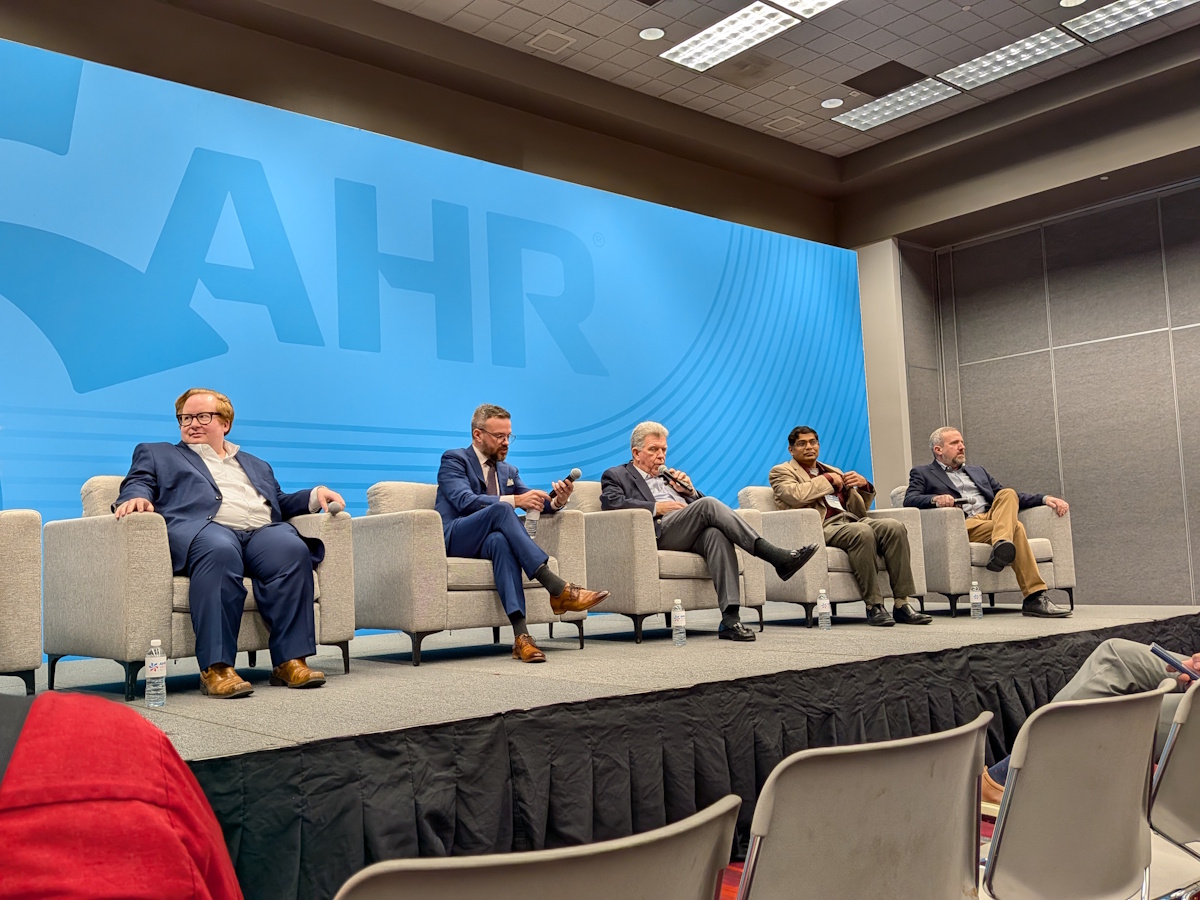
POLICY PANEL: At the AHR Expo, a panel of experts, including (from left to right) Alex Ayers, Tom Deary, Kevin Fay, Ram Narayanamurthy, and Scott Stone, discussed refrigerant policies. (Staff photo)
“This is all a proposed rule, so it hasn’t changed anything in terms of what’s on the books and what’s the law,” he said. “We expect a final rule to come out by the middle of this year — maybe sooner, but there's no timeline.”
EPA has attempted to reduce uncertainty by issuing “no action assurance” statements for specific sectors, signaling that enforcement may be temporarily deprioritized while the rulemaking proceeds. But Stone cautioned that such assurances do not change the law itself.
“In pure legal terms, nothing’s changed. The law is the law,” he noted, even if enforcement risks may differ in practice.
Looking for quick answers on air conditioning, heating and refrigeration topics? Try Ask ACHR NEWS, our new smart AI search tool. Ask ACHR NEWS
Kevin Fay of the Alliance for Responsible Atmospheric Policy outlined the political backdrop influencing refrigerant policy. The industry has been navigating the Kigali Amendment and AIM Act implementation for nearly a decade, beginning with the amendment’s adoption in 2016 and culminating with U.S. ratification in 2022. When the Trump administration returned to office in 2025, some stakeholders feared the refrigerant transition could be rolled back. Instead, Fay said the industry has maintained a strategy of engagement and education.
“We’ve been patient, we’ve been consistent,” said Fay. “The reality is there’s no question that this administration is very much in a deregulatory mode … but they also said, ‘Look, we understand that the AIM Act is the law.’”
While Congress considered several actions affecting refrigerant policy — including Congressional Review Act challenges and funding debates — none fundamentally altered the regulatory framework. Fay believes the core structure of the AIM Act will remain intact despite political turbulence.
“It's chaotic, it's confusing, it's frustrating, but our expectation is that we're going to get to the end of this year, and the basic framework — what the industry had proposed and supported at the international level and the domestic level — will hold true,” he said.
A2L Transition
Tom Deary of AHRI reflected on another key component of the transition: the adoption of building codes allowing the use of mildly flammable A2L refrigerants. In the years leading up to the transition, code adoption was considered a potential bottleneck, but looking back at 2025, Deary said the process ultimately went more smoothly than expected.
“I would say realistically [2025] could not have gotten better in terms of this refrigerant transition from a building code standpoint,” he said. Many states passed temporary legislation allowing A2L equipment while local codes were updated, and industry groups spent significant effort educating building officials. According to Deary, those outreach efforts helped resolve questions quickly and prevent disruptions as the transition began.
From the distribution side, HARDI’s Alex Ayers described 2025 as a year of uncertainty but ultimately a success. The refrigerant transition included the first nationwide installation deadline requiring legacy equipment to be installed by a specific date, which was a major logistical challenge for distributors.
“We are very weather dependent, so that’s a very scary proposition,” he said. “We did not have great weather for selling air conditioners and heat pumps last year. It was cool for a lot of the country in ways that depressed demand.”
Even so, adoption of A2L systems accelerated rapidly, and by the spring of 2025, more than half of the market had transitioned to the new lower-GWP refrigerants. A temporary shortage of R-454B cylinders created complications, but Ayers said the industry quickly addressed the issue.
“If you think of the last nationwide shortage of a product, it was probably toilet paper during COVID, and it took them until August 2021 to solve that shortage across the entire country,” he said. “We did it in less than nine months. No one has told me that they cannot find a cylinder of R-454B if they want it right now.”
He added that while the industry did a great job solving the refrigerant shortage problem, it never should have happened in the first place.
“Now we're waiting on EPA to decide on that install date issue, but less than 6% of all inventory is R-410A systems to be installed as a complete system. That's doing a very good job.”
State Policies
While federal policy sets the overarching framework, several states are pursuing their own initiatives. Ram Narayanamurthy of the California Energy Commission described the state’s long-term climate goals, which include refrigerant transitions as part of a broader pathway toward carbon neutrality by 2045.
California’s legislation already sets phased limits on high-GWP refrigerants in service markets, including bans on certain virgin refrigerants that began last year and stricter limits in the coming decade.
“The big one is going to be 2030, when R-410A falls under that category,” he said. “One of the things that we are really looking to try and understand is the state of the refrigerant recovery and reclaim market. We need that market to be active, to have a lot of reclaimed refrigerant in inventory for the ongoing transition.”
Other states, including Washington and New York, are considering similar policies. New York’s regulation is particularly concerning, because it would lower the allowable GWP for refrigerants across all sectors to 10, rather than following the tiered approach used elsewhere — 700 GWP for most air conditioning equipment and 150 or 300 GWP for most commercial refrigeration applications. According to Stone, some equipment categories could be required to meet New York’s stricter limit before the end of the decade.
The good news is that most states are not going to try to create a refrigerant regulatory program that is already being implemented at the federal level, said Fay. “Most states don't have the budget or the capabilities to start implementing these programs.”
That said, contractors in the Empire State face a different regulatory landscape. As Ayers explained, “New York state has its own set of rules. It has its own install date, and it goes farther than the EPA. They are going through a much different transition into this coming year than the rest of the states. If you're in New York state, it is absolutely an issue you need to be paying attention to.”
Looking for a reprint of this article?
From high-res PDFs to custom plaques, order your copy today!