1942: From Overlooked to Essential: HVACR’s Full-Circle Moment
When refrigeration had to prove its worth
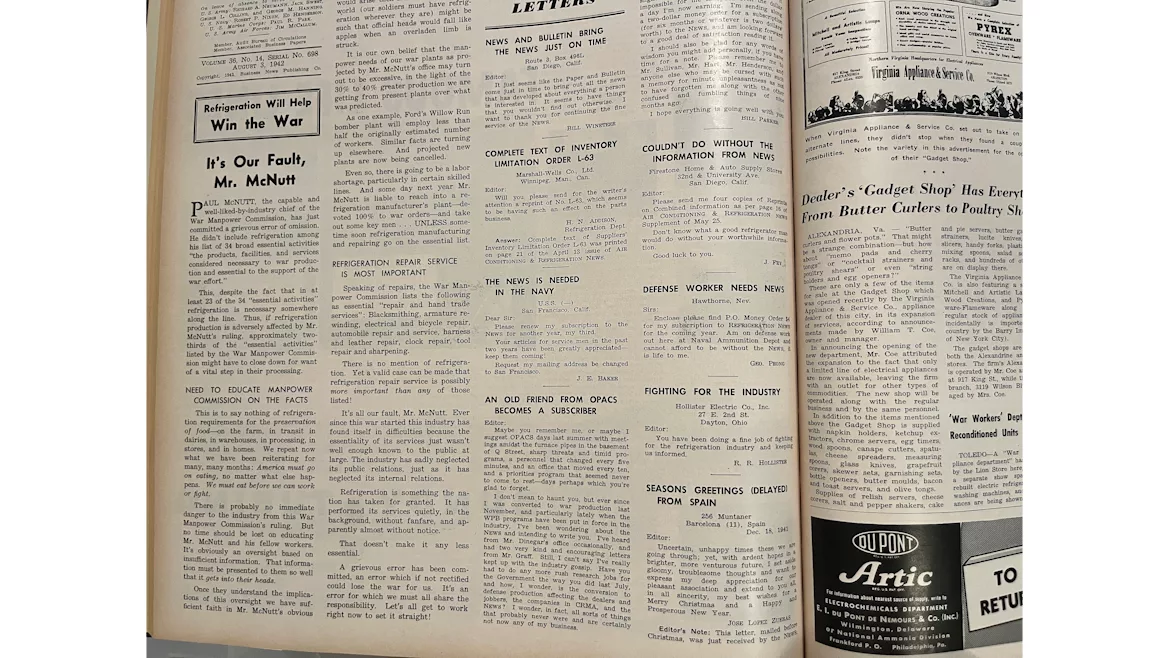
THE FIGHT: During World War II, refrigeration played a critical role in food preservation, military logistics, and industrial processes, even as the industry worked to gain formal recognition as essential.
In an August 3,1942 issue of The Electric Refrigeration News (now The ACHR NEWS) titled “Refrigeration Will Help Win the War,” a frustrated editor wrote about the fact that refrigeration had been left out of the War Manpower Commission’s list of essential activities, or “the products, facilities, and services considered necessary to war production and essential to the support of the war effort.”
“It’s our fault,” the piece declared, placing the blame on an industry that had “performed its services quietly, in the background, without fanfare.” (Sound familiar?)
But that didn’t make it any less essential, the editor argued. And he was right.
It took nearly 80 years, but during the COVID-19 pandemic, HVACR technicians finally found themselves in a very different position: They were officially deemed essential. It marked a full-circle moment, and a quiet shift for an industry once overlooked, now undeniable.
FIGHTING FOR RECONGITION
Then warning issued in the piece was not subtle.
“If proper presentations are not made to Mr. McNutt, if the error is not rectified, in 1943 it’s possible that we may have a refrigeration crisis somewhat comparable to the rubber crisis we now face,” the editor wrote.
This was despite the fact that refrigeration was absolutely necessary for food preservation at every stage, “on the farm, in transit, in dairies, in warehouses, in processing, in stores, and in homes.”
Looking for quick answers on air conditioning, heating and refrigeration topics? Try Ask ACHR NEWS, our new smart AI search tool. Ask ACHR NEWS
“We repeat now what we have been reiterating for many, many months: America must go on eating, no matter what else happens. We must eat before we can work or fight.”
Additionally, military forces relied on refrigeration to store rations and medical supplies, while industrial processes depended on temperature control.
And in at least 23 of the 34 essential activities, refrigeration was necessary somewhere along the line.
So much so that the editor went as far as to say that if the ruling of Paul McNutt, the chairman of the War Manpower Commission, adversely effected refrigeration production, roughly two-thirds of the industries that were listed as essential would be disrupted.
THE LABOR SHORTAGE
But even as the refrigeration industry fought for recognition, it continued to support war efforts. At the same time, the workforce behind it was shrinking.
Approximately 16 million Americans served in the armed forces during World War II, signaling one of the earliest large-scale labor shortages affecting the trades, including refrigeration. And unbeknownst to the editor at the time, it’d create a ripple effect still impacting the trades decades and decades later.
From the 1942 piece:
“If priorities on manpower stymie refrigeration equipment production, the war effort might be held up along the line. The howls of anguish which would arise then from all parts of the world (our soldiers must have refrigeration wherever they are) might be such that official heads would fall like apples when an overladen limb is struck.
It is our own belief that the manpower needs of our war plants as projected by Mr. McNutt’s office may turn out to be excessive, in the light of the 30% to 40% greater production we are getting from present plants over what was predicted.
As one example, Ford’s Willow Run bomber plant will employ less than half the originally estimated number of workers. Similar facts are turning up elsewhere. And projected new plants are now being cancelled.
Even so, there is going to be a labor shortage, particularly in certain skilled lines. And some day next year Mr. McNutt is liable to reach into a refrigeration manufacturer’s plant — devoted 100% to war orders — and take out some key men … UNLESS sometime soon refrigeration manufacturing and repairing go on the essential list.”
A DECADES-LONG SHIFT
While the industry still faces labor shortages today, it’s no longer fighting for recognition.
Since the pandemic, the world has gained a clearer understanding of the trades and their impact on daily life, well-being, and public health.
This editor would like to imagine that the early editors of The Electric Refrigeration News, once frustrated by how the industry was perceived (or rather, not perceived due to the overall lack of recognition) would be both pleased with this progress, yet still howling for more.
Here is the call to action the editorial ended with:
“A grievous error has been committed, an error which if not rectified could lose the war for us. It’s an error for which we must all share the responsibility. Let’s all get to work right now to set it straight!”
In many ways, the industry did just that. Even if it took nearly 80 years to fully materialize.
The HVACR industry’s essential status has always been there — even before the war, 100 years ago. The unfortunate circumstances of the world since, including but not limited to the COVID-19 pandemic, just revealed it.
What had to be argued and fought for in 1942 was simply understood in 2020.
And it may be one of the clearest tangible measures of showing how far the industry, and its voice of stakeholders, has come.
Looking for a reprint of this article?
From high-res PDFs to custom plaques, order your copy today!