Survey: 25% of Residential Contractors Using AI to Boost Business
Contractors express concerns over weathering labor shortages and rising costs

FINDING A SOLUTION: Residential contractors are turning to AI for solutions to productivity and efficiency as workforce shortages and price increases persist.
As residential HVAC contractors aim to increase revenue in 2026, more are turning toward retaining customers and adopting artificial intelligence to offset rising labor and overhead costs.
The insights come from a survey of more than 1,000 residential specialty contractors by ServiceTitan, including HVAC companies. The 2026 Residential State of the Trades survey asked contractors about their business goals, the risks they’ll need to overcome, and how they’re implementing technology.
Labor and overhead costs were the top concerns for contractors, with 60% listing them as a business risk in 2026. This is partly from raising wages, as maintaining margins requires balancing wage increases with pricing. Over half (54%) are increasing wages by 1-3%. Of them, 21% are raising them by 1%. Only 14% say they’re not increasing them in 2026.
Around 53% list the skilled labor shortage as a top business risk. Increased material prices round out the top three concerns at 48%. Another 32% are worried about new competition, while just under a quarter are worried about an economic recession.
In reaction to these market conditions, 27% of contractors expect to raise service prices by 6-10%, while 23% are anticipating 2-3% increases. However, 28% say they’re keeping them the same, which Ellen Rohr, brand and industry marketing lead at ServiceTitan, said isn’t always the best move.
“If materials cost more, the job costs more. Other industries don't apologize for market shifts, and neither should you. Keeping your pricing aligned with your expenses isn't 'aggressive' — it's just smart business,” said Rohr.
Is AI the Answer?
AI adoption is on the rise, indicating that more residential contractors are turning to it for streamlining their operations.
Looking for quick answers on air conditioning, heating and refrigeration topics? Try Ask ACHR NEWS, our new smart AI search tool. Ask ACHR NEWS
AI adoption is still in the early stages, with only 25% of respondents using it. Even so, contractors using AI associate it with measurable gains in productivity (48%), time savings (45%), and improved customer experience (32%). This positions AI as the next phase of digital maturity as businesses look to do more with limited labor.
"AI isn’t just improving how we work. It has unlocked speed and precision at scale for us,” said Luke Peluso, technology manager at Quality Service Company in South Carolina. “With agentic command center tools like Atlas, we’ve been able to automate scheduling and remove bottlenecks that directly impact our productivity and decision-making.”
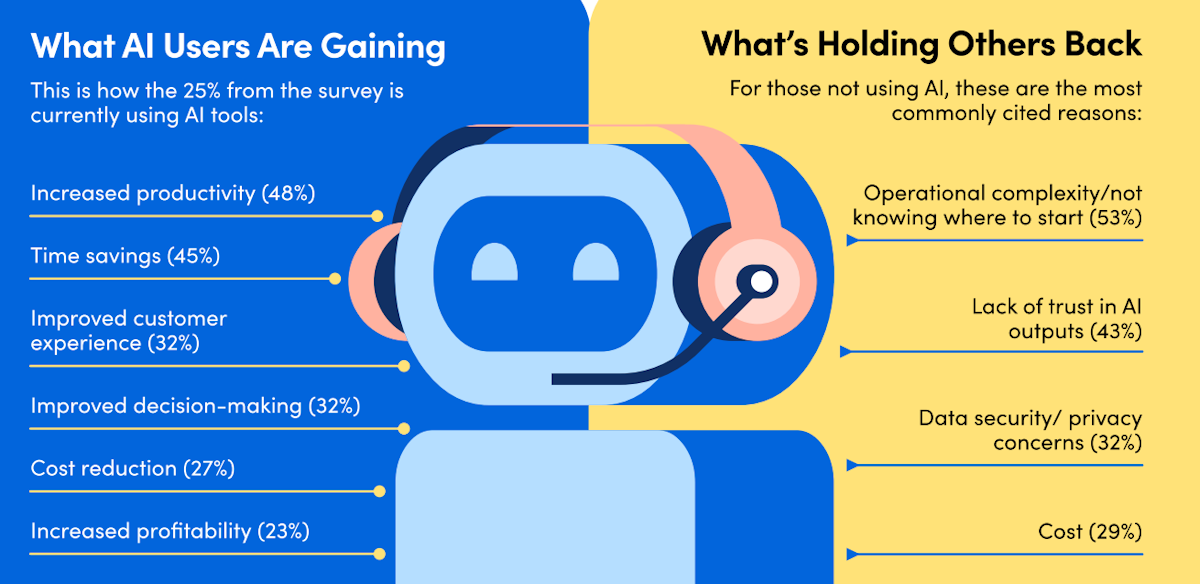
DO YOU TRUST AI?: Survey respondents to ServiceTitan’s 2026 Residential State of the Trades listed what they like about AI and reasons why they’re not using it.
Despite 73% of contractors saying early AI adoption gives them a competitive edge, they’re still reluctant to pull the trigger. The biggest hurdle is the operational complexity, or simply not knowing where to start. Over half (53%) cite this as their biggest hesitation.
AI also has a reputation for not always being reliable. As such, 43% of contractors cite a lack of trust in AI outputs. Similarly, 32% are concerned about data security and privacy.
With contractors watching their margins, it’s unsurprising that 29% cite cost as the reason they’re not using AI.
“Labor consumes the largest share of annual budgets, while software and technology remain single-digit percentages, underscoring that efficiency — not cost-cutting — is the primary path to margin improvement,” said Rohr.
When asked about their top goals for 2026, 66% named growing revenue as their main objective. Retaining customers is the second most-cited goal at 53%, while improving cash flow is a top goal for 35% of residential contractors.
This puts contractors in a tight spot. On one hand, improving operations can lead to increased revenue, but with labor shortages and rising costs, AI is becoming not only an attractive option — it’s becoming critical.
“Our dispatch and CRM application has been transformative,” said Chris Petri, operations manager at Perti Plumbing, Heating, Cooling & Drain Cleaning in New York. “It provides in-depth reporting that allows us to track performance and operate efficiently. Additionally, it tracks client history, which enables us to provide service to the highest standards.”
How to Win in 2026
Responding quickly to leads is how residential contractors can win the job over their competition, along with meeting customer demand for transparency, ease of payment, and multiple purchasing options.
The survey results support these initiatives, with 52% of contractors saying they now respond to new leads within one hour. Phone calls remain the top channel, with 60% of initial customer contacts happening over the phone. Compare this to 13% with online bookings.
“Now nearly 30% of our bookings flow end-to-end without any human involvement from call to schedule dispatch,” said Peluso. “This technology has fundamentally changed how we operate daily and will continue to reshape the industry by setting a new standard for execution.”
According to the survey, 15% of competitors capture leads when contractors don’t respond until one or two days after initial contact.
“This is now a game of seconds, not hours. The winner gets the job,” said Chris Hunter, principal industry advisor at ServiceTitan. “There is a huge opportunity to get ahead of the competition simply by having the tools in place to respond and capture the lead instantly.”
Not only are customers expecting fast responses, but they’re also seeking pricing info. Nearly three-quarters of customers (73%) say clear, upfront pricing is the “primary reason” for choosing a contractor.
Customers expect options as well, though only 31% of contractors surveyed present multiple pricing options. When customers are ready to sign the contract, 50% of transactions are “frictionless,” meaning they’re processed via credit card or financing.
Given that costs are rising, contractors are scaling by focusing more on retaining current customers than acquiring new ones. In doing so, they’re shifting their strategies toward revenue optimization and operational control.
"The winning contractors this year won't be the ones with the longest list of potential customers,” said Amer Mkhalalati, senior vice president and general manager of residential at ServiceTitan. “They’ll be the ones who ensure every technician, every hour on the clock, and every conversation with a client actually moves the needle and boosts the bottom line."
Looking for a reprint of this article?
From high-res PDFs to custom plaques, order your copy today!