Software Rules in HVAC Load Calculations
65% of contractors who do load calculations report using software tools

BEST PRACTICES: The use of software for load calculations is a key trait of the contractor of the future, according to the latest Contractor of the Future study from ACCA and the Farmington Consulting Group.
The vast majority of HVAC contracting businesses do their own load calculations for equipment installations, and of those, 65% use software tools while the other 35% perform the calculations manually.
Those are among the findings of the latest Contractor of the Future study from ACCA and the Farmington Consulting Group, which concluded that using load calculation software is one of the key traits of the contractor of the future. The study included a survey of more than 1,000 contractors from around the country that was conducted last fall.
ACCA details load calculations for most residential dwellings in its Manual J, and for small- and medium-sized commercial buildings in its Manual N.
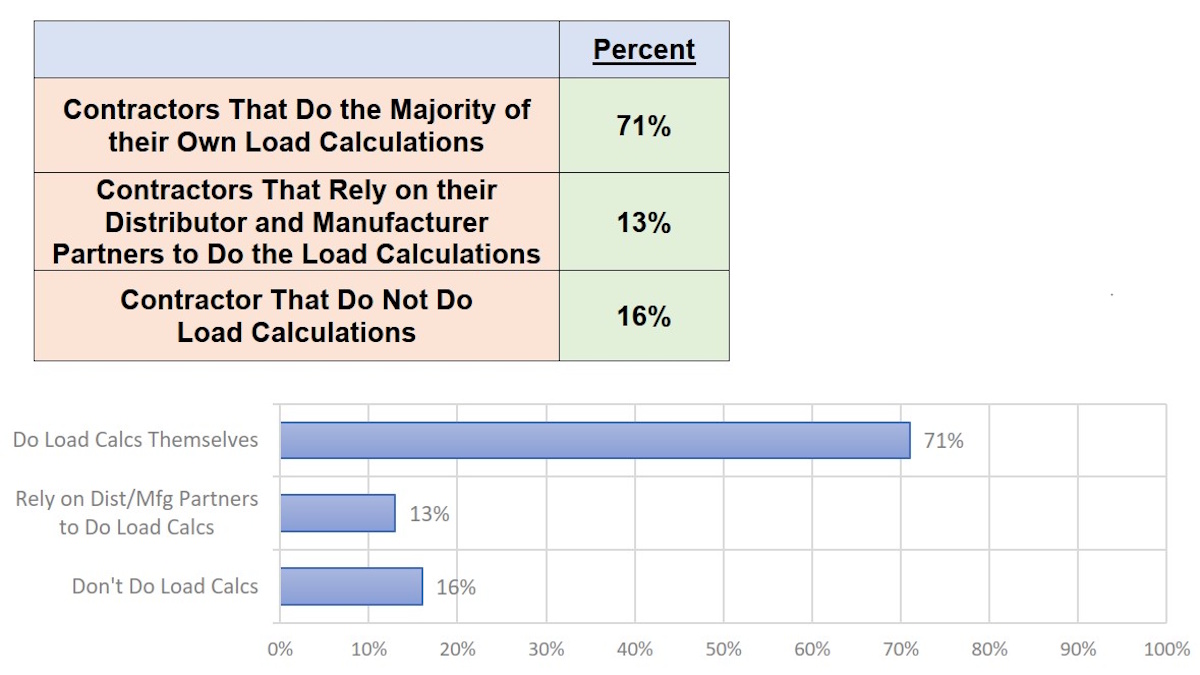
MAJORITY REPORT: More than two-thirds of contractors who responded to the latest Contractor of the Future study reported doing load calculations in-house, while 13% said they rely on manufacturers or distributors for them, and 16% said they don’t do them at all. (Courtesy of ACCA and Farmington Consulting Group)
Some 71% of survey respondents reported doing load calculations in-house, while another 13% said they rely on distributor or manufacturer partners to do them. The remaining 16% said they do not do load calculations.
Load calculations are a must, said Joanna Buglewicz, president and owner of Green Valley Cooling & Heating in Green Valley, Arizona.
“There are no circumstances where we would skip a load calculation,” Buglewicz said. “It is a standard part of our installation process and a foundational component of designing a properly sized and performing system.”
Load calculations at Green Valley are done by the company’s design technicians with the use of Wrightsoft software, Buglewicz added. “We do not outsource this responsibility, as proper system design is a core competency of our company,” she said.
Looking for quick answers on air conditioning, heating and refrigeration topics? Try Ask ACHR NEWS, our new smart AI search tool. Ask ACHR NEWS
Wrightsoft was by far the most popular load calculation software, the Contractor of the Future survey found, used by 27% of contractors responding to the survey. Cool Calc Manual J, used by 15% of contractors, was next, followed by Elite RHVAC/CHVAC (6%) and Adtek (4%). No other software was used by more than 2% of survey respondents.
“Utilizing professional software ensures both efficiency and accuracy. Manual calculations are extremely time-consuming and introduce greater risk for human error,” Buglewicz said. “With the complexity of today’s building envelopes, insulation standards, window performance, and airflow requirements, software is essential to deliver precise, defensible results.”
Thornton & Grooms Heating, Cooling & Plumbing, in Farmington Hills, Michigan, also uses software for load calculations, which are performed for every installation by the company’s comfort advisors, said president Matt Bergstrom.
“It makes the process easier and more consistent,” Bergstrom said. “Third-party softwares also make it easy to share with a municipality,” or a rebate program or utility that may require documentation, he added.
Wrightsoft, Cool Calc Manual J, Elite RHVAC/CHVAC, and Adtek are all approved by ACCA. Among ACCA member contractors, the survey found, 42% use Wrightsoft and 15% use Cool Calc Manual J.
Asked about the top training and technical needs of HVAC contractors, load calculation and duct sizing was ranked third, ahead of training on A2L refrigerants and on the installation and servicing of variable refrigerant flow (VRF) and mini-split systems.
Based on what she sees in the industry, Buglewicz said, load calculations and duct-sizing training is a major training need.
“Without proper training, systems are frequently oversized or undersized, which impacts efficiency, comfort, humidity control, and equipment longevity,” Buglewicz said. “Establishing consistent education and accountability around load calculations would significantly elevate overall system performance and professionalism within the industry.”
“Our software provider does a great job training and keeping our team up to date on the software changes, and updates on best practices,” Bergstrom said.
Looking for a reprint of this article?
From high-res PDFs to custom plaques, order your copy today!


