No New Refrigerant Transition — But Challenges Persist
Affordability and state-level mandates emerge as HVAC industry’s next concerns

NEXT TRANSITION? Contractors just getting used to A2L refrigerants are wondering if another refrigerant transition is on the horizon.
After navigating one of the most turbulent periods in recent HVACR history — marked by new minimum efficiency standards, the refrigerant transition, and supply chain disruptions — contractors are wondering whether more changes are on the horizon.
At an AHR Expo seminar moderated by Bryan Orr, founder of HVAC School and president of Kalos Services Inc., leaders from HARDI, AHRI, and ASHRAE addressed that uncertainty head-on. Noting that the recent refrigerant shortage is easing and another nationwide transition does not appear imminent, they said the industry is finally beginning to enter a period of “hopeful calm.” Still, significant risks remain, with state-level mandates, equipment longevity, and mounting affordability pressures rapidly emerging as the next major challenges.
Refrigerant Shortage
Orr opened the panel discussion with the question on everyone’s mind: Is the refrigerant shortage finally over? For the most part, said Talbot Gee, CEO of HARDI, stating that the worst appears to be behind us.
“Is the market 100% set like it will be for years going forward? No, not quite,” he said. “But are we looking at big shortages? No, not necessarily.” He added that refrigerant pricing — which spiked during last year’s R-454B supply crunch — has also eased and that 2026 is shaping up to look “more normal-ish.”
To prevent another refrigerant shortage, Gee emphasized the need for more transparency across the channel. Last year’s disruption, he said, wasn’t just about supply — it was about communication gaps between contractors, distributors, and component suppliers.
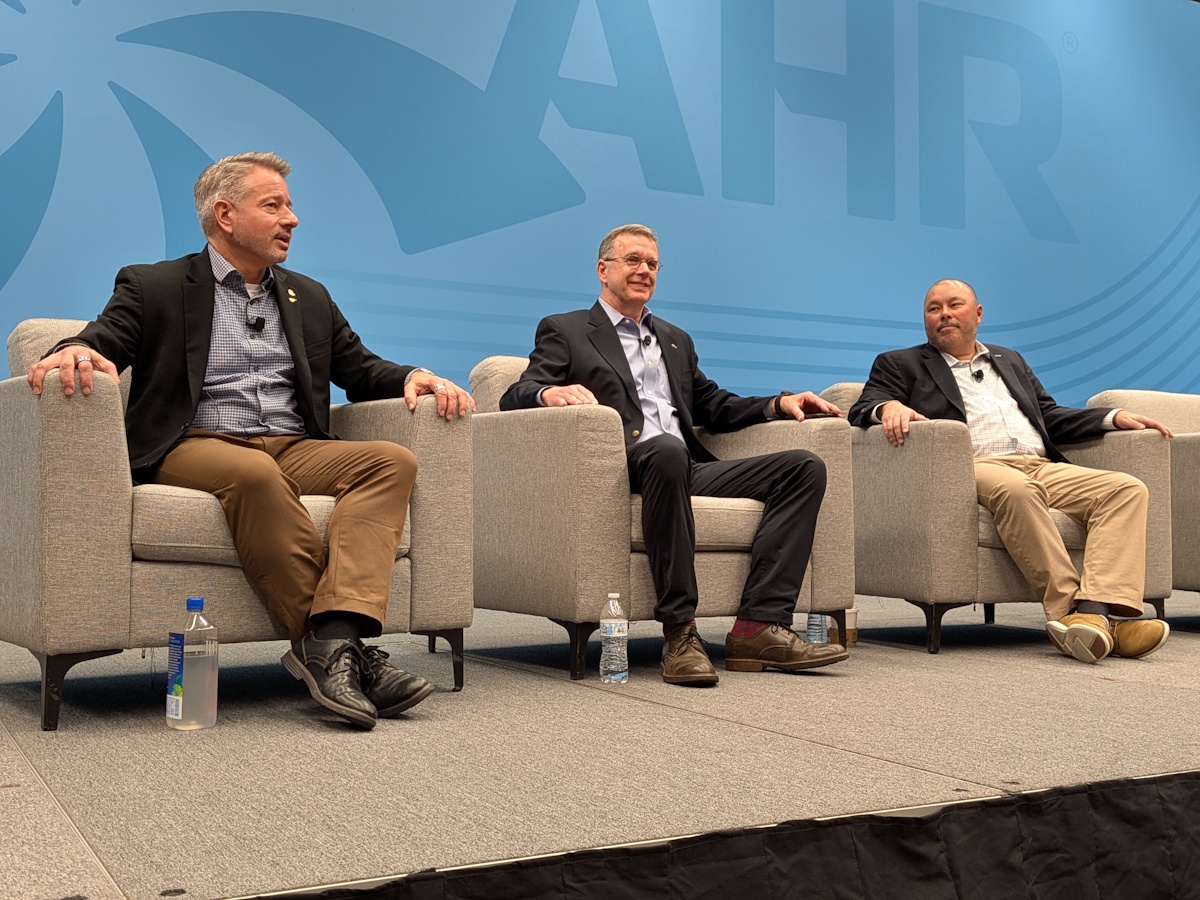
STATE OF THE INDUSTRY: From left to right, Bill McQuade, Stephen Yurek, and Talbot Gee shared their thoughts about the state of the HVACR industry. (Staff photo)
“We had multiple breakdowns in the channel,” he said. “Our effort now is to make sure those breakdowns don’t take place again.”
One key disconnect involved residential contractors who initially panicked about the refrigerant transition and vowed to stick with R-410A forever.
Looking for quick answers on air conditioning, heating and refrigeration topics? Try Ask ACHR NEWS, our new smart AI search tool. Ask ACHR NEWS
“It’s always Armageddon, right? It’s the end of the world, and this is the last [transition] I’m ever doing,” said Gee, describing contractors’ initial reaction. But as in past transitions, that resistance faded quickly, and many contractors went all in on the new refrigerants. “I think that happened even faster and bigger this time with more contractors, especially larger ones, going all in and their suppliers not being fully aware of that,” he added.
Gee also noted that manufacturing and blending next-generation refrigerants is far more complex than many realize — a challenge the industry may have underestimated.
“I think a lot of people in the industry, including probably even some of our own organizations, took that for granted,” he said. “I don’t think even our government understands what the industry has accomplished with so many transitions in such a short amount of time.”
While acknowledging last year’s refrigerant shortages were disruptive, Gee said the outcome could have been worse. Roughly 60% of contractors were largely unaffected by the R-454B shortage, he stated, while only about 30% experienced significant challenges.
“It was not that the sky was falling,” he said. “There were certain aspects of the channel that saw issues, but it wasn’t like business just stopped.”
Given the disruptive nature of the refrigerant shortage, Stephen Yurek, president and CEO of AHRI, sought to reassure contractors that no other major changes are imminent. Over the past five to 10 years, he noted, the industry has navigated an unusually intense stretch of change — from the shift to SEER2 standards to the latest refrigerant transition — each requiring major product overhauls in rapid succession.
“That type of change caused a lot of angst,” he said.
While innovation will continue, he does not see another refrigerant transition or major residential efficiency overhaul on the horizon. Instead, he anticipates a period of relative stability.
“We’re looking at a period of hopeful calm,” he said, which will allow manufacturers to refocus on research and development and give the channel time to smooth out operations.
Bill McQuade, president of ASHRAE, agreed, noting that the industry appears to be entering a more stable stretch.
“I think now we're entering into a longer phase where we can make some adjustments and get some calm — for one period, anyway.”
Affordability And Longevity
Affordability also emerged as a key theme during the session, with Gee noting it is top of mind for both residential and commercial customers. He said rising costs are forcing the industry to shift away from “aspirational” selling and refocus on practical, cost-effective solutions that meet customers’ real needs.
“It’s harder to be aspirational when everything is ridiculously more expensive,” he said. Instead, he said that contractors must focus on delivering “the absolute best solution, most cost-effective solution for the problem.” He added that even environmental advocates have to acknowledge that when higher-priced, aspirational options dominate the conversation, “those jobs just aren’t going to get sold. So let's worry about a more reasonable way to proceed and progress as an industry that actually serves the affordability needs of the customer in the end.”
In addition to affordability, Yurek noted that equipment longevity needs to be part of the policy conversation, as today’s systems often do not last as long as those installed in years past. While modern HVAC equipment is more efficient and technologically advanced, he said, it has thinner coils, more electronics, and variable-speed components instead of the single-speed, heavy-duty systems of the past. Yet many legislative models still rely on outdated assumptions about equipment life expectancy when projecting long-term cost savings.
“I don't think any of the equipment that we have today is going to last 30 years,” said Yurek. “So is that the right analysis to be looking at, if we're looking at affordability?”
That reality, he contended, should factor into how policymakers and regulators evaluate cost savings. While efficiency gains may prove cost-effective in 20 or 30 years, customers are focused on upfront cost, repair expenses, and real-world operating costs.
“It’s that first cost and being able to afford it and then being able to operate it,” said Yurek. “All those issues really need to be looked at.”
Another Transition?
As Yurek noted earlier, another refrigerant transition is not imminent. However, he said the industry will “constantly be looking at better solutions, better refrigerants, and better lubricants that will improve the efficiency, life expectancy, and performance of HVAC equipment.” In some applications, that could mean greater use of natural refrigerants such as CO₂, ammonia, or hydrocarbons like R-290 (propane).
Still, he made clear that widespread adoption of flammable (A3) refrigerants such as R-290 in U.S. residential comfort cooling equipment is unlikely in the near term, as it would take years to develop the necessary safety standards, building codes, and equipment designs. That said, A3 refrigerants are already common in small-charge applications — most household refrigerators, for example — and could eventually expand into monobloc air-to-water systems, where the refrigerant remains outdoors rather than inside occupied spaces.
Even so, some states are already pushing for another refrigerant transition, and Yurek cautioned against regulatory mandates that outpace equipment availability. In states like New York, for example, ultra-low-GWP requirements are being mandated before compliant equipment, and the necessary safety codes are fully in place, he said — a dynamic that could lead to unintended consequences if certain systems cannot legally be installed.
Gee urged contractors in those markets to push back.
“Make your voices heard,” he said. “Your livelihood and those of the families that rely on you, rely on your ability to sell and install solutions in this industry, and some of these state policies are making it nearly impossible for you to do that. That's unacceptable. Your voices matter in those markets.”
Looking for a reprint of this article?
From high-res PDFs to custom plaques, order your copy today!