HVACR’s State Political Landscape
HARDI, which tracked industry-relevant state issues in 2025, urges grassroots involvement
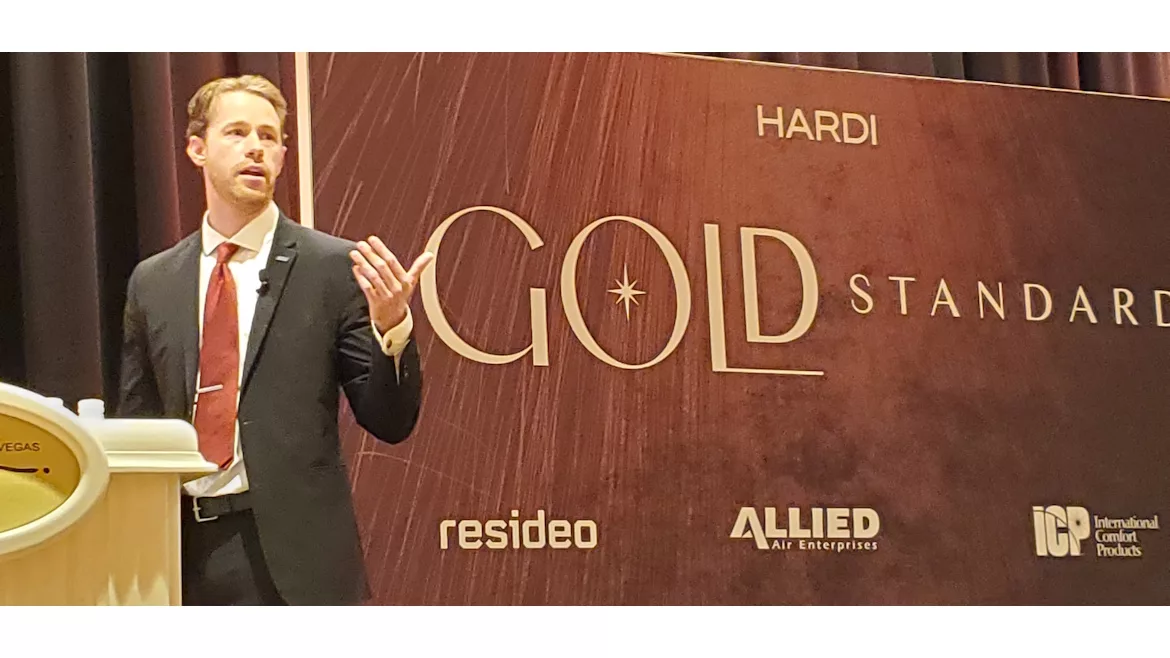
POLITICAL WATCHDOG: Todd Titus, director of state government affairs at Heating, Air-conditioning & Refrigeration Distributors International (HARDI), speaks to distributors during the recent HARDI conference at The Wynn, a resort in Las Vegas, Nevada.
Last year was a busy one for Todd Titus, director of state government affairs Heating, Air-conditioning & Refrigeration Distributors International (HARDI).
In 2025 alone, Titus, who is also an attorney, and his HARDI colleagues tracked 330 policies and proposals, in states across the country, that impact or could impact the HVAC industry. He calls that kind of work “total policy engagement” on behalf of HARDI members.
“It’s not just the things you see on the surface,” such as policies from the U.S. Environmental Protection Agency (EPA) or the Department of Energy (DOE), Titus told distributors during the recent HARDI conference in Las Vegas, Nevada. Like an “iceberg,” Titus added, “there’re a lot of things underneath that are going on” that have the potential to affect HVACR distribution.
“So we have to make sure that we’re looking at this from the entire approach, not just what you … see above the surface,” said Titus, who called for more political engagement by HARDI members.
In a presentation during the conference, Titus highlighted the emerging policies around a few major issues that touch HVACR, and HARDI’s approach to those policies. Here’s a look at three of those issues:
PFAS Restrictions
PFAS, shorthand for per- and polyfluoroalkyl substances, are chemicals found in many products, including some refrigerants, that can accumulate in the body and pose health risks. The U.S. Environmental Protection Agency (EPA) has identified more than 16,000 PFAS chemicals.
Refrigerants should be exempted from PFAS bans, Titus said, citing research that found that refrigerants with PFAS are not persistent, bioaccumulative, or toxic. The ability of refrigerants with PFAS to enter the food chain, Titus said, is nearly impossible.
Looking for quick answers on air conditioning, heating and refrigeration topics? Try Ask ACHR NEWS, our new smart AI search tool. Ask ACHR NEWS
Two states, Maine and Minnesota, have adopted PFAS restrictions that will apply to HVACR.
In Minnesota, a PFAS ban begins in 2032.
“We’re working very hard to make sure that gets adjusted, and we get properly exempted from that product prohibition,” Titus said.
In Maine, HVACR equipment is exempted from the state’s ban through 2040.
“We’re not settling with that,” Titus said. “We’re continuing to have conversations, and (are) going to try to make sure that we are protecting refrigerant well beyond 2040.”
Seven other states have introduced PFAS restrictions that would apply to HVACR, 13 states have no restrictions adopted or introduced, 26 states have introduced or adopted restrictions that would not or do not affect HVACR, and two states — New Mexico and New Hampshire — have PFAS restrictions that exempt HVACR.
Further GWP Limits
Some states are moving toward limits on refrigerants’ global warming potential (GWP) that are even lower than those set by federal law.
New York state has already adopted a phaseout plan that will limit the industry to refrigerants with “ultra-low” global warming potential, GWP 10 or GWP 20 in some cases, and officials in the states of Washington and California are studying GWP restrictions.
“So carbon dioxide, ammonia, propane, and isobutane are going to be the only refrigerants that you really have available,” Titus said, adding later that propane is flammable and ammonia is toxic to breathe, and both are made using fossil fuels. CO2 refrigerant, he added, requires extremely high pressures and would mean adopting new technology and training service workers to handle it safely.
HARDI and the Air Conditioning, Heating, and Refrigeration Institute (AHRI) sued the New York State Department of Environmental Conservation (NYSDEC) over the restrictions, which are amendments to Part 494 of the New York Codes, Rules and Regulations, and in January appealed a December court ruling that upheld the restrictions.
“We’re going to fight that till the end,” but are still pursuing a legislative fix, Titus said.
Fossil Fuel And NOx Restrictions
Some state and local governments, Titus said, have been attempting to ban or restrict the use of fossil fuels through energy and building codes and limits on emissions, such as that of nitrogen oxides, or NOx.
“We have to make sure that we’re taking the time to invest, taking the proper energy stances, building relationships to make sure we can handle all these from the beginning,” Titus said.
In California, a proposal calls for a zero-emissions water heater standard, which would mean a transition to electric water heaters. In Washington, a voter-approved measure to protect access to natural gas service is being challenged in the state’s Supreme Court. And in Southern California, the South Coast Air Quality Management District (SCAQMD), which covers all of Orange County and parts of Los Angeles, proposed a phasedown of NOx emissions from natural gas furnaces and small water heaters that would have begun in 2027.
The latter proposal was shelved after pushback from HARDI and other groups. That victory, Titus said, showed the power of grassroots advocacy, and Titus urged his distributor audience to get involved, to build relationships with federal, state, and local officials, and to inform HARDI of emerging issues involving HVACR. Titus also said he expects a NOx emissions restrictions plan to be revived by SCAQMD.
“In order to have a successful grassroots advocacy, we need to make sure that we’re building relationships,” he said.
Looking for a reprint of this article?
From high-res PDFs to custom plaques, order your copy today!