Closing the Skills Gap, One HVAC Technician at a Time

FINISHING TOUCH: With training being split between classroom instruction and field experience, HVAC contractors should rely on their designated mentors to help shape young technicians.
Finding HVAC technicians is becoming an increasingly difficult task. Finding skilled technicians is even more challenging.
According to the U.S. Bureau of Labor Statistics, HVAC jobs are projected to grow 8% between 2024 and 2034, creating more than 40,000 new openings annually due to retirements and rising demand.
Community colleges and technical schools are working hard to mold the next generation of the workforce into technicians, but sometimes, even the best programs can produce graduates who still have skills gaps.
That’s why contractors and manufacturers are launching their own training programs to ensure technicians are setting themselves up for a long, rewarding career, while also keeping customers happy and safe.
Building from the Ground Up
Matt Marsiglio has been in the industry for over 30 years. He entered the trades on the ground floor, pushing a broom, and is now the general manager of Flame Heating, Cooling, Plumbing, and Electrical, where he has spent over 27 years of his career.
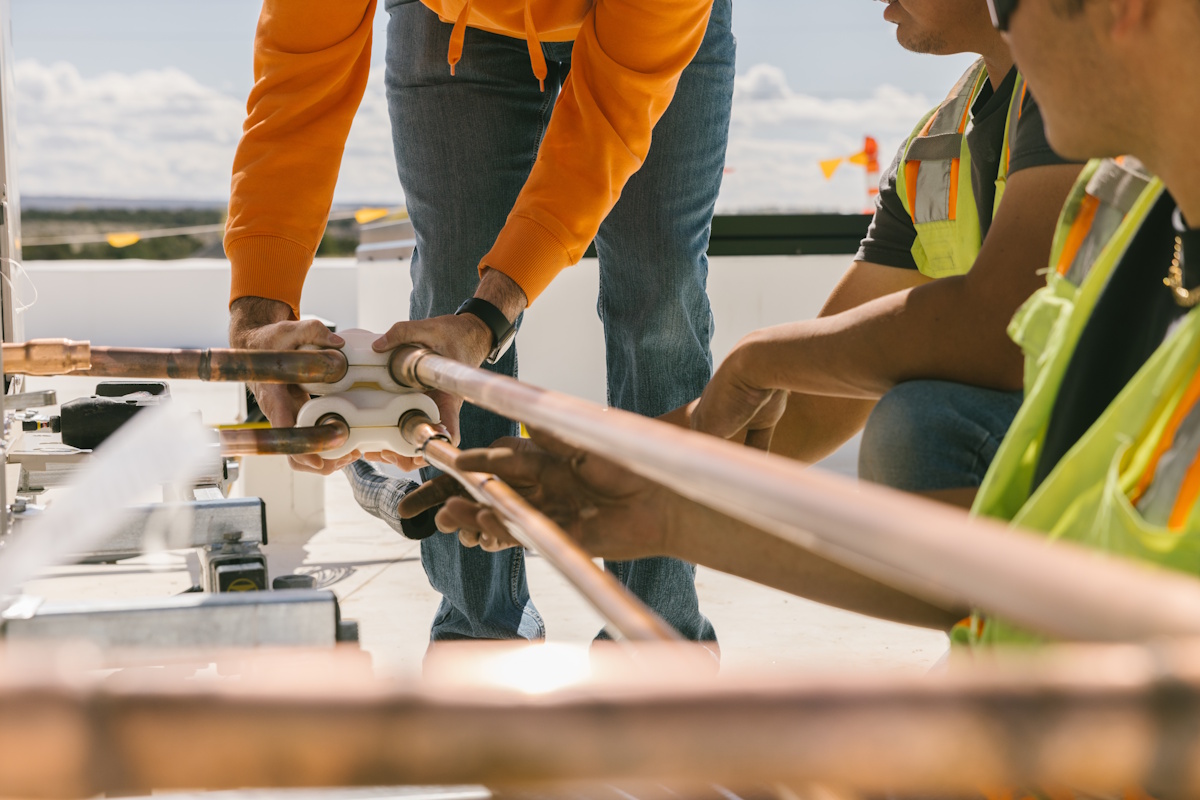
JUST START: To the HVAC contractors thinking of opening their own training programs, the best advice is to not overthink it and just start. (Courtesy of Fujitsu)
Marsiglio said one of the solutions to some of the issues that are popping up in developing a workforce is simple: Hire technicians straight out of trade school and immediately immerse them in the company’s internal academy.
Depending on skill level, some recruits may start in the warehouse before being fast-tracked into the field. Within roughly 12 weeks, many are already working as maintenance techs.
Looking for quick answers on air conditioning, heating and refrigeration topics? Try Ask ACHR NEWS, our new smart AI search tool. Ask ACHR NEWS
The philosophy that Marsiglio holds when it comes to new recruits is that the trades schools have done an excellent job of teaching theory, but it’s up to them to make sure a new technician's hands and mind connect.
That’s the biggest skills gap he’s seeing — applying theory to actual equipment.
“Some of them come to us never having worked on a furnace that fired,” he said.
Closing the Theory-to-Equipment Gap
To address this, new technicians are placed directly in front of live equipment. Instructors walk them through the sequence of operation and troubleshooting, emphasizing core measurements and startup procedures.
“Measuring gas pressures, measuring static pressures, doing a full factory startup so that they understand what a furnace is supposed to do,” Marsiglio said.
In the lab, older furnaces are intentionally faulted by instructors, so trainees have the opportunity to diagnose real-world issues without real-world stress.
“So they can actually take what they’ve read, from maybe a troubleshooting chart, and transfer that over to what the meter or gauges are telling them — they’re able to see that theory put into practical experience,” Marsiglio said.
Mentorship in the Field
With training being split between classroom instruction and field experience, Marsiglio said they also rely on their designated mentors to help shape young technicians. Typically, they will rotate between two mentors during their time in the finishing program.
“The mentors give us feedback on them on a weekly basis and actually sign off to say that they’ve witnessed and performed these tasks effectively in the field,” Marsiglio said.
Marsiglio helped develop the academy and get it off the ground before moving into a general manager role. While the program has been successful, it is not without challenges.
Difficult conversations occasionally arise when a technician struggles to grasp a concept. In those cases, mentors and instructors review field progress reports together, and the technician is given another opportunity to practice the skill in the classroom.
“We’ve only had a couple of students that we’ve had to have that conversation with — that this may not be the trade for you,” Marsiglio said. “Or we’ll say, ‘Let’s get you back to the warehouse, let’s get you more acclimated with the pieces and parts, and then give it a go.’ But we’ve had great success with it.”
How to Get Started
Analysis paralysis is the act of overthinking a task to the point that it’s simply never started. When it comes to a training program or academy, it doesn’t take much — just the will to actually do it.
Before the company was acquired by private equity, Marsiglio said their academy began with minimal space and equipment. And by minimal, he said they literally started the program out of a broom closet.
“We created our curriculum and had very minimal equipment,” Marsiglio recalled, emphasizing that the most important step is committing, even if the program isn’t perfect at the start. He also referenced a quote commonly attributed to Henry Ford that really summed up their attitude toward getting their program up and running: “The only thing worse than training your employees and having them leave is not training them and having them stay.”
“In our industry, we have huge ebbs and flows, we have seasonality. So the toughest part about making that investment in a slow season when maybe cash flow isn’t the greatest, or profitability is down,” he said. “A lot of the time we lay that talent off, and that’s the time to invest in training.”
“All you need to start training is one furnace and one air conditioner,” Marsiglio added.
As for putting together curriculum, the situation will be different for every contractor. Marsiglio said organizations like ACCA have a ton of training materials, but in his case, he taught for 20 years at a local community college, so he leaned heavily on that experience.
“You don’t have to be the smartest person in the room (to start an academy), there are a lot of resources,” Marsiglio said. In fact, he said they learned that sometimes, when they had used some outside resources, it actually resonated better with the students, mainly because the information was coming from someone else. Marsiglio said maybe that’s just kind of the “parent effect,” where a child won’t listen to something mom or dad says, but will gladly accept that same information if it’s coming from a cool friend or that cool friend’s parents.
New Technologies in Training
When it comes to the biggest breakthroughs in training, virtual reality has to be at the top. Marsiglio said they were actually an early adopter of Interplay Learning and VR, a horse he’s glad they bet on.
“It allows us to simulate things that we just can’t do in the classroom,” he said, adding that there are endless troubleshooting scenarios.
As for new technologies and equipment, Marsiglio said they have a great partnership with their supplier, who has helped them get their hands on new training equipment, especially R-454B.
Being proactive here helped them get technicians ahead of the curve.
“We wanted them to be prepared, we wanted them to be comfortable, because the customer is going to see that panel that has a bunch of sticks on it that says ‘flammable,’” Marsiglio said.
Everyone, from the most seasoned to the greenest techs were trained on R-454B, making sure they understood every step of the process. While installation isn’t all that different, aside from the leak detection system, it was important for Marsiglio to be an early adopter and have their techs get their hands on the new equipment as soon as possible.
Even if a contractor might not have access to all of the latest tools right now, that shouldn’t be an excuse when it comes to ensuring technicians are properly trained.
“I would say if you’re thinking about doing a training program, just do it — it’s paid for itself 100 times over,” he said.
Manufacturers Help Fill the Gaps
Manufacturers have long been a driving force in ensuring that technicians have the knowledge necessary for proficiency, but as of late, they’re stepping up their game even more in the workforce development sphere.
At Carrier, the figures from the U.S. Bureau of Labor Statistics were eye-opening, and also a real motivator in the launch of its “TechUp” initiative.
“This shortage is particularly acute in residential HVAC, where rapid growth in new home construction, energy-efficient retrofits, and smart home technology requires technicians with advanced skills in installation, diagnostics, and system integration,” said Catie Sheppick, director of marketing at Carrier. “Carrier launched TechUp to bridge this gap by connecting aspiring technicians with local dealerships and elevating awareness and interest in the skilled trades.”
The next five years will be pivotal for the HVAC workforce, Sheppick said, citing accelerating retirements among experienced technicians, creating a knowledge gap, demand for advanced technical skills in areas like smart diagnostics, energy efficiency, and sustainable technologies, and the digital transformation of HVAC systems, requiring technicians to master IoT-enabled solutions and predictive maintenance tools.
“Carrier’s strategy includes working with organizations like TechForce and Building Talent Foundation to promote careers in the trades and align training with evolving industry needs,” Sheppick said.
TechUp serves as an entry point into the dealer talent pipeline, designed to spark interest and raise awareness of HVAC as a rewarding career offering competitive salaries and long-term stability.
Once on the site, prospective technicians have two primary options:
1. Start Your Career: Submit your information and resume to local Carrier dealers actively seeking talent.
2. Explore Training Opportunities: Access Carrier’s MyLearningCenter.com to begin introductory courses or determine if HVAC is the right career path for you.
“TechUp’s resources are available to anyone, but serious applicants should ensure their resume is current, relevant, and well-crafted to stand out to dealers,” Sheppick said. “With demand for skilled technicians at an all-time high, a strong resume can set you apart and open doors to immediate opportunities.”
Sheppick said, so far, Carrier has been surprised by the high level of interest and engagement from dealerships and candidates, indicating that the demand for structured workforce programs is even greater than anticipated.
“Additionally, the speed at which engagements with educational institutions and nonprofits have scaled has exceeded expectations, reinforcing the need for collaborative solutions,” Sheppick added.
As for advice on how contractors can build a stable talent pipeline, the folks at Carrier gave four pieces of advice:
· Invest in training and upskilling. Continuous education in emerging technologies is critical.
· Collaborate with workforce development programs like TechUp, TechForce, Building Talent Foundation, and other industry associations to access talent pools.
· Engage with your local schools and trade organizations to promote HVAC careers early.
· Leverage digital tools for predictive maintenance and diagnostics to reduce reliance on emergency labor. These steps help contractors create a resilient pipeline and adapt to evolving industry demands.Looking for a reprint of this article?
From high-res PDFs to custom plaques, order your copy today!