Residential Credits Wind Down, Commercial Geothermal Powers Ahead
With federal incentives still in play, commercial geothermal projects are gaining ground
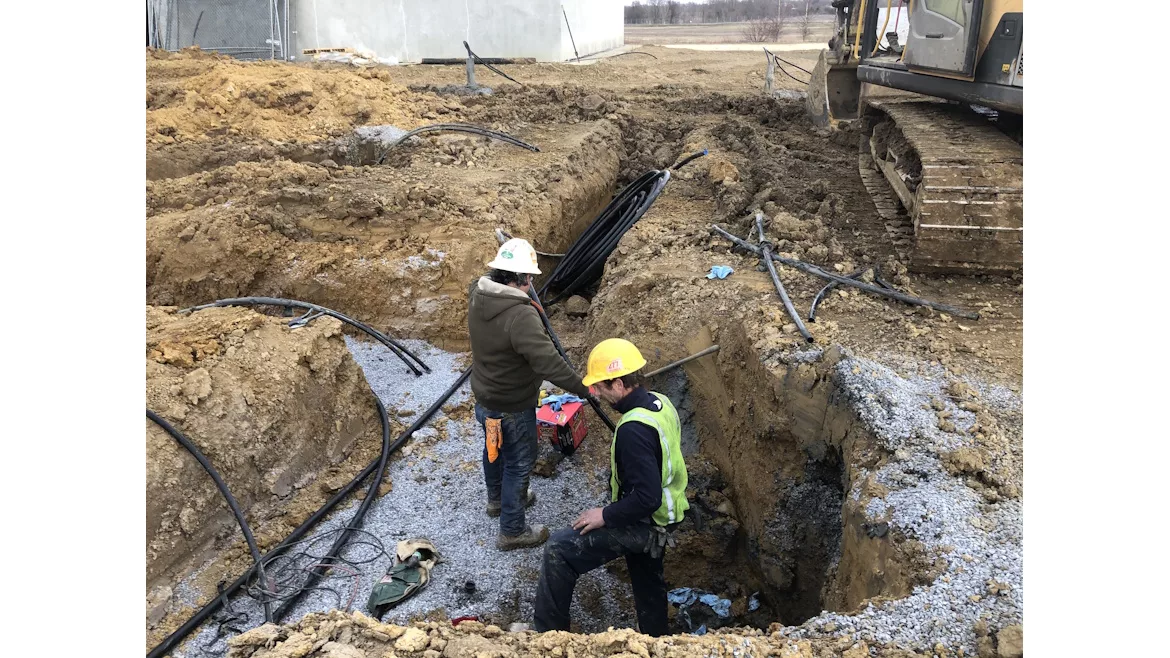
THE MARKET: Advances in drilling and installation efficiency are helping expand opportunities for HVACR contractors in the commercial market.
While residential geothermal tax credits (25C and 25C) are set to sunset after 2025, the commercial tax credits remain, and geo experts say the field is gathering momentum.
“A number of sources are projecting strong growth for commercial geothermal HVAC in 2026, primarily driven by some innovative technological advancements, increased demand for sustainable energy solutions, and the tailwinds of the continued tax incentives,” said Jason Bose, commercial sales manager at Climate Control Group (CCG) “The projections we are looking at estimate growth in the range of 10-12% over the next five years.”
As Joe Parsons, founder and principal of Resonant Energy Strategies, put it: The year 2026 isn’t a cliff — it’s a pivot point.
“As service models mature and incentives persist for commercial owners, geothermal will continue expanding as a managed utility service, not a niche technology,” Parsons said. “The companies that de-risk the subsurface early, verify performance transparently, and deliver repeatable, bankable designs will define the next decade of clean, resilient thermal energy.”
2026 Market Momentum
Attention is now shifting toward the commercial sector as the expiration of residential geothermal credits inches closer. Combine that with decarbonization efforts, maturing drilling technology, and a push to educate — and it makes for a favorable environment for growth.
Bonnie Morrison, controller of Morrison Geothermal in Duncannon, Pennsylvania, said they’ve seen the new construction side of the commercial geo market increase substantially over the last two years.
“Combining federal tax credits with other incentives such as carbon credits has made initial installation costs hard to beat,” Morrison said.
Looking for quick answers on air conditioning, heating and refrigeration topics? Try Ask ACHR NEWS, our new smart AI search tool. Ask ACHR NEWS
With the expiration of the residential tax credits looming, some expect a slowdown. Others don’t. That’s because they know what geothermal can offer to commercial spaces.
“Decarbonization efforts and the energy efficiency benefits for long-term savings have always made geothermal systems more attractive for commercial buildings. … Some traction [is from] district scale applications becoming more accepted,” said Bose.
Parsons is also among those who don’t expect commercial geo to slow down.
“The commercial side retains powerful tools: the Investment Tax Credit, direct pay for tax-exempt entities, transferability, and the Section 179D deduction for energy-efficient commercial buildings available for projects that begin construction before July 1, 2026, under H.R. 1,” Parsons said. “Combined with state and utility programs, these incentives create a robust framework that will sustain demand through 2026 and beyond.”
Geothermal Growth
Since its inception, geothermal technology has stayed a natural fit for schools, hospitals, and municipal buildings. That likely won’t change anytime soon, but due to continued tax incentives, the applications are expanding.
“In recent years, there has been more interest — and some recent applications for high-rise multifamily buildings where we have successfully applied geothermal technology, which is very encouraging,” Bose said. “Retrofits and upgrades are a promising segment that we see having great potential with the help of the federal incentives — geothermal HVAC is certainly not strictly for new construction.”
Parsons said that the continued availability of these commercial incentives for sectors with long-term horizons and predictable loads favors market segments like education, health care, and government buildings because these types of projects value comfort, resilience, and energy-cost stability.
“Multifamily housing and light industrial are also poised to benefit thanks to diverse, simultaneous heating and cooling loads that improve system efficiency,” Parsons said. “In all these sectors, geothermal aligns neatly with broader electrification and decarbonization goals, and that alignment will keep capital flowing even after other credits expire.”
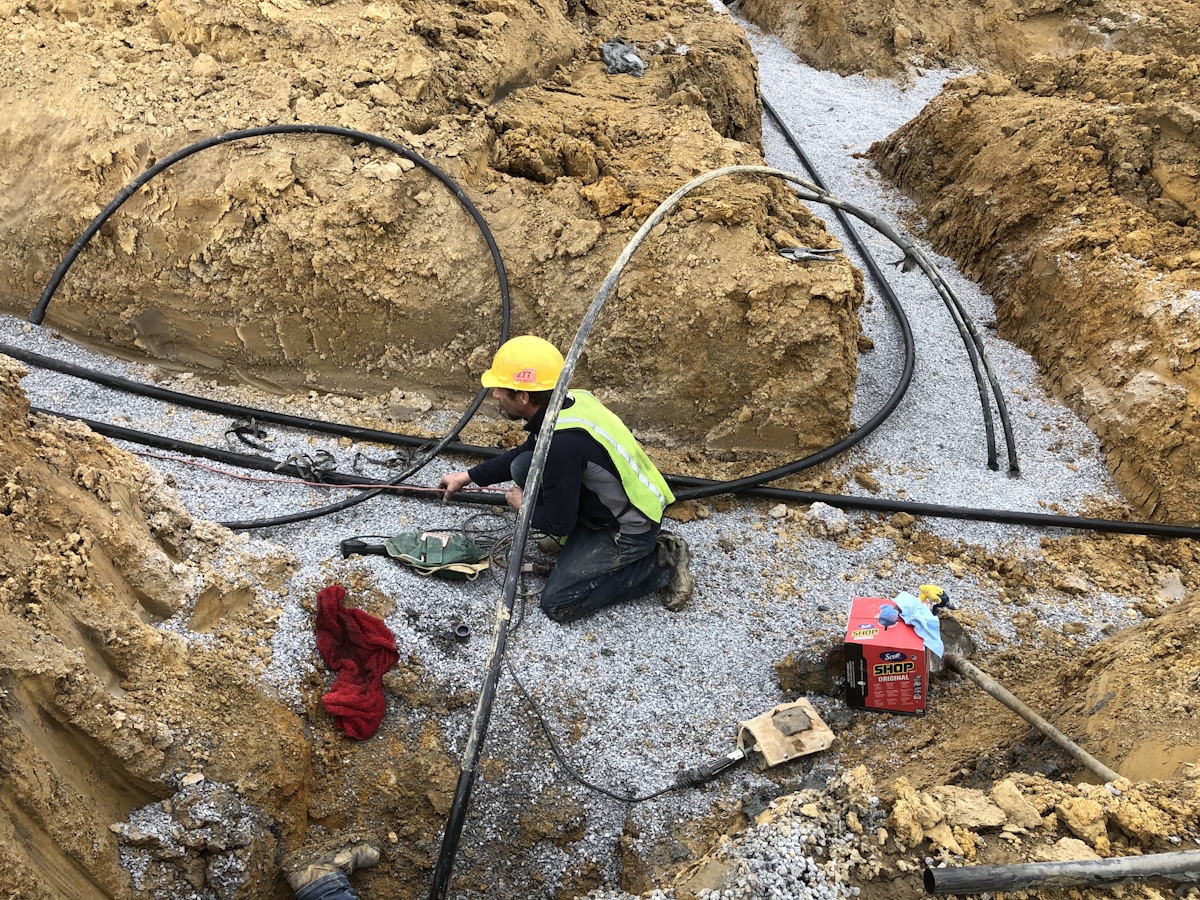
ADVANCING THE FUTURE: Workforce training and hands-on experience are critical as commercial geothermal projects continue to grow nationwide. (Courtesy of Morrison Geothermal)
Barriers
Even as commercial geothermal gains traction, challenges remain. Chief among them are education, perception, and workforce readiness.
“The biggest barriers are still education and acceptance of the many benefits geothermal can provide — proper design and installation provide a system that will provide comfort, energy savings, and longevity of equipment,” Morrison said.
Awareness is critical, particularly among owners and developers who may still perceive geothermal as costly. And of course, having the necessary skilled techs who can do the job.
“Widening the scale of qualified and trained loop contractors and drillers in certain markets is an issue that our industry is addressing with new and improved technical and business training to raise awareness and address the labor and knowledge shortages,” said Bose. “The upfront cost of the ground loop has become far less of a barrier with the government incentives, and if done properly, the incentives can completely erase the cost of the loop and make geothermal an even lower cost than many conventional HVAC systems.”
Cost-perception is seemingly one of the biggest hurdles to commercial geothermal adoption.
“Owners often focus on initial bids rather than lifecycle cost,” Parsons said. “Add to that subsurface uncertainty, limited drilling capacity, and fragmented permitting, and timelines can stretch unnecessarily.”
Bose said perceptions are beginning to shift.
“Once the loop cost is not an issue, geothermal is an obvious choice,” he said. “General awareness of geothermal HVAC systems and changing the old and very out-of-date mindset of ‘geothermal is too expensive’ is something that we are focused on and fully intend to propagate this message to all that will listen.”
Those same issues also highlight the need for continued training and standardization.
“Every project should have documented commissioning protocols: flush/purge verification, grout-density checks, as-built loop maps, and monitored performance data,” Parsons said. “The more transparent we are, the more confidence lenders and owners will have.”
Geothermal Innovation
One of the most significant drivers of commercial growth lies in the evolution of drilling and loop technologies.
“While drilling techniques continue to progress, each site determines the best installation technique depending on the conditions encountered,” said Morrison. “The newer rig technology has made drilling easier, faster, and deeper — allowing sites with smaller footprints to consider geothermal.”
Bose said that as advanced geothermal systems, like deep-closed loop systems, continue to evolve, so does the potential to grow the industry. CCG is encouraged that the projects underway in the enhanced geothermal (‘hot rock’) sector could also inform commercial HVAC applications.
“The emergence of deep closed-loop systems is changing the feasibility equation,” Parsons said. “These wells can deliver higher, steadier temperatures without producing fluid, which is ideal for dense urban sites or complex geology. For many projects, the winning approach will be hybrid, with deep wells providing baseload energy paired with shallow borefields that handle peaks. In that configuration, developers can reduce land area, improve temperature stability, and tap multiple funding mechanisms.”
The new deep-loop technologies don’t necessarily have to compete with conventional ground-source heat pumps. With the right implementation, the two go hand-in-hand.
“Traditional borefields will remain the most cost-effective where conditions allow, while deep closed-loop and thermal-storage approaches fill the gaps,” Parsons said. “The industry’s future lies in site-specific hybrids that balance cost, footprint, and performance.”
Looking 5-10 years out, Parsons expects the market to evolve along three lines: single building to networked systems, upfront CapEx to service models, and custom design to standardized, repeatable solutions.
“Expect growing interest in thermal-energy networks, utility-owned assets, and hybrid systems combining heat pumps, thermal storage, and load management,” Parsons said. “The shift from artisanal projects to scalable infrastructure is already underway.”
Growth Hotspots
Geothermal adoption isn’t uniform across the country. There’s strong momentum in the northeast and Midwest, with early signs of expansion in the West.
“These states have grown the market through both incentive and regulation,” Morrison said.
The decarbonization/electrification states are seeing the most demand — like New York, Bose said.
“Its ban on fossil fuels and their state incentives, paired with the federal incentives, has experienced exponential growth. … But in general, the Midwest and eastern parts of the country have the most traditional traction for geothermal HVAC applications. Decarbonization trends are becoming more prevalent and increasing in the coming years in Western states. … There is far more potential there to be tapped,” Bose said.
Parsons said that the northeast and mid-Atlantic remain the most active, propelled by building-performance standards and utility-backed thermal-network pilots.
“The Great Lakes states … are following closely, and new clusters are forming in Colorado’s Front Range and the Pacific Northwest,” Parsons said. “Across the country, federal and Department of Defense campuses are emerging as anchor clients because geothermal directly supports resilience and mission continuity.”
Workforce/Supply Chain Readiness
With more commercial projects in the pipeline, the industry’s ability to deliver them depends heavily on training, workforce development, and supplier coordination.
“We started our own apprentice program 15 years ago to train our workforce,” said Morrison. “Our program entails training in all aspects of an installation, including drilling, grouting, manifolding, and equipment repair/maintenance.”
Expanding the talent pool is a top priority of the industry.
“Training is certainly something the industry is focused on, and we’re actively making a push with our partners at International Ground Source Heat Pump Association (IGSHPA), Geo Exchange, and others in an effort to get more people trained and continue developing the workforce necessary to support the expected growth,” Bose said. “That goes to supporting the architects, mechanical engineers, mechanical contractors, loop contractors, the distribution networks, and continuing all the way up to the building owners.”
But it’s not just about expanding driller and installer capacity, it’s also about enhancing coordination across all trades.
“Installer and designer training needs to go beyond equipment, covering load diversity, controls integration, and seasonal storage,” Parsons said. “Equally important is training facility directors and finance teams to understand M&V dashboards, performance guarantees, and contract management.” There’s also a need for supply chain alignment. “OEMs, EPCs, and distributors should coordinate early to lock in rigs, grout, HDPE, and heat-recovery chillers to avoid bottlenecks.”
Financing And The Rise Of Service Models
As the commercial geothermal market matures, financing models are also evolving to remove traditional barriers and attract long-term investment.
One promising example, Parsons said, is what he describes as the Thermal-as-a-Service (TaaS) model, a third-party leasing approach that treats geothermal as infrastructure rather than equipment that’s been gaining traction with campuses, districts, and municipalities — spaces especially where performance-based contracts align incentives between the owner and operator.
“Under this model, a third party finances, owns, and operates the bore-field (and often the plant), selling measured thermal energy to the facility through a long-term agreement, much like a solar Power Purchase Agreement (PPA),” said Parsons. “This approach removes capital expense, transfers subsurface risk, and unlocks tax benefits for investors who can monetize them more efficiently.”
Beyond 2026
As the industry looks beyond 2026, sources agree that the growth of commercial geothermal will not hinge solely on federal incentives. Instead, it will depend on how well the industry scales, standardizes, and communicates the long-term value of geothermal systems.
For HVACR contractors, distributors, and manufacturers, that means opportunity — not just in equipment sales, but in workforce development, partnerships, and service delivery. With the right mix of innovation and collaboration, commercial geothermal may be entering not just another growth cycle, but a lasting role in the clean energy economy.
Looking for a reprint of this article?
From high-res PDFs to custom plaques, order your copy today!