FROSTlines
Drip Happens: Fixing Reach-In Cooler Drain Issues
Condensate leaks are often easy to repair, but some jobs can be more time-consuming
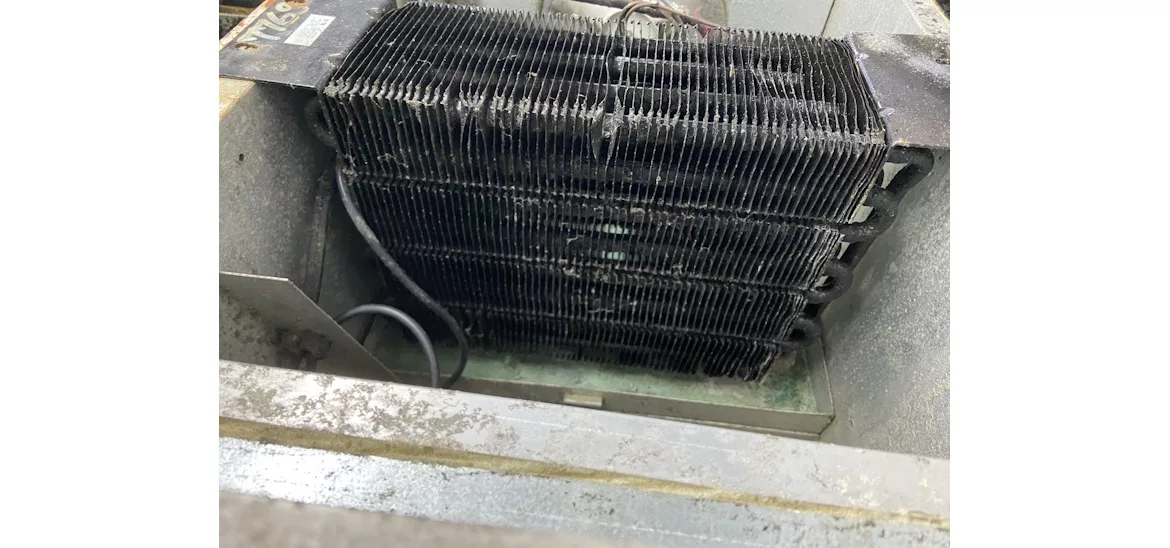
DIFFICULT PROBLEM: In a reach-in cooler, a plugged drain opening or cracked drain pan can be a more difficult problem to resolve.
A common complaint on reach-in coolers is water leaking either inside or outside the cabinet. Many times, this is a simple and quick repair, but there are times when this can become difficult and time-consuming — and a real inconvenience for the customer.
Water leaking inside the case is usually caused by either a clogged drain hose, a plugged drain opening, or a cracked drain pan. When the issue is a clogged hose, simply removing the drain hose and cleaning it will generally solve this issue. Most of the time, it is not too difficult, except on very old units where the hose has hardened and bonded to the drain stub. In this case, the hose may need to be cut off the stub and replaced.
A plugged drain opening or cracked drain pan is a more difficult problem to resolve. This will require removing the panel covering the evaporator in order to access the drain. Depending on the design of the case, this can be very time-consuming. Some or all of the product and shelving may need to be removed, and removing the panel can be difficult.
Once the drain is exposed, you can determine if the drain opening is the issue or if the drain pan is cracked. Generally, a plugged drain opening can be cleared with a small bottle brush. If the drain pan is cracked, it is best to replace it; however, you can try to seal the pan using a food-grade silicon. Before replacing the panels covering the evaporator, it is best to shop vac any remaining debris that could clog the drain opening again. Also, pour water into the drain to confirm the problem has been resolved.
Condensate from these units generally flows into a pan in the compressor compartment, and by design, the heat generated by the system will evaporate the water. Some units will route the discharge line of the system into the pan to help evaporate the water. Some units will have a wick kit installed in the pan to absorb the water and help it evaporate.
Water leaking under the cabinet can be caused by the pan overflowing or the drain hose not being directed into the pan. A misdirected drain hose is generally caused by a previous technician moving the drain hose to make a repair and simply forgetting to direct it back into the pan. We had a technician who, after replacing the compressor on a reach-in cooler, forgot to put the drain hose back into the pan. This caused water to leak onto the floor, into the basement, and onto boxes filled with office papers for the restaurant. The owner was quite upset and stopped calling us to repair their equipment.
An overflowing condensate pan can be the result of the pan simply being too small or, if it has a wicking kit, a disintegrated wick. If the pan is too small, try replacing it with a larger pan, if possible. If the pan was not originally heated, see if a universal heated pan can be mounted on the case, and the drain hose can be directed into that pan.
Looking for quick answers on air conditioning, heating and refrigeration topics? Try Ask ACHR NEWS, our new smart AI search tool. Ask ACHR NEWS
Another option is to extend the drain hose to a floor drain. This is generally not the best solution, since there is usually not a floor drain close by. In addition, any time the cooler would need to be moved for maintenance or repairs, the drain hose would need to be redirected to the floor drain, which can be easily overlooked, causing water to leak onto the floor.
Dealing with condensate issues may not be the hardest repair on a reach-in cooler, but it can certainly be time-consuming.
Looking for a reprint of this article?
From high-res PDFs to custom plaques, order your copy today!