3 Common HVAC Code Violations with Dryer Vents and Fiberglass Insulation
Avoid these frequent HVAC code mistakes for safer systems
Standards and codes are established with one primary purpose: to protect human life and property. Many of these guidelines were created as reactions to past disasters, serving as preventive measures to ensure such tragedies do not recur.
Despite the essential role these codes play, a considerable number of HVAC technicians do not consistently adhere to them, putting both human safety and property at risk.
While working across New York and New Jersey on both commercial and residential properties — from apartment buildings to brownstones — MainDuct technicians have consistently observed the same recurring code violations by HVAC service providers.
Let’s explore the three most common code violations in the HVAC industry — and how to address them.
1. Dryer Vent System Components
This mainly concerns transition ducts and backdraft dampers. Because these components are replaced relatively often and the servicing process is simple, many providers handle this work. However, problems can arise. Not all ducts are created equal. Transition ducts must fully comply with UL 2158A and be properly labeled and listed.
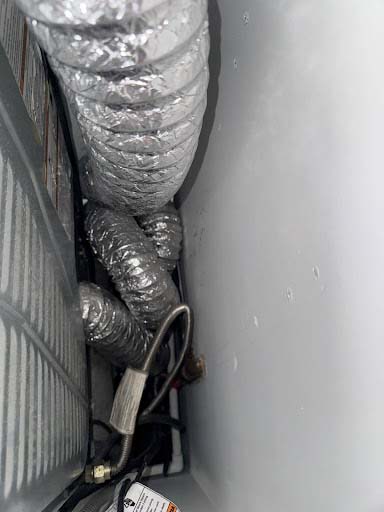
Non-compliant transition duct. (Courtesy of Mainduct)
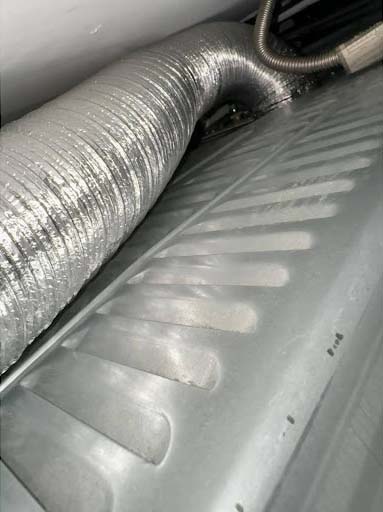
Compliant transition duct. (Courtesy of Mainduct)
Another frequent issue is the duct length. Transition ducts connecting the dryer to the exhaust system must not exceed 8 feet. If the transition duct length cannot be kept under 8 feet, the exhaust vent system must be modified or extended accordingly to comply with code requirements. These requirements are written in New York State Mechanical Code (MCNYS) and National Fire Protection Association Standard No. 211 (NFPA 211), specifically MCNYS 504.8.3 and NFPA 211 10.7.3.10.
Backdraft dampers, as part of a dryer vent system, must also comply with code requirements — specifically, they should not reduce the vent’s cross-sectional area and must be made of noncombustible materials.
Looking for quick answers on air conditioning, heating and refrigeration topics? Try Ask ACHR NEWS, our new smart AI search tool. Ask ACHR NEWS
Metal dampers meet these criteria because they allow lint to pass through safely, offer superior durability, and can be cleaned repeatedly without damage, unlike commonly used plastic dampers, which pose fire hazards.
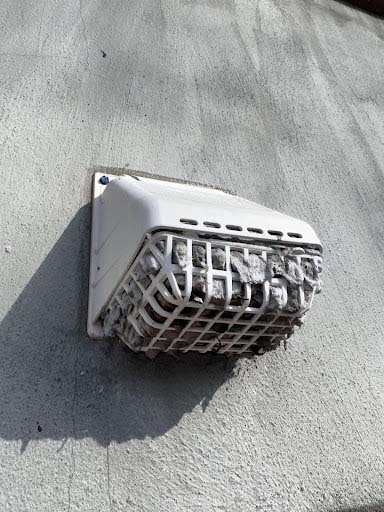
Plastic damper. (Courtesy of Mainduct)

High-quality metal damper powder painted. (Courtesy of Mainduct)
2. Dryer Vent Material
Because dryer vents expel heated gases and may accumulate combustible deposits that pose a fire risk, the material must be robust and fire-resistant.
Many installers opt for flexible ducting due to its lower cost and ease of installation. However, this approach violates code requirements. Both the MCNYS and NFPA 211 codes mandate that dryer ducts be made of metal with a smooth interior surface to prevent lint buildup and reduce fire hazards. MCNYS specifies a minimum metal thickness of 0.016 inches (0.4 mm), while NFPA 211 sometimes requires a thicker 24-gauge metal (0.024 inches or 0.6 mm). Additionally, ducts should have a diameter of 4 inches, as outlined in MCNYS 504.8.1 and NFPA 211 10.7.3.8.
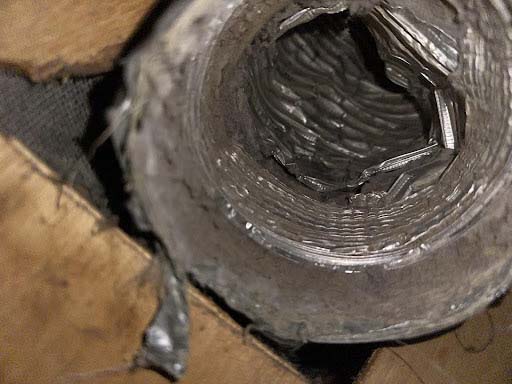
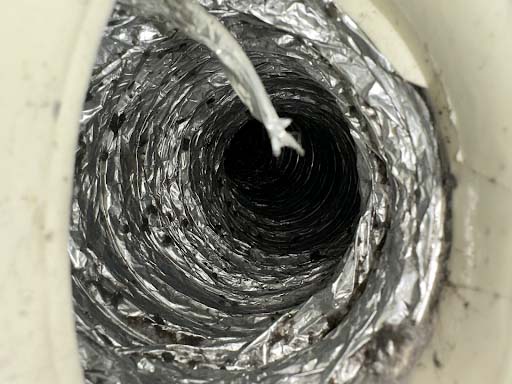
Flexible ducting inside the wall. (Courtesy of Mainduct)


Compliant dryer vent. (Courtesy of Mainduct)
3. Fiberglass Insulation
Fibrous glass insulation, frequently used in air ducts, is one of the more common HVAC installation mistakes. The edges of fibrous glass must be promptly encapsulated to prevent fiberglass particles from entering the airflow.
However, installing fiberglass insulation inside air ducts is inherently problematic. Often, technicians purchase ducts with preinstalled fiberglass and then assemble the duct system. Fiberglass inside the ducts significantly reduces their lifespan — which can otherwise be 50 to 60 years — and as the fiberglass deteriorates, black dust accumulates on surfaces, and these particles can be inhaled in significant amounts. MainDuct technicians frequently observe such issues. Therefore, it is best to install metal ducts initially and insulate them from the outside using properly rated insulation if needed.
Sometimes fiberglass insulation is used to reduce noise. However, in most cases, simply installing wider ducts and using variable-speed HVAC components can effectively solve this problem without the complications associated with fiberglass.
When fiberglass is necessary, it is important to choose high-quality brands that provide excellent sealing of the internal layers. Ordinary fiberglass is easily damaged during cleaning and tends to accumulate dirt and mildew. It must be installed meticulously, including any required access doors, following NADCA (National Air Duct Cleaners Association) guidelines. NADCA takes fiberglass properties and specifications into account, as detailed in NADCA Standard 4.2.8.
In a very common case where deteriorated fiberglass is already installed inside ducts, the simplest correct solution is to apply fiberglass encapsulation to lock in the fiberglass particles.
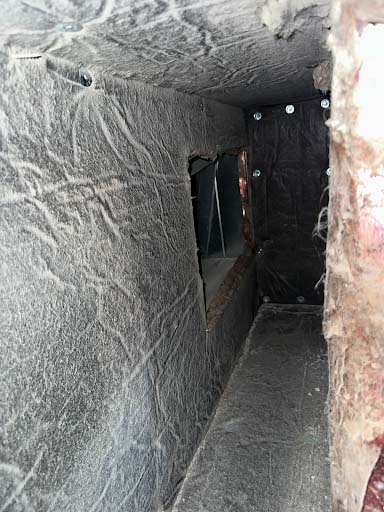
Deteriorating fibreglass in the air duct. (Courtesy of Mainduct)

Encapsulated fiberglass. (Courtesy of Mainduct)
Looking for a reprint of this article?
From high-res PDFs to custom plaques, order your copy today!