ACHR News
search
Ask ACHR NEWS AI
cart
facebook twitter instagram linkedin youtube
  • Sign In
  • Subscribe
  • Sign Out
  • My Account
ACHR News
  • NEWS
    • Breaking News
    • New HVAC Products
    • Featured Products
    • Manufacturer Reports
    • HVAC Data
    • Legislation
    • ACHR NEWS Centennial
  • RESIDENTIAL
    • Air Conditioners
    • Furnaces
    • Residential Heat Pumps
    • Ductless
    • Residential IAQ
    • Testing, Monitoring, Tools
    • Components & Accessories
  • COMMERCIAL
    • Air Handlers
    • Rooftop Units
    • Chillers and Cooling Towers
    • Commercial Heat Pumps
    • Boilers and Hydronics
    • VRF/Ductless
    • Commercial IAQ
  • REFRIGERATION
    • Refrigerants
    • Refrigerant Regulations
    • Leak Management
  • CONTRACTOR PRO
    • Geothermal
    • Homeowner Study
    • VRF and VRV Ductless
    • Unitary Trends
  • EDUCATION
    • Training and Education
    • Business Management
    • Service and Maintenance
    • Continuing Education
    • Market Research >
      • HVAC Brand Awareness Report
      • VRV, VRF, VRVZ Report
      • Unitary Trends Report
      • Water Heat Professionals Report
    • Webinars
    • Sponsor Insights
    • eProducts Info
    • White Papers
  • EVENTS
    • HVAC Contractor Forum
    • Industry Events and Webinars
  • MEDIA
    • Videos
    • AHR Expo 2025 Videos
    • Podcasts >
      • ACHR News Podcast
      • HARDI Podcasts
      • AHR Expo Podcasts
      • ACCA Podcasts
    • Interactive Spotlights
    • Quizzes
    • eBooks
    • HVAC Talkback
  • HVAC GROUP
    • ACHR NEWS >
      • Current Issue
      • Digital Edition
      • Subscribe
    • Distribution Trends
    • SNIPS NEWS >
      • Join SNIPS NEWS
    • Engineered Systems News >
      • Join ES News
    • HVACR Directory
    • Contests
    • Newsletters
    • Contact
    • Advertise
    • My Account
NewsRefrigeration

FROSTlines

Leak Detection Critical as Industry Transitions to A2L Refrigerants

Techs should focus on preventing leaks in both new and existing HVACR systems
By Justin Bailey
heatcraft training justin bailey

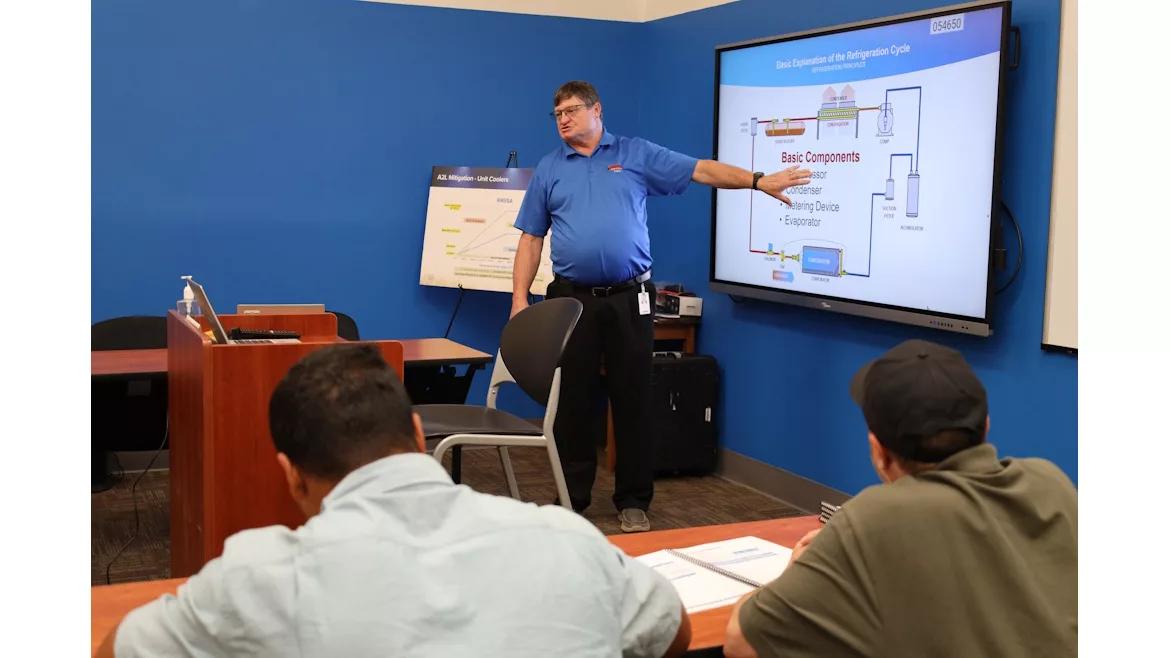
TECHNICAL TRAINER: Justin Bailey teaches a class at Heatcraft, where he is currently a technical trainer. (Courtesy of Heatcraft) 

July 28, 2025

As the industry transitions to mildly flammable A2L refrigerants, leak detection has become a priority. Two key areas of focus include both new system installations, as well as refrigerant leaks, that occur after a system is operational. 

New air conditioning and refrigeration systems that use A2L refrigerants are now required to be equipped with refrigerant detection systems (RDS). While refrigerant monitors have long been used in mechanical rooms and enclosed spaces housing equipment such as chillers and refrigeration racks, the same technology is now being applied to individual air conditioning and refrigeration units. 

These systems not only monitor for refrigerant leaks and initiate system shutdowns, but they may also be required to activate a mitigation response. Every equipment manufacturer must either install these detection systems at the factory or provide field installation kits designed specifically for their equipment. As a result, technicians will encounter a variety of RDS kits in the field. While system designs may differ, they all perform the same core functions. 

When a refrigerant leak is detected, the system shuts down to eliminate potential ignition sources, followed by the appropriate mitigation response. For residential and smaller systems that contain less refrigerant, shutdown alone may be sufficient. In refrigeration systems, a shutdown valve in the liquid line and a check valve in the suction line — positioned outside the refrigerated enclosure — are typically required. Larger systems may require additional mitigation steps, depending on refrigerant volume and the enclosed area. 

Each installation must be evaluated individually to determine the appropriate mitigation level. ASHRAE Standards 15 and 34 guide this determination. 


Leaky Systems 

The second key area of focus involves locating and repairing leaks in existing systems. Solid installation practices are key to preventing leaks, and using proper brazing materials and techniques, as well as pressure testing systems before startup, can prevent future issues. Here are some best practices: 

  • For flared connections, always inspect the mating surfaces for scratches or debris, and ensure proper alignment and tightening; 
  • Misalignment and overtightening can distort the flare and cause leaks; 
  • Avoid using utility knives or tools that may damage flared surfaces when removing protective caps; and 
  • Always remove any debris from the flaring tool and apply a small amount of refrigeration oil during the flare process.  

As the saying goes, prevention is the best cure — especially when replacing or installing new units. 

Looking for quick answers on air conditioning, heating and refrigeration topics? Try Ask ACHR NEWS, our new smart AI search tool. Ask ACHR NEWS →

Despite best efforts, even properly installed and maintained systems can develop leaks over time. Technicians can spend countless hours tracking down leaks, as some are obvious and easy to find, while others are minuscule and challenging.  

Many tools and techniques can help in the field. A thorough visual inspection may reveal oil stains or discoloration, which can point to a leak. Check for sections of piping or distributor tubes that may be rubbing, and inspect areas where piping passes through panels or clamps. The tube sheets at the ends of the condenser and evaporator coils are common leak points due to metal expansion and contraction. These leaks can be difficult to locate and repair.  

I’ve had success using a flat punch to gently move the metal around multiple tubes to expose leaks — but first, the leak must be located. 


Leak Detection Tools 

Electronic leak detectors are more common than ever, and it is important to make sure the detector is rated for the refrigerant in use. Regularly maintain or replace the sensing element or chip as recommended by the manufacturer, and clean any oil or dirt, and replace filters as needed.  

Be aware that air movement can displace leaking refrigerant, making the leak appear elsewhere. Start leak checks at the top and move downward, as refrigerant is heavier than air and will fall. Many detectors also offer adjustable sensitivity to help pinpoint leaks. Power on the detector in a refrigerant-free area before use and allow time for calibration and warmup as needed. 

Ultraviolet dye is another popular leak detection method; however, some equipment manufacturers do not recommend its use and may void warranties if it’s applied. UV dye must be used in the correct quantity for the system size and refrigerant charge, and take care to avoid spills and contamination during injection. After the dye circulates through the system during operation, an ultraviolet light can be used to locate leaks. Be sure to apply identifying labels to systems where dye has been used. 

Despite advances in technology, soap bubbles remain one of the most effective methods for confirming leaks. Available in spray bottles, with brushes, and in low-temperature formulas for freezers, soap bubbles can pinpoint leaks even after detection with electronic devices. 

Each technician may have preferred tools or techniques for leak detection, but many reliable methods exist. It’s essential to remain diligent and adapt to each situation. 

KEYWORDS: A2L Refrigerants FROSTlines leak prevention

Share This Story

Looking for a reprint of this article?
From high-res PDFs to custom plaques, order your copy today!


Heatcraft justinbailey
Justin Bailey is a technical trainer with Heatcraft Refrigeration Products and has worked in the HVACR industry for nearly 40 years. After running an HVAC service company for 15 years, Bailey moved into training and became the HVAC department director at a technical school. Bailey holds an unrestricted license in the state of Georgia and is a proctor for EPA refrigerant certification exams. For additional information, visit www.heatcraftrpd.com/training.

Recommended Content

JOIN TODAY
To unlock your recommendations.

Already have an account? Sign In

  • HVAC-enrollment

    The Trades Are Back: HVACR Programs See Nearly 30% Enrollment Spike

    A new wave of future technicians is entering the pipeline.  
    Training and Education
    By: Matt Jachman
  • 2025 Top 40 Under 40

    2025 Top 40 Under 40 HVACR Professionals List

    The 11th annual Top 40 Under 40 list highlights those...
    HVAC Commercial Market
    By: Hannah Belloli-Oster
  • LG Ductless Mini-Split Systems

    The 9 Types of Heat Pumps

    As the U.S. moves toward electrification, heat pumps are...
    Air Source Heat Pumps
    By: Joanna R. Turpin
Subscription Center
  • Create an Account
  • Start a Subscription
  • Manage My Account
  • Sign Up for Newsletters
  • Visit Customer Service
  • Update Preferences

More Videos

Sponsored Content

Sponsored Content is a special paid section where industry companies provide high quality, objective, non-commercial content around topics of interest to The News audience. All Sponsored Content is supplied by the advertising company and any opinions expressed in this article are those of the author and not necessarily reflect the views of The News or its parent company, BNP Media. Interested in participating in our Sponsored Content section? Contact your local rep!

close
  • Piggy Bank
    Sponsored byWatercress Financial

    Energy Prices, Inflation, and HVAC: What Today’s Homeowners Care About

  • Refrigerated Food
    Sponsored bySolstice Advanced Materials

    R-455A Refrigeration: A Cold Storage Solution for the Future

  • Airex Rooftop Units
    Sponsored byAirex Manufacturing Inc

    Consolidating Roof Penetrations: A Growing Trend in Multifamily HVAC Design

Popular Stories

HVAC-Price-Increase-graphic

HVAC Price Increase List: June 2026

Trump-Section-232.jpg

Trump Reduces Section 232 Tariffs on HVAC Equipment to 15%

Heat-pump-cutaway.jpg

PFAS Rules and A2L Building Codes Continue to Evolve

Midea-training.jpg

HVAC Workforce Crisis Expands Beyond Technicians to Instructor Shortages

U.S. Supreme Court building

95% Furnace Efficiency Rule to Get New Hearing

View The ACHR NEWS
Centennial Anniversary Timeline

The ACHR News Timeline Chart
Submit a Letter
Submit a letter to our editors.

Events

November 6, 2025

Next-Gen Data Center Cooling: HVAC Innovation and Real-World Solutions

On Demand As AI workloads and high-density computing push traditional cooling methods to their limits, the data center industry is accelerating the adoption of next-generation HVAC technologies.

June 17, 2026

Decarbonization Without Disruption

This webinar will explore practical HVAC decarbonization strategies that minimize disruption while maximizing long-term performance and ROI.

View All Submit An Event

Poll

Summer Staff

Are you fully staffed for the summer season?
View Results Poll Archive

Products

BNI Mechanical/Electrical Square Foot Costbook, 2026 Edition

BNI Mechanical/Electrical Square Foot Costbook, 2026 Edition

See More Products
Decarbonization Without Disruption - Free Webinar - 6/17/2026

Related Articles

  • Should Leak Detection Methods Change with A2L Refrigerants?: A2L Refrigerant Transition – Episode 3

    Should Leak Detection Methods Change with A2L Refrigerants?

    See More
  • ashrae-logo.jpg

    The Industry Transition To A2L Refrigerants: Where Are We and Where Are We Headed?

    See More
  • KeepRite-Installation

    Engineering the Transition to A2L Refrigerants

    See More

Related Products

See More Products
  • The ACHR News - July 28, 2025

    ACHR NEWS July 28, 2025, Issue

See More Products

Related Directories

  • Spectronics Corp./Spectroline Leak Detection

    Established in 1955, Spectronics Corporation is the inventor of UV fluorescent leak detection technology and manufacturer of leak detection tools for AC&R systems. Our fluorescent dyes and system additives are OEM-grade, universal (POE), co-solvent free, and NSF-certified.
  • Reliance Detection Technologies LLC

    Commercial-grade indoor plumbing leak detection and automatic water shutoff solutions for every space and budget. Monitor water mains, water heaters, washing machines, dishwashers, HVAC units.
×

Sign Up. Stay Informed.

The #1 trusted source for the HVACR industry since 1926

SUBSCRIBE
  • RESOURCES
    • Advertise
    • Contact Us
    • Advisory Board
    • Classifieds
    • Submit a Letter
    • Directories
    • Store
  • ACCOUNT CENTER
    • Create an Account
    • Start a Subscription
    • Manage My Account
    • Sign Up for Newsletters
    • Visit Customer Service
    • Update Preferences
  • SERVICES
    • Marketing Services
    • Reprints
    • Market Research
    • List Rental
    • Survey/Respondent Access
  • STAY CONNECTED
    • LinkedIn
    • Facebook
    • Instagram
    • YouTube
    • X (Twitter)
  • PRIVACY
    • PRIVACY POLICY
    • TERMS & CONDITIONS
    • DO NOT SELL MY PERSONAL INFORMATION
    • PRIVACY REQUEST
    • ACCESSIBILITY

Copyright ©2026. All Rights Reserved BNP Media, Inc. and BNP Media II, LLC.

Design, CMS, Hosting & Web Development :: ePublishing