FROSTlines
Comparing Refrigeration Systems for a Cold Storage Facility
There are pros and cons for ammonia and transcritical CO₂ systems
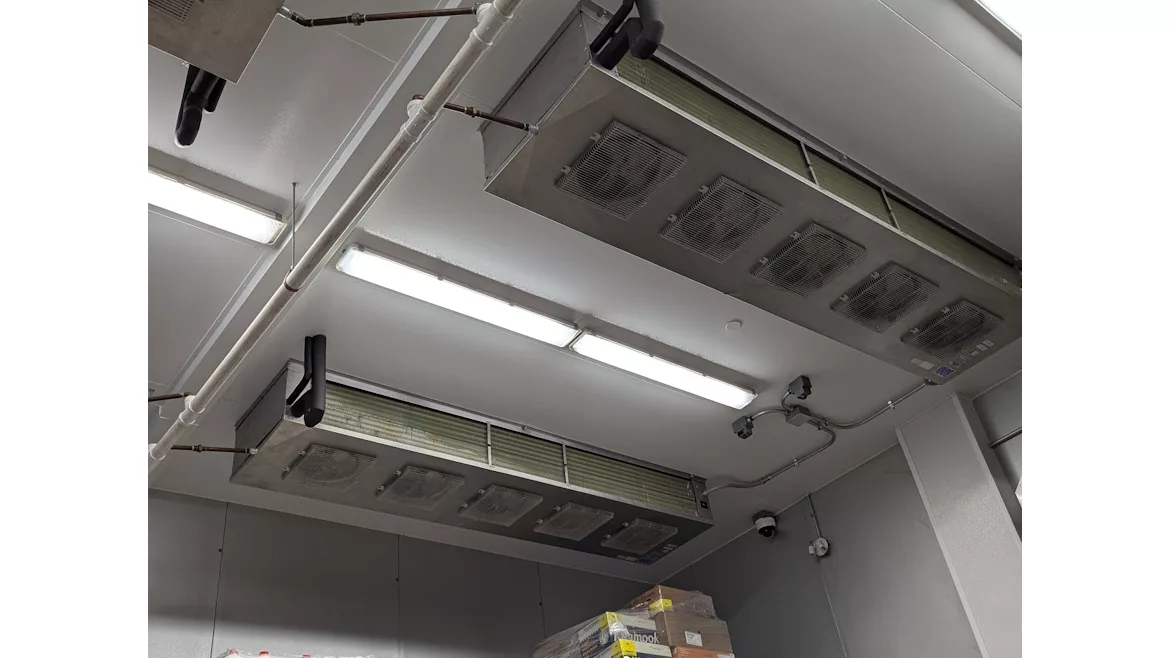
TAILORED ANALYSIS: Choosing the right refrigeration system requires a tailored analysis to meet the end user's needs. (Staff photo)
In today’s rapidly evolving refrigeration landscape, choosing the right system can feel like navigating a maze of competing technologies, regulations, and priorities. At the 2025 International Institute of All-Natural Refrigeration (IIAR) Conference in Phoenix, Arizona, Kurt Liebendorfer, vice president at Evapco, and Ryan Reardon, P.E., owner and president of R2 Mechanical Consultants in Lodi, California, tackled this issue, presenting a case study comparing three different refrigeration options for a cold storage facility in San Antonio, Texas.
What they found out was that sometimes, there is no single “right” answer — what works best depends on a host of variables, including installation and operating costs, utility rates, building and system design choices, and site location, to name just a few. With end users facing an unprecedented number of system choices, they stressed the importance of carefully evaluating performance metrics and the specific factors driving each project.
Key Factors
The case study compared three refrigeration system options for the cold storage facility in Texas: stick-built ammonia, packaged low-charge ammonia, and transcritical CO₂. The goal was to provide an apples-to-apples comparison of these technologies to help the end user determine which system would be the best fit for their application.
“This wasn't going to be about cutting-edge technology or the newest thing we have out there,” said Liebendorfer. “This would be something that we would normally see, that the contractor is going to install. Something that’s going to work for the industry as a whole.”

THREE OPTIONS: Evapco’s Kurt Liebendorfer presented a case study comparing three different refrigeration options for a cold storage facility. (Staff photo)
To that end, he said that several key factors were taken into consideration that could significantly impact refrigeration system analysis and design. These include building size and height, number of rooms, temperature requirements (e.g., freezer vs. cooler), product type, and whether processes like blast freezing are used. Location and weather, as well as actual load profiles — especially peak loads — are also critical.
System design preferences also influence outcomes, said Liebendorfer. Choices such as ceiling-hung vs. penthouse units, condenser technologies (air-cooled, adiabatic, or evaporative), and refrigerants (CO2, ammonia) each have pros and cons depending on climate and water usage. Equipment redundancy, control platforms (especially with CO2 systems), and construction materials (e.g., carbon steel vs. stainless steel piping) can also affect cost and owner preference. These variables can shift from project to project and should be carefully considered.
“This case study only compared CO2 and ammonia solutions, but there are other solutions out there, including Freon solutions,” said Liebendorfer. “This case study didn't incorporate that, but those refrigerants have their own issues associated with the environmental phase-down and restrictions. We just looked at ammonia and CO2, and then the number of packages.”
Looking for quick answers on air conditioning, heating and refrigeration topics? Try Ask ACHR NEWS, our new smart AI search tool. Ask ACHR NEWS
The Facility
When approaching this case study, Reardon explained that they treated each of the three systems as if they were going to be fully built — developing complete plans and detailed drawings for each. They then estimated the costs and evaluated the potential capital and life cycle expenses for every option.
According to Reardon, the 250,000-sq-ft cold storage facility in San Antonio included two -10°F freezers, a convertible room (-5°F to 40°F), and a 35°F refrigerated dock with about 40 doors. Freezer A (108,000 sq. ft.) had a 272-ton load; Freezer B (90,000 sq. ft.) had an estimated capacity load of 243 tons; the convertible room (36,000 sq. ft.) at -5°F had 92 tons; and the dock required 242 tons. The total load was around 850 tons, averaging 325 sq. ft./ton for the whole facility -- within reasonable industry expectations.
“We made everything as similar as possible,” said Reardon. “All three designs use the same amount of evaporators — 19 ceiling-hung evaporators throughout the entire facility. Valving is similar, where possible, and the pipe routing is nearly the same. We also have the exact same glycol underfloor heating networks through all three designs. For materials of construction, we looked at carbon steel and stainless steel 304L piping for ammonia designs and stainless steel 304L (Schedule 40 or heavier) for the CO2 design.”
As far as equipment was concerned, the stick-built ammonia system utilized five compressors, two condensers, and 19 DX evaporators, while the low-charge ammonia system used seven individual units, eight compressors, and 19 DX evaporators. The transcritical CO2 system used three racks, two gas coolers, 19 DX evaporators, and 32 compressors. Reardon said the design conditions for all three systems for condensing or gas cooling were similar across the board, based on 100°F dry-bulb temperature and 78.4°F wet-bulb temperature.
The estimated total site refrigerant charge came in at 12,700 lbs. for the stick-built ammonia system; 4,400 lbs. for the packaged low-charge ammonia system; and 10,800 lbs. for the transcritical CO2 system. Reardon noted that the CO2 system was the big winner as far as water consumption was concerned, using potentially only 2.2 million gallons a year. The packaged low charge ammonia system utilized 5.7 million gallons per year, and the stick-built system used 19.4 million gallons per year.
According to Reardon, the most efficient design was the packaged low-charge ammonia system, which used about 10 million kilowatt hours per year. The transcritical CO2 system used 12 million kilowatt hours per year, and the stick-built ammonia system used 10.3 kilowatt hours per year.
The Winner Is…
Capital cost estimates were developed for all three refrigeration systems and included equipment, installation, electrical, and structural costs. Among the three, stick-built ammonia had the lowest equipment cost at $4.2 million, while low-charge ammonia was $8.9 million, and transcritical CO₂ was $6.8 million. Liebendorfer noted that installation costs for the stick-built system were the highest at $8 million, compared to $5 million for CO₂ and just under $4 million for low-charge ammonia.
Electrical costs were similar across all systems, ranging from $1.1 million to $1.2 million. Structural costs, including rooftop equipment supports and the central machinery room required for the stick-built ammonia system, added roughly $1 million to that design.
Taking all costs into account, the final totals were $13.2 million for the CO₂ system; $14.4 million for the low-charge ammonia system, and $14.9 million for the stick-built ammonia system. Overall, the transcritical CO₂ system was the least expensive option, though Liebendorfer stressed that variations in layout, control platforms, materials, and structural choices could significantly influence final costs.
When annual electricity and water costs are included, the CO₂ system has the lowest total installed lifecycle cost in year one at $14.2 million, according to Liebendorfer. The low-charge ammonia system costs $1 million more, and the stick-built ammonia system is $1.3 million more expensive.
“Prorating that out, in year seven, the extra capital cost of $1 million for the low charge ammonia system pays for itself, due to the lower electric bills,” said Liebendorfer. “After 30 years of operation, the transcritical CO2 system costs $4.7 million more to operate, and the stick-built ammonia system costs $4.6 million more to operate than the low-charge ammonia solution.”
Risk is another important consideration, said Liebendorfer, and end users must be comfortable with the fact that ammonia is a toxic substance. CO₂ presents its own challenges, he added, including the fact that it’s a relatively new technology, operates at high pressure, and requires a well-trained, experienced installation team.
“In conclusion, first cost, lifecycle cost, and risk considerations matter,” said Liebendorfer. “Building design and its location will also influence this comparison. Often, there is no clear system winner, and incomplete comparisons can bias the outcome.”
Ultimately, choosing the right refrigeration system goes beyond initial cost and requires a tailored analysis to meet the end user's needs.
Looking for a reprint of this article?
From high-res PDFs to custom plaques, order your copy today!