ACHR News
search
Ask ACHR NEWS AI
cart
facebook twitter instagram linkedin youtube
  • Sign In
  • Subscribe
  • Sign Out
  • My Account
ACHR News
  • NEWS
    • Breaking News
    • New HVAC Products
    • Featured Products
    • Manufacturer Reports
    • HVAC Data
    • Legislation
    • ACHR NEWS Centennial
  • RESIDENTIAL
    • Air Conditioners
    • Furnaces
    • Residential Heat Pumps
    • Ductless
    • Residential IAQ
    • Testing, Monitoring, Tools
    • Components & Accessories
  • COMMERCIAL
    • Air Handlers
    • Rooftop Units
    • Chillers and Cooling Towers
    • Commercial Heat Pumps
    • Boilers and Hydronics
    • VRF/Ductless
    • Commercial IAQ
  • REFRIGERATION
    • Refrigerants
    • Refrigerant Regulations
    • Leak Management
  • CONTRACTOR PRO
    • Geothermal
    • Homeowner Study
    • VRF and VRV Ductless
    • Unitary Trends
  • EDUCATION
    • Training and Education
    • Business Management
    • Service and Maintenance
    • Continuing Education
    • Market Research >
      • HVAC Brand Awareness Report
      • VRV, VRF, VRVZ Report
      • Unitary Trends Report
      • Water Heat Professionals Report
    • Webinars
    • Sponsor Insights
    • eProducts Info
    • White Papers
  • EVENTS
    • HVAC Contractor Forum
    • Industry Events and Webinars
  • MEDIA
    • Videos
    • AHR Expo 2025 Videos
    • Podcasts >
      • ACHR News Podcast
      • HARDI Podcasts
      • AHR Expo Podcasts
      • ACCA Podcasts
    • Interactive Spotlights
    • Quizzes
    • eBooks
    • HVAC Talkback
  • HVAC GROUP
    • ACHR NEWS >
      • Current Issue
      • Digital Edition
      • Subscribe
    • Distribution Trends
    • SNIPS NEWS >
      • Join SNIPS NEWS
    • Engineered Systems News >
      • Join ES News
    • HVACR Directory
    • Contests
    • Newsletters
    • Contact
    • Advertise
    • My Account
HVAC ContractingNewsBusiness Management

How AI and IoT Help Fill the HVAC Technician Gap

HVAC techs work smarter, faster, and stay focused on skilled service

By Hannah Belloli-Oster
Pro-IQ-4.jpg

MONITOR: AI and IoT solutions such as can provide real-time system insights that allow businesses to assess HVAC performance remotely and identify potential issues before they become urgent. (Courtesy of Resideo) 

June 10, 2025

As the HVAC industry faces a growing technician shortage, AI and IoT technologies are proving to be powerful tools in bridging that gap. 

By transforming how technicians approach equipment service — providing real-time diagnostics, predictive insights, and streamlined workflows — these technologies enable techs to work more efficiently and effectively. Rather than replacing skilled HVACR professionals, AI and IoT technologies allow technicians to concentrate on the work they were trained for, instead of wasting billable hours on mundane tasks like typing work summaries on a phone or searching lengthy equipment model numbers online. 

“Techs go where the opportunity is — and with our AI tools being purposely developed to enable quicker service times and more effective jobsite visits, technicians now have the resources to stay engaged in their workflow and find success,” said Lee Bridges, vice president of product management at XOi Technologies. “Having instant access to this jobsite data in the field, along with workflows enhanced by AI, not only satisfies their customer; it promotes a style of work that hearkens back to the soul of what being a field technician is: a skilled tradesperson, not an administrator.”  

Instead of overloading technicians with urgent, last-minute repairs, AI and IoT solutions such as can provide real-time system insights that allow businesses to assess HVAC performance remotely and identify potential issues before they become urgent.  


Remote Troubleshooting 

Dave Quam, connected solutions leader at Resideo, identified three key ways that AI and IoT help techs solve issues quicker: remote troubleshooting, data-driven maintenance, and smart alerts for multi-unit properties. 

AI provides technicians with immediate access to extensive knowledge bases — including error codes, manuals, and diagnostic protocols — leveling the playing field between seasoned professionals and newcomers, regardless of their level of hands-on experience. 

“IoT sensors transform service delivery by alerting technicians to potential failures before systems completely break down, enabling remote diagnosis and often resolution without an on-site visit,” said Roland Ligtenberg, co-founder of Housecall Pro.  

Looking for quick answers on air conditioning, heating and refrigeration topics? Try Ask ACHR NEWS, our new smart AI search tool. Ask ACHR NEWS →

For example, if a furnace is short cycling, or if there is some sort of system freeze, remote diagnostics can analyze sensor data so techs can pinpoint the problem remotely — whether the issue is a clogged filter, a faulty flame sensor, a pressure switch problem, etc. Allowing technicians to avoid the delays and inefficiencies of discovering the issue during an on-site service call. 

“This shift from reactive emergency repairs to proactive maintenance not only maximizes each technician's productivity but fundamentally changes how we deploy our limited technical workforce across more customer touchpoints,” said Ligtenberg.  


Data-Driven Maintenance 

When discussing data-driven maintenance, Quam said that predictive maintenance tools also highlight early warning signs of equipment failure, enabling proactive service that prevents larger breakdowns.  

“A smart thermostat, for instance, has the intelligence to detect if an HVAC unit is running longer than usual to maintain temperature, signaling a possible refrigerant leak or compressor inefficiency,” said Quam. “By addressing the issue early, technicians can help prevent costly failures and extend equipment lifespan.” 

For multi-unit properties in both commercial and multifamily applications, Quam said AI-driven monitoring can track system health across multiple units simultaneously and alert building operators when specific units show declining efficiency. 

“AI-powered diagnostic tools can analyze system performance data, cross-reference with thousands of similar cases, and pinpoint the most likely failure points in seconds. … IoT sensors tracking refrigerant pressure, temperature differentials, and electrical consumption patterns can immediately alert techs to the specific component causing inefficiency,” said Ligtenberg. 

Perhaps more importantly, AI also simplifies complex technical manuals into clear, actionable repair steps, removing the frustration of interpreting difficult manufacturer documentation and thus, enabling even less-experienced technicians to handle even complex repairs with confidence. 

“This digital guidance acts like having a master tech looking over your shoulder at every job, turning what used to be knowledge gaps into streamlined workflows,” said Ligtenberg.  

Not only can AI simplify technical documentation for technicians, it also excels at making sense of large amounts of data and breaking it down into useful information.  

Bridges also highlighted the value of analyzing multiple data points for greater precision. The AI technology XOi has developed can identify trends based on location, model family, manufacturer, age of equipment, etc.  

“The data collected can be refined based on variables such as the type of refrigerant used or the placement of a unit to more accurately predict potential system failures. For technicians, AI certainly accelerates the diagnostic phase — which can account for a considerable amount of time on the jobsite, especially at locations with limited reception. … By leveraging AI to highlight the most important parts of a piece of equipment’s service history, the model’s common issues, and other crucial jobsite data, technicians spend less time searching and more time fixing,” said Bridges.  


Smart Predictive Maintenance 

One of the most promising ways AI and IoT are easing the burden on HVAC technicians is through predictive maintenance and smart alerts. By analyzing real-time data and recognizing patterns before problems arise, AI and IoT technologies are helping technicians prevent system failures before they happen. 

“Proactiveness can take various forms, from recognizing early warning signs and scheduling service visits to remote diagnostics that allow technicians to assess issues before arriving on-site,” said Quam. “With predictive analytics, contractors can dispatch the right technician with the right parts in advance, streamlining service operations and minimizing downtime. This not only strengthens customer relationships but also positions HVAC businesses as tech-savvy service providers capable of anticipating and preventing failures.” 

For multi-unit properties in both commercial and multifamily applications, Quam said AI-driven monitoring can track system health across multiple units simultaneously and alert building operators when specific units show declining efficiency. 

Quam said that the benefits go beyond individual system monitoring. Predictive maintenance is also laying the foundation for the HVAC industry’s broader adoption of smart home services.   

“As HVAC professionals embrace connected solutions, they can offer more seamless and data-driven customer experiences while driving operational efficiency,” Quam said.  

The key to making this possible is advanced pattern recognition — enabled by both AI and IoT.  

“Advanced IoT sensors can detect subtle pattern changes in vibration, sound, and electrical consumption that typically precede component failure weeks before catastrophic breakdowns occur,” said Ligtenberg. “AI algorithms continuously learn from total installed base performance data across hundreds of thousands of units industry-wide, becoming increasingly precise at distinguishing between normal operational variations and genuine warning signs.” 

Ligtenberg said what makes this approach really powerful is when AI connects sensor data with comprehensive service history from a field service management platform, integrating things like installation dates, maintenance logs, and parts replacements — in order to develop increasingly accurate predictions about specific systems. 

“AI-powered diagnostic tools can analyze system performance data, cross-reference with thousands of similar cases, and pinpoint the most likely failure points in seconds. IoT sensors tracking refrigerant pressure, temperature differentials, and electrical consumption patterns can immediately alert techs to the specific component causing inefficiency,” said Ligtenberg 

KEYWORDS: Artificial Intelligence (AI) IoT market technicians Workforce

Share This Story

Looking for a reprint of this article?
From high-res PDFs to custom plaques, order your copy today!


Hannah belloli
Hannah Belloli is editor-in-chief of Plumbing & Mechanical and Supply House Times. She brings six years of experience as a trade journalist with BNP Media, including four years as an editor at The ACHR NEWS and two years with Walls & Ceilings. Hannah holds a bachelor’s degree in communications from Wayne State University, where she also earned minors in English, journalism, and creative writing. As the daughter of a carpenter, she has long held an appreciation for the skilled trades and the professionals who drive the industry forward.

Recommended Content

JOIN TODAY
To unlock your recommendations.

Already have an account? Sign In

  • HVAC-enrollment

    The Trades Are Back: HVACR Programs See Nearly 30% Enrollment Spike

    A new wave of future technicians is entering the pipeline.  
    Training and Education
    By: Matt Jachman
  • 2025 Top 40 Under 40

    2025 Top 40 Under 40 HVACR Professionals List

    The 11th annual Top 40 Under 40 list highlights those...
    HVAC Contracting
    By: Hannah Belloli-Oster
  • LG Ductless Mini-Split Systems

    The 9 Types of Heat Pumps

    As the U.S. moves toward electrification, heat pumps are...
    Heat Pumps
    By: Joanna R. Turpin
Subscription Center
  • Create an Account
  • Start a Subscription
  • Manage My Account
  • Sign Up for Newsletters
  • Visit Customer Service
  • Update Preferences

More Videos

Sponsored Content

Sponsored Content is a special paid section where industry companies provide high quality, objective, non-commercial content around topics of interest to The News audience. All Sponsored Content is supplied by the advertising company and any opinions expressed in this article are those of the author and not necessarily reflect the views of The News or its parent company, BNP Media. Interested in participating in our Sponsored Content section? Contact your local rep!

close
  • Piggy Bank
    Sponsored byWatercress Financial

    Energy Prices, Inflation, and HVAC: What Today’s Homeowners Care About

  • Refrigerated Food
    Sponsored bySolstice Advanced Materials

    R-455A Refrigeration: A Cold Storage Solution for the Future

  • Airex Rooftop Units
    Sponsored byAirex Manufacturing Inc

    Consolidating Roof Penetrations: A Growing Trend in Multifamily HVAC Design

Popular Stories

Refrigerants-and-gauge.jpg

HVAC Industry Warns of Counterfeit Refrigerants Entering U.S. Supply Chain

U.S. Supreme Court building

95% Furnace Efficiency Rule to Get New Hearing

Midea-training.jpg

HVAC Workforce Crisis Expands Beyond Technicians to Instructor Shortages

Data_Center_facility.jpg

HVAC Manufacturers Respond to Growing Data Center Backlash

HVAC Minute retail refrigeration system

EPA Final Rule’s Impact on R-410A Deadlines

View The ACHR NEWS
Centennial Anniversary Timeline

The ACHR News Timeline Chart
Submit a Letter
Submit a letter to our editors.

Events

November 6, 2025

Next-Gen Data Center Cooling: HVAC Innovation and Real-World Solutions

On Demand As AI workloads and high-density computing push traditional cooling methods to their limits, the data center industry is accelerating the adoption of next-generation HVAC technologies.

June 23, 2026

HVAC Duct Sealing Mastics: Why Selection Matters

In this webinar we will detail what HVAC material buyers and technicians need to know when selecting duct mastics, including matching mastic to substrate, alternatives to liquid mastic, and where UL 181 Listings fit into real world installations.

View All Submit An Event

Poll

Summer Staff

Are you fully staffed for the summer season?
View Results Poll Archive

Products

BNI Mechanical/Electrical Square Foot Costbook, 2026 Edition

BNI Mechanical/Electrical Square Foot Costbook, 2026 Edition

See More Products
HVAC Duct Sealing Mastics: Why Selection Matters - Free Webinar - 6/23/2026

Related Articles

  • Retrofit and air separator system help fill the air with flexibility and savings at UNL

    See More
  • Five Star Home Services Training Academy

    Homegrown Training Academies Help HVAC Contractors Fill the Workforce Gap

    See More
  • Home-Remote-Access

    How AI-Powered and Mobile Tools Could Fill the Talent Shortage

    See More

Related Products

See More Products
  • 0-88069-031-3-228x228.jpg

    HVAC Technician's Handbook

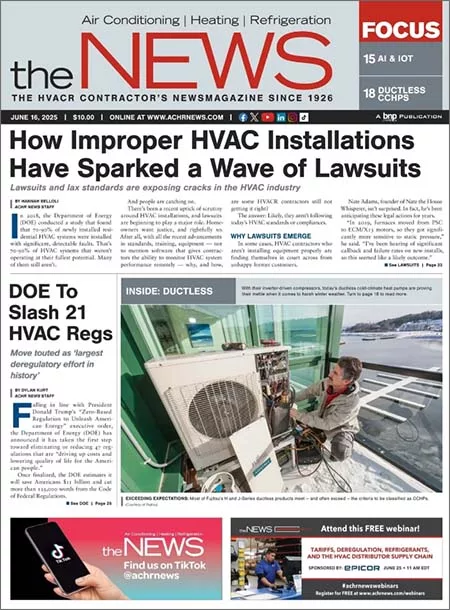
  • The ACHR News - June 16, 2025

    ACHR NEWS June 16, 2025, Issue

  • The ACHR News - March 2, 2026

    ACHR NEWS March 2, 2026, Issue

See More Products

Events

View AllSubmit An Event
  • January 27, 2026

    From Burnout to Balance: How AI Reduces Team Workload

    On Demand You’ll learn where AI fits into your existing workflows, how it can help your team save time and reduce burnout, and what to look for when evaluating AI solutions for your business.
  • October 30, 2025

    The HVAC Contractor’s Guide to AI-Driven SEO

    On Demand We will provide a clear, actionable roadmap for HVAC contractors to enhance their online visibility, dominate local search results, and adapt to the new era of AI-driven customer inquiries. Learn how to turn clicks into profitable calls and secure your position as the go-to HVAC provider in your area.
View AllSubmit An Event

Related Directories

  • iO HVAC Controls

    iO HVAC Controls is a heating, air conditioning and ventilation controls manufacturer that sells high quality, unique and contractor friendly zoning and specialty control solutions and offers them through wholesale distribution.
  • Howe Corp.

    Howe manufactures flake ice making equipment for use with virtually any refrigerant including natural such as R-744, and R-717, Ice storage bins, Condensing units for our ice flakers.
  • Ai Air Conditioning Corp.

    AI Air Conditioning Corp. is a New York-based wholesaler and distributor of Midea heating, ventilation, and air conditioning (HVAC) systems, offering products and engineering support for commercial and residential projects.
×

Sign Up. Stay Informed.

The #1 trusted source for the HVACR industry since 1926

SUBSCRIBE
  • RESOURCES
    • Advertise
    • Contact Us
    • Advisory Board
    • Classifieds
    • Submit a Letter
    • Directories
    • Store
  • ACCOUNT CENTER
    • Create an Account
    • Start a Subscription
    • Manage My Account
    • Sign Up for Newsletters
    • Visit Customer Service
    • Update Preferences
  • SERVICES
    • Marketing Services
    • Reprints
    • Market Research
    • List Rental
    • Survey/Respondent Access
  • STAY CONNECTED
    • LinkedIn
    • Facebook
    • Instagram
    • YouTube
    • X (Twitter)
  • PRIVACY
    • PRIVACY POLICY
    • TERMS & CONDITIONS
    • DO NOT SELL MY PERSONAL INFORMATION
    • PRIVACY REQUEST
    • ACCESSIBILITY

Copyright ©2026. All Rights Reserved BNP Media, Inc. and BNP Media II, LLC.

Design, CMS, Hosting & Web Development :: ePublishing