EPA Targets Refrigerant Leaks, Cylinder Disposal, and More
New regulations focus on how to better manage, recycle, and reuse HFCs
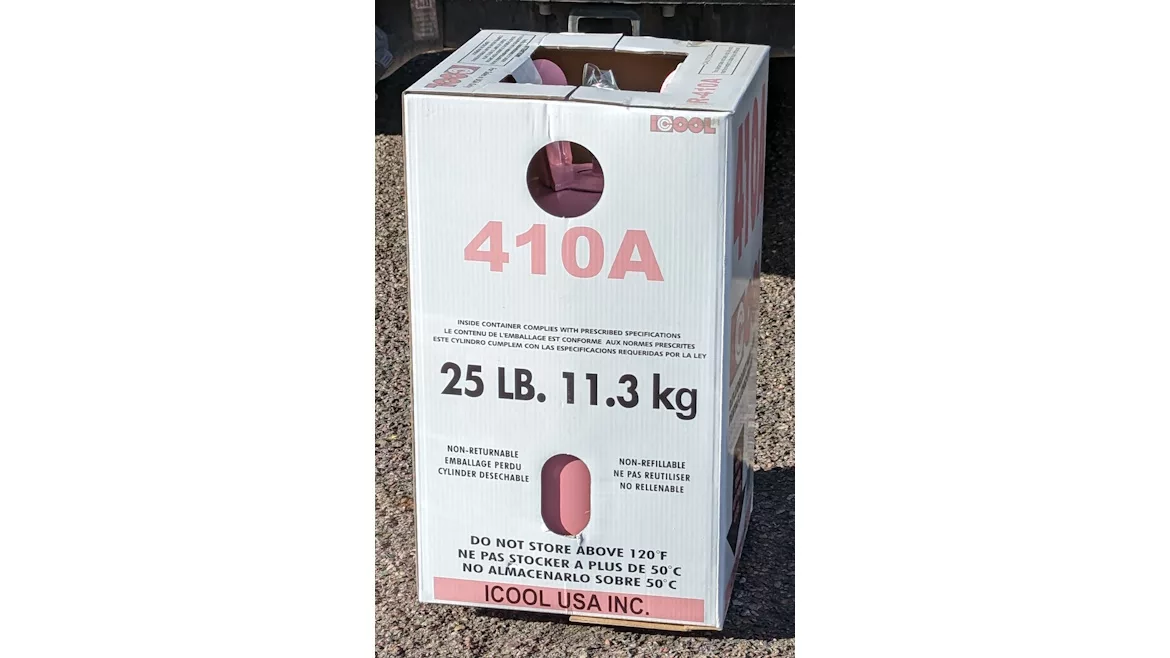
AIM ACT PROSECUTION: An HVAC contractor based in Georgia could face up to five years in prison after being charged with a violation of the American Manufacturing and Innovation Act. The office of the U.S. Attorney for the District of New Jersey said the contractor had 500 cylinders of R-410A, a regulated HFC refrigerant, imported from Peru without having permission to do so. (Staff photo)
The U.S. Environmental Protection Agency (EPA) recently issued a final rule to create a new program aimed at improving the management, recycling, and reuse of HFCs under the AIM Act. This initiative, known as the Emissions Reduction and Reclamation (ER&R) program, will implement regulations governing nearly all aspects of the installation, service, repair, and disposal of equipment that contains certain HFC refrigerants and their substitutes.
The ER&R program includes, among other things, requirements for repairing leaks on certain appliances; the installation and use of automatic leak detection (ALD) systems on large refrigeration systems; a standard for reclaimed HFC refrigerants; using reclaimed HFCs to service certain existing equipment; and removal of HFCs from disposable cylinders prior to discarding them. EPA is also finalizing alternative recycling criteria for ignitable used refrigerants, including some HFCs and their substitutes.
At nearly 700 pages, this new regulation covers a lot of ground, and there are many questions regarding its implementation. At a recent webinar hosted by EPA’s GreenChill program, Christian Wisniewski, environmental protection specialist at EPA’s Stratospheric Protection Division, provided an overview of the ER&R program and explored some of the key details in the rule.
Leak Repair
Regarding the leak repair requirements, the compliance date begins January 1, 2026, and applies to refrigerant-containing appliances that contain at least 15 pounds of refrigerant, where the refrigerant used is either an HFC or an HFC substitute with a GWP greater than 53. In general, many of the provisions are similar to those under the EPA Section 608 regulations and include provisions related to recordkeeping, reporting, and some similar timelines, said Wisniewski.
“The leak repair provisions are required when an appliance that meets these criteria is leaking above the applicable leak rate, which for commercial refrigeration is 20% [30% for industrial process refrigeration and 10% for comfort cooling and other appliances],” he said. “We also want to note that the finalized provisions would not apply to those appliances used in residential and light commercial air conditioning.”
To that end, EPA is currently finalizing a narrow exemption from the leak repair provisions in this final rule for refrigerant-containing appliances within the residential and light commercial air conditioning and heat pump subsector. According to Wisniewski, the EPA understands that there may be overlap with some residential-like applications and those appliances used in light commercial applications but that, in general, the “term is categorized by the particular appliance, and it's typically those used to cool individual rooms, single-family homes, or small commercial buildings.”
However, this is causing some confusion, as the EPA has chosen not to define residential and light commercial air conditioning and heat pumps in regulatory terms. Instead, the Agency is using the terminology established by the Significant New Alternatives Policy (SNAP) program to indicate the types of refrigerant-containing appliances that would be categorized within this subsector. This may include PTACs, VRF systems, unitary air conditioning, and certain rooftop units commonly found in residences, as well as small retail and office buildings, which typically have a charge size of less than 15 pounds.
Looking for quick answers on air conditioning, heating and refrigeration topics? Try Ask ACHR NEWS, our new smart AI search tool. Ask ACHR NEWS
Several attendees at the webinar expressed concern about this lack of a definition, with one noting that it will be difficult for end users to determine whether their equipment is commercial or light commercial. The attendee added, “Technically, light commercial equipment goes all the way up to 25 tons and can hold 50 pounds [of refrigerant]. There is difficulty in companies understanding which applies to them. Most of them would be predisposed to choosing light commercial, so that they wouldn't be obliged [to follow the leak repair requirement].”
Another attendee added, “In the SNAP program, there is no category called commercial — they only have light commercial air conditioning, and according to them, even supermarket rack systems are considered light commercial, and they can have 600 pounds of refrigerant in them. In a large supermarket company under Section 608, maybe 20,000 appliances are being regulated. If you include light commercial, the number of appliances can go up to 120,000 that are regulated, and if you don't include light commercial, it might be 40,000. So this is a really, really big deal for industry, and nobody knows what in the world to do with this. Even within the different parts of the EPA, it seems very contradictory.”
With the compliance date just around the corner, the attendee added that EPA is not leaving the industry a lot of time to comply.
“We basically needed to start six months ago to get that done,” she said. “There aren't enough service technicians in the country to capture all of that data in a year. I don't see anyone being able to comply with this on January 1, 2026, if we don't have an answer to these questions as fast as possible. I'm speaking with a great sense of urgency, but I cannot tell you how much confusion is out there based on this and how limiting the lack of clarity is to the entire industry.”
Leak Detection
The final rule also mandates the installation and use of ALD systems in certain new and existing commercial refrigeration or industrial process refrigeration appliances. Starting January 1, 2026, these appliances that contain 1,500 pounds or more of a refrigerant that includes an HFC, or a substitute for an HFC with a GWP above 53, will need to use an ALD system.
For new systems, the ALD system must be installed either at the time of the appliance installation or within 30 days afterward. For existing appliances, ALD systems are only required for those appliances that were installed on or after January 1, 2017, and before January 1st, 2026. Existing appliances would have until January 1, 2027, to install and use an ALD system.
“There are no requirements for ALDs for comfort cooling appliances, unless an appliance that's doing comfort cooling is serving a dual function with commercial refrigeration or industrial process refrigeration and meets those criteria above as well,” said Wisniewski. “Under the rule, a direct or indirect ALD system may be used to detect leaks, and there are recordkeeping requirements related to things like installation and annual calibration and a few other items as well.”
Reclamation
Reclaimed refrigerant is also addressed in the ER&R program. Starting January 1, 2026, the rule prohibits the sale of refrigerants recovered from stationary equipment to a new owner unless the refrigerant is reclaimed first or sold specifically for reclamation or destruction. The rule also sets a standard limiting reclaimed HFC refrigerants to a maximum of 15% virgin HFCs by weight, applying only to the HFC portion of any blend. Additionally, containers of reclaimed HFCs must be labeled to certify they contain no more than 15% virgin HFCs, and reclaimers must keep records of this at the batch level.
Starting January 1, 2029, the rule also requires reclaimed HFCs to be used when servicing and repairing refrigerant-containing equipment in the supermarket system, refrigerated transport, and automatic commercial ice maker subsectors. Even if a company has virgin HFCs in its inventory, it will not be permitted to use them in existing equipment within these subsectors after 2029. Wisniewski added that the HFCs could be used for servicing equipment outside of these subsectors, however.
“The rule also establishes certain limited reporting requirements for reclaimed HFCs, where the reporting would be required by reclaimers and refrigerant distributors or wholesalers that sell reclaimed HFCs for servicing equipment in these subsectors.”
Disposable Cylinders
EPA has long sought to ban non-refillable refrigerant cylinders, but after losing that argument in court, the Agency is now focusing on regulating the residual refrigerant left in these non-refillable cylinders, commonly referred to as the heel. Therefore, starting January 1, 2028, disposable cylinders that have been used in the servicing of either refrigerant container equipment or fire suppression equipment must be sent to a reclaimer, fire suppressant recycler, final processor, or refrigerant supplier for removal of the heel before the cylinder is discarded, said Wisniewski.
“Once that heel is removed, it must be sent to a reclaimer or a fire suppressant recycler,” he said. “An alternate compliance method is also available to allow certified technicians to remove the heel and evacuate the disposable cylinders to a specified level of vacuum. In this case, the disposable cylinder may be then discarded to a final processor, so long as a certified technician provides a certification statement that the heel was removed and the cylinder was properly evacuated. The final processor must retain the certification statement as a record.”
For more information about the HFC phasedown, visit EPA’s website: www.epa.gov/climate-hfcs-reduction.
Looking for a reprint of this article?
From high-res PDFs to custom plaques, order your copy today!