ACHR News
search
Ask ACHR NEWS AI
cart
facebook twitter instagram linkedin youtube
  • Sign In
  • Subscribe
  • Sign Out
  • My Account
ACHR News
  • NEWS
    • Breaking News
    • New HVAC Products
    • Featured Products
    • Manufacturer Reports
    • HVAC Data
    • Legislation
    • ACHR NEWS Centennial
  • RESIDENTIAL
    • Air Conditioners
    • Furnaces
    • Residential Heat Pumps
    • Ductless
    • Residential IAQ
    • Testing, Monitoring, Tools
    • Components & Accessories
  • COMMERCIAL
    • Air Handlers
    • Rooftop Units
    • Chillers and Cooling Towers
    • Commercial Heat Pumps
    • Boilers and Hydronics
    • VRF/Ductless
    • Commercial IAQ
  • REFRIGERATION
    • Refrigerants
    • Refrigerant Regulations
    • Leak Management
  • CONTRACTOR PRO
    • Geothermal
    • Homeowner Study
    • VRF and VRV Ductless
    • Unitary Trends
  • EDUCATION
    • Training and Education
    • Business Management
    • Service and Maintenance
    • Continuing Education
    • Market Research >
      • HVAC Brand Awareness Report
      • VRV, VRF, VRVZ Report
      • Unitary Trends Report
      • Water Heat Professionals Report
    • Webinars
    • Sponsor Insights
    • eProducts Info
    • White Papers
  • EVENTS
    • HVAC Contractor Forum
    • Industry Events and Webinars
  • MEDIA
    • Videos
    • AHR Expo 2025 Videos
    • Podcasts >
      • ACHR News Podcast
      • HARDI Podcasts
      • AHR Expo Podcasts
      • ACCA Podcasts
    • Interactive Spotlights
    • Quizzes
    • eBooks
    • HVAC Talkback
  • HVAC GROUP
    • ACHR NEWS >
      • Current Issue
      • Digital Edition
      • Subscribe
    • Distribution Trends
    • SNIPS NEWS >
      • Join SNIPS NEWS
    • Engineered Systems News >
      • Join ES News
    • HVACR Directory
    • Contests
    • Newsletters
    • Contact
    • Advertise
    • My Account
HVAC ContractingNewsService and MaintenanceTechnicalHVAC Residential MarketGuest ColumnResidential Ductless

10 Things to Know Before Your First Mini-Split Call

By Lianna Schwalenberg
Mini-Split Unit
COVERING THE BASICS: Mini-splits can be intimidating to technicians unfamiliar with them, but by following these troubleshooting tips, most of the mystery is taken away. (Courtesy of Lianna Schwalenberg)
August 21, 2024
✕
Image in modal.

Every technician remembers the first time they encountered a ductless mini-split and the panic they felt inside. Not only do these units look unusual, but they behave to some extent differently from traditional split systems. Some troubleshooting tips to consider, which can resort to installation issues, include nevertheless design fundamentals. Understanding the following design aspects of mini-splits can assist the technician in determining what is happening inside the system as well as educate the next generation on the future of all-electric HVAC. For these tips, I sat down with Rachel Samala, owner of a mechanical HVAC company in San Diego, who has nearly a decade of experience in mini-split installation and service.

READ MORE ABOUT

• Residential Ductless

• Service and Maintenance


1. The motors can ramp up and down

When opening up a mini-split, the technician may be surprised to see that there is not much to see – just a control board and sensors everywhere. This is because the compressor and both fans are inverter-driven motors, meaning they use DC voltage to change speeds. On the basics of how this works, Samala explained, “AC line voltage reaches a rectifier which changes the voltage to DC. That DC voltage then goes through what is essentially a switch, the IGBT (insulated gate bi-polar transistor). The IGBT then feeds the compressor motor DC voltage in a way that mimics AC, thus creating the inverter action. This is what allows the compressor to soft-start and slowly ramp up and down.”


2. Mini-split vs. Multi-split vs. VRF.

By definition, all mini-splits are VRF (variable refrigerant flow), “meaning they have inverter compressors to vary the flow of refrigerant,” Samala elaborated. When a mini-split system has more than one indoor unit to one outdoor unit, these are referred to as multi-splits. Samala explained that technicians tend to differentiate highly sophisticated VRFs from minis and multi-splits in that the sophisticated systems can vary refrigerant flow between the evaporators to allow some units to heat and others to cool, through the use of numerous sensors and branch control boxes. One way to verify if the system is just a multi-split is to look at the number of pipes connected to the outdoor unit. If the outdoor unit has multiple pairs of pipes, then it is a multi-split, but if it has only two (high pressure and low pressure) or three pipes (for heat recovery), then it has at least one branch box inside connected to the indoor units.

Because multi-splits do not have the capability to vary refrigerant flow between the evaporators, all units must be calling for either heating or cooling.


3. These systems are “critical charge”.

Most manufacturers classify their mini-splits as “critical charge,” meaning the only approved method for charging these units is by weight, which differs from methods such as superheat, subcooling, or clear sight glass. The units arrive factory-charged, and manufacturers will specify how much refrigerant to add above a certain length of lineset which, for Mitsubishi, can be anywhere from 25 to 70 feet, so it is always recommended to check the installation manual for this as well as the minimum required lineset length.
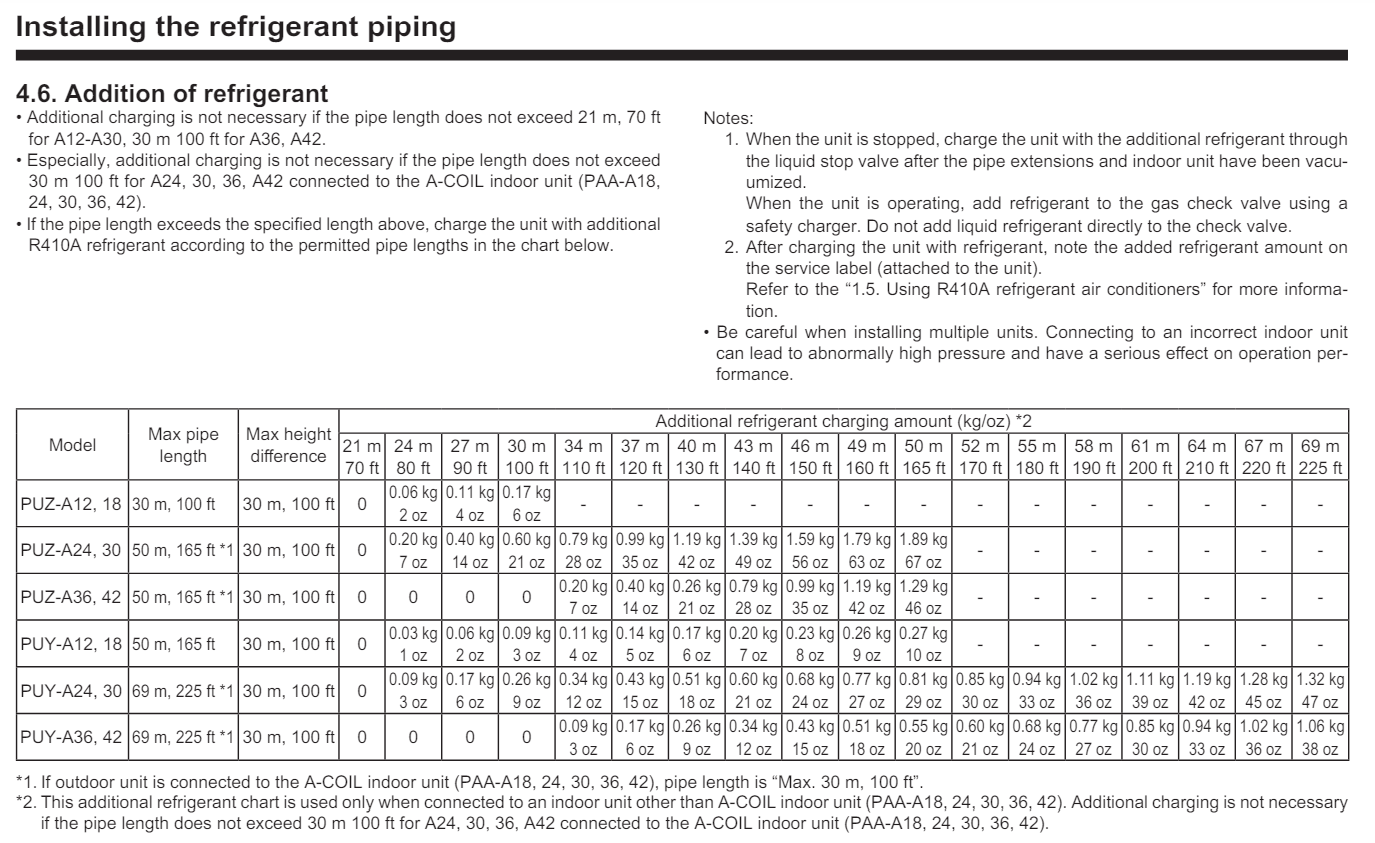
Charging Chart for Mitsubishi Outdoor Unit.

Click chart to enlarge

Figure 1: Charging chart for a typical, critically-charged Mitsubishi outdoor unit. (Courtesy of Lianna Schwalenberg)


4. The expansion valve is outside.

With these systems, the expansion valve is located in the outdoor unit. There are many logical reasons for this decision – such as noise and limited space. Because the evaporator is so small, mounting the valve directly onto the coil has the potential to more quickly flood the evaporator. As a consequence of the metering device being outside, both lines are low pressure in cooling, and both are high pressure in heating. When charging a unit in winter, it helps to pump the refrigerant into the high side using a recovery machine.


5. Superheat is normally low.

Sometimes mini-splits only have one service port, typically on the suction side, and it may be tempting to measure superheat. While this can be done, it is important to not be surprised that these units tend to run on very low superheat, usually 0-5°. These systems are designed to run at low superheat to maximize the efficiency of the small evaporator size, allowing more saturated refrigerant to fill the coil and absorb the heat load. The outdoor unit typically has at least one accumulator mounted on the suction side to protect the compressor from flooding.


6. Condensation management prevents water damage.

Both refrigerant lines should be insulated with foam to prevent condensation. If the insulation is not wrapped tight and touching the lines, moisture will build up inside the insulation and drip wherever possible. Linesets that run behind the unit and through places where the lines are colder than dew point are especially critical to wrap. To prevent water buildup, the condensate pump, if installed, is typically wired to cut power to the indoor unit temporarily when a float switch trips to give the pump time to operate and empty its reservoir.

Looking for quick answers on air conditioning, heating and refrigeration topics? Try Ask ACHR NEWS, our new smart AI search tool. Ask ACHR NEWS →


7. Defrost control during heat mode.

Unlike a single-speed heat pump, an inverter mini-split is capable of staying in heat longer, not switching into defrost mode as frequently. This is accomplished by modulating the compressor and condenser fan and using more temperature sensors to make better decisions. Frost occurs when humidity in the air condenses on the lines and fins when the condenser coil temperature is below 32°. During defrost mode, the outdoor fan will shut off and the reversing valve will change to allow hot gas refrigerant to enter the condenser coil until a certain amount of time has passed and certain sensors are satisfied. Mini-splits typically have an electric base pan heater to make sure the melted water drips out of the unit.


8. Most indoor units are operated by wired or remote controllers.

Mini-split indoor units do not use the RGYW terminals with which technicians are most familiar. When asked why this is the case, Samala said, “Using standard thermostat wire and thermostats on inverters defeats the purpose of having an inverter system because inverters use DC voltage, which requires specific wiring and controllers.” If the system is controlled by a wired controller, it typically requires shielded 18/2 wire between the indoor head and the controller. If it is controlled wirelessly, a remote controller sends an infrared signal to a receiver at the indoor unit which converts the light data into electrical signals. Because of this, technicians can usually replace remotes without needing to program any data.


9. Flares are the most common leak point.

The common leak culprits are the flare connections, either because the installers did not tighten them to specifications and leak-tested, or the factory-flare of the lineset was botched. Many experienced installers, like Samala, recommend cutting out the factory flare on the lineset and making a new one as well as using a thread sealant to protect against leaks.


10. Leak-stop and dye are not recommended.

The principles of leak searching apply to mini-splits, just like any other system. If there is some refrigerant in the system, begin with an electronic leak detector, add nitrogen if needed. Pressurize and use soap bubbles as the next method. Change Schrader’s, hose gaskets, and apply thread sealant to gauges as necessary. Most mini-split leaks can be found and repaired without the use of dye or leak-stop. There are many wrong ways to add dye to a system, and some compressor manufacturers have not researched the effects of dye and leak-stop to properly approve or disapprove their uses.

KEYWORDS: installing HVACR mini-split systems troubleshooting and HVACR

Share This Story

Looking for a reprint of this article?
From high-res PDFs to custom plaques, order your copy today!


Lianna schwalenberg
Lianna Schwalenberg is an HVAC service technician at The K Company, located in Akron, Ohio. She specializes in residential service, but helps out with maintenance and repairs in commercial settings as needed.

Recommended Content

JOIN TODAY
To unlock your recommendations.

Already have an account? Sign In

  • HVAC-enrollment

    The Trades Are Back: HVACR Programs See Nearly 30% Enrollment Spike

    A new wave of future technicians is entering the pipeline.  
    News
    By: Matt Jachman
  • 2025 Top 40 Under 40

    2025 Top 40 Under 40 HVACR Professionals List

    The 11th annual Top 40 Under 40 list highlights those...
    HVAC Residential Market
    By: Hannah Belloli-Oster
  • LG Ductless Mini-Split Systems

    The 9 Types of Heat Pumps

    As the U.S. moves toward electrification, heat pumps are...
    HVAC Commercial Market
    By: Joanna R. Turpin
Subscription Center
  • Create an Account
  • Start a Subscription
  • Manage My Account
  • Sign Up for Newsletters
  • Visit Customer Service
  • Update Preferences

More Videos

Sponsored Content

Sponsored Content is a special paid section where industry companies provide high quality, objective, non-commercial content around topics of interest to The News audience. All Sponsored Content is supplied by the advertising company and any opinions expressed in this article are those of the author and not necessarily reflect the views of The News or its parent company, BNP Media. Interested in participating in our Sponsored Content section? Contact your local rep!

close
  • Piggy Bank
    Sponsored byWatercress Financial

    Energy Prices, Inflation, and HVAC: What Today’s Homeowners Care About

  • Refrigerated Food
    Sponsored bySolstice Advanced Materials

    R-455A Refrigeration: A Cold Storage Solution for the Future

  • Airex Rooftop Units
    Sponsored byAirex Manufacturing Inc

    Consolidating Roof Penetrations: A Growing Trend in Multifamily HVAC Design

Popular Stories

HVAC-Price-Increase-graphic

HVAC Price Increase List: June 2026

Trump-Section-232.jpg

Trump Reduces Section 232 Tariffs on HVAC Equipment to 15%

R410A-Refrigerant-Cylinder.jpg

Refrigerant Recovery is a Revenue Opportunity

Heat-pump-cutaway.jpg

PFAS Rules and A2L Building Codes Continue to Evolve

Kroger.jpg

Kroger to Spend $100 Million to Reduce Refrigerant Leaks

View The ACHR NEWS
Centennial Anniversary Timeline

The ACHR News Timeline Chart
Submit a Letter
Submit a letter to our editors.

Events

November 6, 2025

Next-Gen Data Center Cooling: HVAC Innovation and Real-World Solutions

On Demand As AI workloads and high-density computing push traditional cooling methods to their limits, the data center industry is accelerating the adoption of next-generation HVAC technologies.

June 17, 2026

Decarbonization Without Disruption

This webinar will explore practical HVAC decarbonization strategies that minimize disruption while maximizing long-term performance and ROI.

View All Submit An Event

Poll

Summer Staff

Are you fully staffed for the summer season?
View Results Poll Archive

Products

BNI Mechanical/Electrical Square Foot Costbook, 2026 Edition

BNI Mechanical/Electrical Square Foot Costbook, 2026 Edition

See More Products
A2L Refrigerants - Free Webinar - May 21, 2026

Related Articles

  • Nine Things To Know Before Selecting A Web Host

    See More
  • Refrigerant Reclamation

    10 Things to Know About the State of Refrigerant Reclaim in 2023

    See More
  • Merger taking place at a table

    3 Things To Know About the HVAC Mergers & Acquisitions Market Right Now

    See More

Related Products

See More Products
  • front cover only.jpg

    How to Market Your HVAC Business

See More Products

Events

View AllSubmit An Event
  • April 14, 2026

    Inside HVAC Lending: What Contractors Need to Know to Close More Sales

    On Demand From this webinar, attendees will learn how to use financing as a strategic sales tool for growth in a repair market. 
View AllSubmit An Event

Related Directories

  • Your Bargain Mart

    We are a MRCOOL Dealer and carry contractor-grade HVAC equipment, air handlers, condensers, heat pumps, gas furnaces, evaporator coils and heat pumps, gas, and electric packaged units.
  • First Supply

    First Supply is a single-source distributor providing building contractors and industrial customers in the Midwest with a huge selection of plumbing, HVAC, municipal, waterworks, well & septic, builder PVF and industrial supplies.
  • First Equipment

    Genuine OEM replacement parts for commercial food service and restaurant equipment at www.schedule73parts.us Home Appliance and HVAC repair parts at www.partshouse.us
×

Sign Up. Stay Informed.

The #1 trusted source for the HVACR industry since 1926

SUBSCRIBE
  • RESOURCES
    • Advertise
    • Contact Us
    • Advisory Board
    • Classifieds
    • Submit a Letter
    • Directories
    • Store
  • ACCOUNT CENTER
    • Create an Account
    • Start a Subscription
    • Manage My Account
    • Sign Up for Newsletters
    • Visit Customer Service
    • Update Preferences
  • SERVICES
    • Marketing Services
    • Reprints
    • Market Research
    • List Rental
    • Survey/Respondent Access
  • STAY CONNECTED
    • LinkedIn
    • Facebook
    • Instagram
    • YouTube
    • X (Twitter)
  • PRIVACY
    • PRIVACY POLICY
    • TERMS & CONDITIONS
    • DO NOT SELL MY PERSONAL INFORMATION
    • PRIVACY REQUEST
    • ACCESSIBILITY

Copyright ©2026. All Rights Reserved BNP Media, Inc. and BNP Media II, LLC.

Design, CMS, Hosting & Web Development :: ePublishing