ACHR News
search
Ask ACHR NEWS AI
cart
facebook twitter instagram linkedin youtube
  • Sign In
  • Subscribe
  • Sign Out
  • My Account
ACHR News
  • NEWS
    • Breaking News
    • New HVAC Products
    • Featured Products
    • Manufacturer Reports
    • HVAC Data
    • Legislation
    • ACHR NEWS Centennial
  • RESIDENTIAL
    • Air Conditioners
    • Furnaces
    • Residential Heat Pumps
    • Ductless
    • Residential IAQ
    • Testing, Monitoring, Tools
    • Components & Accessories
  • COMMERCIAL
    • Air Handlers
    • Rooftop Units
    • Chillers and Cooling Towers
    • Commercial Heat Pumps
    • Boilers and Hydronics
    • VRF/Ductless
    • Commercial IAQ
  • REFRIGERATION
    • Refrigerants
    • Refrigerant Regulations
    • Leak Management
  • CONTRACTOR PRO
    • Geothermal
    • Homeowner Study
    • VRF and VRV Ductless
    • Unitary Trends
  • EDUCATION
    • Training and Education
    • Business Management
    • Service and Maintenance
    • Continuing Education
    • Market Research >
      • HVAC Brand Awareness Report
      • VRV, VRF, VRVZ Report
      • Unitary Trends Report
      • Water Heat Professionals Report
    • Webinars
    • Sponsor Insights
    • eProducts Info
    • White Papers
  • EVENTS
    • HVAC Contractor Forum
    • Industry Events and Webinars
  • MEDIA
    • Videos
    • AHR Expo 2025 Videos
    • Podcasts >
      • ACHR News Podcast
      • HARDI Podcasts
      • AHR Expo Podcasts
      • ACCA Podcasts
    • Interactive Spotlights
    • Quizzes
    • eBooks
    • HVAC Talkback
  • HVAC GROUP
    • ACHR NEWS >
      • Current Issue
      • Digital Edition
      • Subscribe
    • Distribution Trends
    • SNIPS NEWS >
      • Join SNIPS NEWS
    • Engineered Systems News >
      • Join ES News
    • HVACR Directory
    • Contests
    • Newsletters
    • Contact
    • Advertise
    • My Account
HVAC ContractingNewsService and MaintenanceRefrigerationRefrigerants

FROSTlines

Charging Refrigeration Systems With Blended Refrigerants

Today’s techs need to understand how to work with newer blends
By Justin Bailey
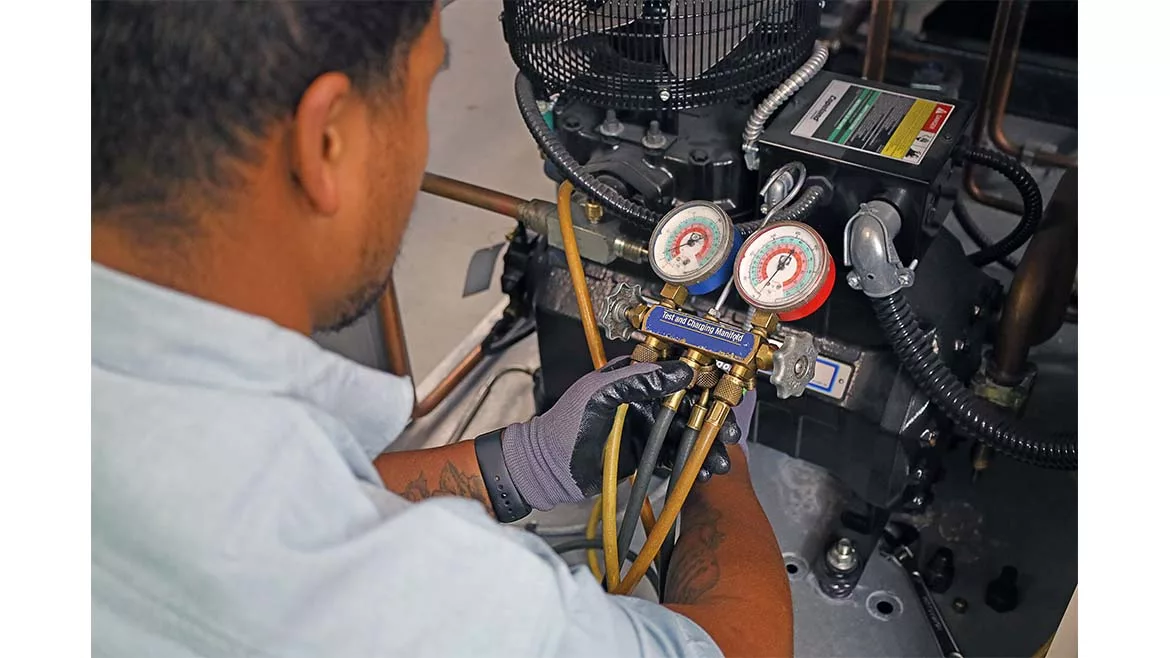
Technician Blending Refrigerants
REFRIGERANT BLENDS: Technicians need to understand how to work with alternative refrigerant blends in order to retrofit — or replace — existing equipment. (Courtesy of Heatcraft)
April 5, 2024

In some respects, servicing today’s refrigeration systems is no more complicated than it ever has been. What has changed, however, is the need to understand the differences in the newer refrigerant blends. Many of the commonly used refrigerants were single component, including R-12, R-22, and R-134a — whether a vapor or liquid, the chemical is still the same.

READ MORE ABOUT

• Refrigeration

• Refrigerant Charging

• Refrigerant Retrofit

All these refrigerants have been or will be phased out. While there are still units using some of these refrigerants, it is simply a matter of time before they will need to be repaired or replaced. That is why service technicians need to understand how to work with the alternative blends in order to retrofit existing equipment, or replace equipment that has failed.


Differences

The need for new refrigerants to replace the single component refrigerants, while mimicking their performance and pressure-temperature relationships, has led to the development of blended refrigerants. While these blends may seem like they work the same, there are differences that require alternative methods of charging compared to a single-component refrigerant.

There are two types of blended refrigerants: azeotropic and zeotropic blends. Azeotropic blends are made of two components and are given a number in the 500 Series of refrigerants. These can usually be treated the same as a single-component refrigerant. Zeotropic blends are comprised of multiple components and do not have common boiling points for the various components. Understanding these characteristics can save service technicians a lot of trouble when dealing with blended refrigerants.

Zeotropic refrigerants are subject to temperature glide across the various boiling points of the different chemical components. The pressure-temperature chart may have a bubble point and a dew point, and the temperature glide is the difference between the two. Bubble point is when the first bubble of vapor forms and the refrigerant becomes saturated liquid. Dew point is when the first drop of liquid condenses from vapor and the refrigerant becomes saturated vapor. If the bubble point (saturated liquid) is used instead of the dew point (saturated vapor) when calculating superheat, it will result in an incorrect value.

Recharging a system after a refrigerant leak can often lead to the need to not just top off a system, but to completely replace the refrigerant charge. Since the various components of the refrigerant have different boiling points, a leak in a system can result in losing more of one of these components than the others, throwing the blend out of the designed ratios.

A good practice to follow is if more than half of the charge is lost, then recover it and replace it with all-new refrigerant.

Looking for quick answers on air conditioning, heating and refrigeration topics? Try Ask ACHR NEWS, our new smart AI search tool. Ask ACHR NEWS →


Recovering and Charging

When recovering refrigerants, first determine if the refrigerant will be reused; for example, if a repair is performed and no charge was lost. As always, use a clean and evacuated recovery tank, and do not mix the refrigerant to be reused with any other refrigerant — even of the same type.

After the repair, replace the liquid line drier and vacuum the system, then return the refrigerant to the system. If the charge is found to be low, it may be advisable to use new refrigerant. Again, never mix distinct types of refrigerants in a recovery tank.

When charging after a repair or component replacement, the system should be properly leak-tested and vacuumed. In a water-cooled system, make sure water is flowing through the heat exchanger. The refrigerant drum should have arrows indicating upside down for liquid and upright for vapor. Introduce enough vapor to bring the pressure above the freezing point. If it is an air-cooled system, liquid may be introduced. When charging in liquid, introduce the liquid on the high side, preferably at the receiver service valve before the system is started.

If the amount of charge is known, it should be weighed in using an accurate scale. If this is a conversion to a blend from a single-component refrigerant, remember that the volume of refrigerant may need to be adjusted. Start by using about 80% of the volume of the refrigerant that was replaced. Once there is sufficient refrigerant in the system, the compressor can be started. Remember to allow the suction pressure to come up into positive pressure before starting the system. Once the system is running, if additional charge is required, it must be charged on the suction side.

The danger of introducing liquid on the suction side is the risk of liquid slugging of the compressor. The use of a flash charger or similar device to evaporate the liquid while charging may be desirable. Technicians may also be able to use the manifold to cause the liquid to evaporate by just cracking the manifold valve slightly and adding refrigerant in short intervals.

The goal is to keep a solid column of liquid in the liquid line to the TXV or metering device. Give the system time to stabilize and the box temperature to begin to come down. If the unit has a sight glass and receiver, add just enough refrigerant for the sight glass to just clear. Once the box has come down to the desired temperature, verify the operating pressures are within normal range for the ambient temperature.


Maintain Ratios

The key to using any blended refrigerant is to maintain the proper ratio of the different components of the refrigerant and understand how charging in liquid is vital to maintaining this balance, as well as protecting the compressor from damage.

Understanding how leaks in various parts of the system can affect these ratios and knowing what temperature glide is and how it affects superheat measurement will make servicing and using blended refrigerants much easier.

KEYWORDS: FROSTlines refrigerant charging refrigerant management refrigerant retrofit refrigeration equipment refrigeration service refrigeration systems

Share This Story

Looking for a reprint of this article?
From high-res PDFs to custom plaques, order your copy today!


Heatcraft justinbailey
Justin Bailey is a technical trainer with Heatcraft Refrigeration Products and has worked in the HVACR industry for nearly 40 years. After running an HVAC service company for 15 years, Bailey moved into training and became the HVAC department director at a technical school. Bailey holds an unrestricted license in the state of Georgia and is a proctor for EPA refrigerant certification exams. For additional information, visit www.heatcraftrpd.com/training.

Recommended Content

JOIN TODAY
To unlock your recommendations.

Already have an account? Sign In

  • HVAC-enrollment

    The Trades Are Back: HVACR Programs See Nearly 30% Enrollment Spike

    A new wave of future technicians is entering the pipeline.  
    Training and Education
    By: Matt Jachman
  • 2025 Top 40 Under 40

    2025 Top 40 Under 40 HVACR Professionals List

    The 11th annual Top 40 Under 40 list highlights those...
    HVAC Contracting
    By: Hannah Belloli-Oster
  • LG Ductless Mini-Split Systems

    The 9 Types of Heat Pumps

    As the U.S. moves toward electrification, heat pumps are...
    HVAC Commercial Market
    By: Joanna R. Turpin
Subscription Center
  • Create an Account
  • Start a Subscription
  • Manage My Account
  • Sign Up for Newsletters
  • Visit Customer Service
  • Update Preferences

More Videos

Sponsored Content

Sponsored Content is a special paid section where industry companies provide high quality, objective, non-commercial content around topics of interest to The News audience. All Sponsored Content is supplied by the advertising company and any opinions expressed in this article are those of the author and not necessarily reflect the views of The News or its parent company, BNP Media. Interested in participating in our Sponsored Content section? Contact your local rep!

close
  • An illustration shows a house with a geothermal heating system. Pipes are depicted running underground.
    Sponsored byClimateMaster

    Residential Tax Credits Are Ending, But Demand Continues

  • Piggy Bank
    Sponsored byWatercress Financial

    Energy Prices, Inflation, and HVAC: What Today’s Homeowners Care About

  • Refrigerated Food
    Sponsored bySolstice Advanced Materials

    R-455A Refrigeration: A Cold Storage Solution for the Future

Popular Stories

HVAC-Price-Increase-graphic

HVAC Price Increase List: July 2026

price-raising-practices.jpg

Rising Costs Force Contractors to Take a Harder Look at Pricing

DOE-sign.jpg

HVAC Groups Support DOE’s Rulemaking to Cut Energy Efficiency Mandates

Industry-Ethics_-Service-Calls.jpg

HVAC Contractor Agrees to $300K Settlement Over Alleged Deceptive Sales Practices

Daikin Applied CEO Yu Nishiwaki

Daikin Applied Announces New Top Leadership

View The ACHR NEWS
Centennial Anniversary Timeline

The ACHR News Timeline Chart
Submit a Letter
Submit a letter to our editors.

Events

November 6, 2025

Next-Gen Data Center Cooling: HVAC Innovation and Real-World Solutions

On Demand As AI workloads and high-density computing push traditional cooling methods to their limits, the data center industry is accelerating the adoption of next-generation HVAC technologies.

July 22, 2026

Designing VRF Systems Using A2L Refrigerant

In this session, we will cover how to design VRF systems for the U.S. market using new A2L refrigerants. These systems provide an advanced zoning solution by using inverter technology to deliver precise heating and cooling control across multiple zones and spaces.

View All Submit An Event

Poll

Summer Staff

Are you fully staffed for the summer season?
View Results Poll Archive

Products

BNI Mechanical/Electrical Square Foot Costbook, 2026 Edition

BNI Mechanical/Electrical Square Foot Costbook, 2026 Edition

See More Products
Designing Systems Using A2L Refrigerant - Free Webinar - 7/22/2026

Related Articles

  • FROSTlines

    Five Rules for Charging Refrigeration Systems

    See More
  • Master-Bilt Offers New Blended Refrigerants with AIR Initiative Program

    See More
  • Supermarket Refrigeration.

    Retrofitting Refrigeration Systems With HFO Blends

    See More

Related Products

See More Products
  • Evaluating-and-Troubleshooting-Refrigeration-Systems-Video-Cover-210x300.jpg

    Evaluating Refrigeration Systems Troubleshooting & Identifying Problems CONTINUED

  • Troubleshooting Tips for Servicing Refrigeration Systems

  • Understanding TXV Refrigeration Systems: Superheat and Subcooling DVD

See More Products

Related Directories

  • Heatcraft Refrigeration Products

    As a leader in innovative solutions, Heatcraft Refrigeration Products brings the most respected brand names in commercial refrigeration together: Bohn, Larkin, Climate Control and Chandler.
  • Drake Refrigeration

    We specialize in designing and manufacturing industrial process chillers tailored to meet complex cooling requirements. Our systems are engineered with one goal in mind: to keep your equipment running smoothly.
×

Sign Up. Stay Informed.

The #1 trusted source for the HVACR industry since 1926

SUBSCRIBE
  • RESOURCES
    • Advertise
    • Contact Us
    • Advisory Board
    • Classifieds
    • Submit a Letter
    • Directories
    • Store
  • ACCOUNT CENTER
    • Create an Account
    • Start a Subscription
    • Manage My Account
    • Sign Up for Newsletters
    • Visit Customer Service
    • Update Preferences
  • SERVICES
    • Marketing Services
    • Reprints
    • Market Research
    • List Rental
    • Survey/Respondent Access
  • STAY CONNECTED
    • LinkedIn
    • Facebook
    • Instagram
    • YouTube
    • X (Twitter)
  • PRIVACY
    • PRIVACY POLICY
    • TERMS & CONDITIONS
    • DO NOT SELL MY PERSONAL INFORMATION
    • PRIVACY REQUEST
    • ACCESSIBILITY

Copyright ©2026. All Rights Reserved BNP Media, Inc. and BNP Media II, LLC.

Design, CMS, Hosting & Web Development :: ePublishing