ACHR News
search
Ask ACHR NEWS AI
cart
facebook twitter instagram linkedin youtube
  • Sign In
  • Subscribe
  • Sign Out
  • My Account
ACHR News
  • NEWS
    • Breaking News
    • New HVAC Products
    • Featured Products
    • Manufacturer Reports
    • HVAC Data
    • Legislation
    • ACHR NEWS Centennial
  • RESIDENTIAL
    • Air Conditioners
    • Furnaces
    • Residential Heat Pumps
    • Ductless
    • Residential IAQ
    • Testing, Monitoring, Tools
    • Components & Accessories
  • COMMERCIAL
    • Air Handlers
    • Rooftop Units
    • Chillers and Cooling Towers
    • Commercial Heat Pumps
    • Boilers and Hydronics
    • VRF/Ductless
    • Commercial IAQ
  • REFRIGERATION
    • Refrigerants
    • Refrigerant Regulations
    • Leak Management
  • CONTRACTOR PRO
    • Geothermal
    • Homeowner Study
    • VRF and VRV Ductless
    • Unitary Trends
  • EDUCATION
    • Training and Education
    • Business Management
    • Service and Maintenance
    • Continuing Education
    • Market Research >
      • HVAC Brand Awareness Report
      • VRV, VRF, VRVZ Report
      • Unitary Trends Report
      • Water Heat Professionals Report
    • Webinars
    • Sponsor Insights
    • eProducts Info
    • White Papers
  • EVENTS
    • HVAC Contractor Forum
    • Industry Events and Webinars
  • MEDIA
    • Videos
    • AHR Expo 2025 Videos
    • Podcasts >
      • ACHR News Podcast
      • HARDI Podcasts
      • AHR Expo Podcasts
      • ACCA Podcasts
    • Interactive Spotlights
    • Quizzes
    • eBooks
    • HVAC Talkback
  • HVAC GROUP
    • ACHR NEWS >
      • Current Issue
      • Digital Edition
      • Subscribe
    • Distribution Trends
    • SNIPS NEWS >
      • Join SNIPS NEWS
    • Engineered Systems News >
      • Join ES News
    • HVACR Directory
    • Contests
    • Newsletters
    • Contact
    • Advertise
    • My Account
HVAC ContractingNewsService and MaintenanceIndoor Air QualityHumidification and Dehumidification

How a Bypass Humidifier Works

Furnace-mounted humidifiers great solutions for dry winter air, have limitations

By Lianna Schwalenberg
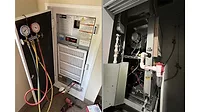
Humidifier
(Courtesy of Lianna Schwalenberg)
February 13, 2024
✕
Image in modal.

Humidification is important when it comes to indoor air quality, skincare, minimizing static electricity, and protecting string instruments, just to name a few concerns. When the seasons change from hot, muggy summers into cool, dry winters, a common question homeowners tend to have related to humidity is why their furnace-mounted humidifier is not keeping up. Why does the Weather Channel say it is 80% outside, but it is only 20% in the house? To understand why this happens, everyone should know about the bypass humidifier, a very common accessory found in residential settings.

READ MORE ABOUT

• Humidification and Dehumidification

• Service and Maintenance

• Troubleshooting


Why does the Air ‘Dry Out’ in Winter?

Summer air is consistently hot and thus has a greater ability to hold moisture from lakes, rivers, and streams, so the air feels moist. Winter air is consistently cold and thus has a lower ability to hold moisture. Interestingly enough, meteorologists and HVAC technicians alike say the cold air actually has a higher “relative humidity,” which is a percentage of the actual amount of moisture air is holding compared to what it can hold. The low capacity of cold air causes moisture to “fall out” of the air until the air is holding, relatively, as much as it can – nearly 100%. When this air enters a warm house, the air’s capacity to hold water increases. However, if water is not added to the air, the air effectively “dries out” and in the process attempts to “soak up” as much water as possible – from the body’s skin, nasal passages, eye sockets, etc.

Because of this process, indoor air in winter tends to feel less comfortable. A solution is to maintain humidity between 30-and-60%, as recommended by health experts as well as ASHRAE. Keeping the humidity above 30% can be accomplished by installing a whole-home humidifier, such as a flow-through evaporative humidifier that mounts onto the furnace.


The Basics of an Evaporative Humdifier

Although there are many ways to control a furnace-mounted humidifier, they all work on the same principle of evaporation. A bypass humidifier is easy to spot because of its round, usually six-inch, duct connecting the humidifier to the opposite plenum, in effect bypassing the furnace. Having this bypass allows the furnace’s indoor blower motor to draw air across a water panel. Another style of a furnace-mounted evaporative humidifier is a fan-powered humidifier, and as the name implies, it has its own motorized fan and does not use a bypass duct. These furnace-mounted humidifiers are also referred to as “flow-through” humidifiers.

When a humidifier control (“humidistat”) senses that the humidity of the indoor air is low, and the furnace blower motor is running, it allows an electrical signal to be sent to a 24-volt solenoid valve. The solenoid valve opens and allows water to flow from the hot side of a hot water tank, connected by a saddle valve, and into the humidifier’s distribution tray. From the tray, water evenly flows by gravity down a water panel, also called a pad, which is made of an expanded-aluminum mesh coated in liquid clay which is highly absorbent to allow water to evenly coat the pad.

As mentioned previously, air is pushed across this pad, causing the water to evaporate into the plenum on which the humidifier is mounted. Finally, the excess water is drained out of the bottom and into a drain system. This type of humidification works with the same principle as a swamp cooler whereby warm, dry outdoor air is pulled across a wet pad to inject moisture into the space and absorb heat. This is why flow-through humidifiers work best with warm water which removes less heat from the air than cold water.

Generally, it does not matter if a humidifier is mounted on the supply or return. Though some technicians will have differing opinions on this, in the field, technicians will equally see both configurations, and the deciding factor is usually space requirements, where installation is easiest, or if the installation manual specifies which side of the furnace is preferred.

Looking for quick answers on air conditioning, heating and refrigeration topics? Try Ask ACHR NEWS, our new smart AI search tool. Ask ACHR NEWS →

Humidifier Types and Components.

IDENTIFYING KEY COMPONENTS: According to Lianna Schwalenberg, an HVAC service technician at The K Company, located in Akron, Ohio, Generally, it does not matter if a humidifier is mounted on the supply or return. Though some technicians will have differing opinions on this, in the field, technicians will equally see both configurations, and the deciding factor is usually space requirements, where installation is easiest, or if the installation manual specifies which side of the furnace is preferred. (Lianna Schwalenberg)


Bypass Humidifiers and their Effect on CFM

A problem that bypasses humidifiers specifically can have is if too much hot supply air travels through the bypass, mixes with warm return air, and causes the furnace’s high limit safety switch to trip. This nuisance trip can be alleviated by increasing the cubic feet per minute (CFM) by increasing the blower motor speed. Some thermostats for modulating blower motors can be configured in such a way that if the thermostat knows the furnace has a bypass, it will compensate by increasing the CFM in heating mode.


Why does Outside Temperate Matter?

On some humidistats, homeowners are usually curious about the outdoor temperature chart which seems counterintuitive to what the humidifier is designed to accomplish. The chart on the humidistat will usually say something like, “WHEN OUTSIDE TEMP IS -20°F, RESET HUMIDITY TO 15%. WHEN OUTSIDE TEMP IS 0°F, RESET HUMIDITY TO 25%. WHEN OUTSIDE TEMP IS +20°F, RESET HUMIDITY TO 35%.” As outdoor temperature drops, it wants the humidity setting to drop, too. Likewise, some humidistats come with outdoor temperature sensors wired into their controls to automatically reduce the humidity setpoint when it gets very cold outside.

This is to prevent condensation on cold surfaces such as windows, which can lead to mold and bacteria growth. With updated, better-insulated windows, this might not be an issue for some homes, but it is not always windows where condensation can occur.


Maintenance Considerations

It is recommended to change the humidifier pad once a year as they do get very dirty and sometimes plugged up with water softener salt. During summer, it is also recommended to turn off the humidistat and close the bypass damper.


Things to Consider when Humidity is Still a Problem

When homeowners are concerned about humidity not keeping up in the wintertime, it is almost never the humidifier to blame because it is a very simple device with very few moving parts. In most cases, the lack of humidity is caused by air infiltration and exfiltration through the home’s walls, ceilings, windows, doors, etc. As warm air escapes to the outside and cold outdoor air infiltrates, the indoor air loses relative humidity, making the air feel uncomfortable if moisture is not added to it.

Because bypass humidifiers interfere with airflow, waste a significant amount of water that just goes down the drain, and they constantly fight with issues of infiltration, homeowners with strict humidity concerns should consider steam humidifiers. These come in the form of whole-home humidifiers, which create steam and put that steam directly into the ductwork without the involvement of the furnace, or “tabletop” humidifiers which can be bought at local drugstores and simply plug into an outlet.

A more high-end solution, especially if homeowners are concerned about stale air as they improve the home’s insulation, is an Energy Recovery Ventilator (ERV) which brings in fresh outside air and tempers it with the heat and humidity of the exhaust air from inside.

KEYWORDS: dehumidification Duct Dynasty humidifiers humidity installing HVACR troubleshooting and HVACR

Share This Story

Looking for a reprint of this article?
From high-res PDFs to custom plaques, order your copy today!


Lianna schwalenberg
Lianna Schwalenberg is an HVAC service technician at The K Company, located in Akron, Ohio. She specializes in residential service, but helps out with maintenance and repairs in commercial settings as needed.

Recommended Content

JOIN TODAY
To unlock your recommendations.

Already have an account? Sign In

  • HVAC-enrollment

    The Trades Are Back: HVACR Programs See Nearly 30% Enrollment Spike

    A new wave of future technicians is entering the pipeline.  
    News
    By: Matt Jachman
  • 2025 Top 40 Under 40

    2025 Top 40 Under 40 HVACR Professionals List

    The 11th annual Top 40 Under 40 list highlights those...
    HVAC Residential Market
    By: Hannah Belloli-Oster
  • LG Ductless Mini-Split Systems

    The 9 Types of Heat Pumps

    As the U.S. moves toward electrification, heat pumps are...
    Heat Pumps
    By: Joanna R. Turpin
Subscription Center
  • Create an Account
  • Start a Subscription
  • Manage My Account
  • Sign Up for Newsletters
  • Visit Customer Service
  • Update Preferences

More Videos

Sponsored Content

Sponsored Content is a special paid section where industry companies provide high quality, objective, non-commercial content around topics of interest to The News audience. All Sponsored Content is supplied by the advertising company and any opinions expressed in this article are those of the author and not necessarily reflect the views of The News or its parent company, BNP Media. Interested in participating in our Sponsored Content section? Contact your local rep!

close
  • Piggy Bank
    Sponsored byWatercress Financial

    Energy Prices, Inflation, and HVAC: What Today’s Homeowners Care About

  • Refrigerated Food
    Sponsored bySolstice Advanced Materials

    R-455A Refrigeration: A Cold Storage Solution for the Future

  • Airex Rooftop Units
    Sponsored byAirex Manufacturing Inc

    Consolidating Roof Penetrations: A Growing Trend in Multifamily HVAC Design

Popular Stories

Refrigerants-and-gauge.jpg

HVAC Industry Warns of Counterfeit Refrigerants Entering U.S. Supply Chain

U.S. Supreme Court building

95% Furnace Efficiency Rule to Get New Hearing

Midea-training.jpg

HVAC Workforce Crisis Expands Beyond Technicians to Instructor Shortages

Data_Center_facility.jpg

HVAC Manufacturers Respond to Growing Data Center Backlash

HVAC Minute retail refrigeration system

EPA Final Rule’s Impact on R-410A Deadlines

View The ACHR NEWS
Centennial Anniversary Timeline

The ACHR News Timeline Chart
Submit a Letter
Submit a letter to our editors.

Events

November 6, 2025

Next-Gen Data Center Cooling: HVAC Innovation and Real-World Solutions

On Demand As AI workloads and high-density computing push traditional cooling methods to their limits, the data center industry is accelerating the adoption of next-generation HVAC technologies.

June 23, 2026

HVAC Duct Sealing Mastics: Why Selection Matters

In this webinar we will detail what HVAC material buyers and technicians need to know when selecting duct mastics, including matching mastic to substrate, alternatives to liquid mastic, and where UL 181 Listings fit into real world installations.

View All Submit An Event

Poll

Summer Staff

Are you fully staffed for the summer season?
View Results Poll Archive

Products

BNI Mechanical/Electrical Square Foot Costbook, 2026 Edition

BNI Mechanical/Electrical Square Foot Costbook, 2026 Edition

See More Products
HVAC Duct Sealing Mastics: Why Selection Matters - Free Webinar - 6/23/2026

Related Articles

  • Fan Center

    How a Fan Center Works

    See More
  • Water Source Heat Pump

    How A Water-Source Heat Pump Works

    See More
  • Heat Pump Water Heater

    How A Heat Pump Water Heater Works

    See More

Related Products

See More Products
  • front cover only.jpg

    How to Market Your HVAC Business

  • The ACHR News - February 16, 2026

    ACHR NEWS February 16, 2026, Issue

  • A-Heat-Pump-Thats-Not-Delivering-Any-Air-DVD-Cover-218x300.jpg

    A Heat Pump That’s Not Delivering Any Air

See More Products

Events

View AllSubmit An Event
  • September 9, 2025

    How Maintenance Plays into the HVAC Decarbonization Trend

    On Demand This webinar will explore maintenance strategies for advanced HVAC systems, including VAVs and demand-controlled ventilation.
View AllSubmit An Event

Related Directories

  • Howe Corp.

    Howe manufactures flake ice making equipment for use with virtually any refrigerant including natural such as R-744, and R-717, Ice storage bins, Condensing units for our ice flakers.
  • Velocity Boiler Works

    Velocity Boiler Works manufactures high-quality residential and commercial gas fired condensing and non-condensing boilers, oil boilers, indirect water heaters, buffer tanks and oil-fired warm air furnaces.
×

Sign Up. Stay Informed.

The #1 trusted source for the HVACR industry since 1926

SUBSCRIBE
  • RESOURCES
    • Advertise
    • Contact Us
    • Advisory Board
    • Classifieds
    • Submit a Letter
    • Directories
    • Store
  • ACCOUNT CENTER
    • Create an Account
    • Start a Subscription
    • Manage My Account
    • Sign Up for Newsletters
    • Visit Customer Service
    • Update Preferences
  • SERVICES
    • Marketing Services
    • Reprints
    • Market Research
    • List Rental
    • Survey/Respondent Access
  • STAY CONNECTED
    • LinkedIn
    • Facebook
    • Instagram
    • YouTube
    • X (Twitter)
  • PRIVACY
    • PRIVACY POLICY
    • TERMS & CONDITIONS
    • DO NOT SELL MY PERSONAL INFORMATION
    • PRIVACY REQUEST
    • ACCESSIBILITY

Copyright ©2026. All Rights Reserved BNP Media, Inc. and BNP Media II, LLC.

Design, CMS, Hosting & Web Development :: ePublishing