Oversizing, Overcharging Chief Concerns Among HVAC Heat Pump Installs
The most common issue with residential air-source heat pumps revolves around improper sizing
Offering energy and cost savings, environmental benefits, and discounts through policy incentives, heat pumps have become one of the most popular comfort options available.
This popularity is demonstrated throughout the HVAC supply chain, as, in 2022, heat pump sales outpaced gas furnaces in the U.S. for the first time.
Data tracked by the International Energy Agency shows that global sales of heat pumps increased by 11% in 2022, marking a second year of double-digit growth for the comfort technology.
As homeowners continue to learn more about the benefits heat pumps afford, contractors are certain to be tasked with more and more installs. As techs familiarize themselves with the nuances of a heat pump, there are a few common problematic areas they must concentrate on to ensure the equipment runs efficiently and effectively for years to come.
Oversizing
The most common issue with residential air-source heat pumps generally revolves around improper sizing.
“If a heat pump cycles on and off instead of running continually at design temp, this is a telltale sign it is oversized,” said Reedie Ward, sales, Comfort Services, Pinehurst, North Carolina. “If it’s sized properly, on a design day, it should run nonstop or at least nearly nonstop. Another indicator is that the system doesn’t dehumidify well, finally resulting in short cycling.”
Undersizing is a rarity in North Carolina, said Ward, largely because oversizing is such an epidemic.
Looking for quick answers on air conditioning, heating and refrigeration topics? Try Ask ACHR NEWS, our new smart AI search tool. Ask ACHR NEWS
“Contractors are scared to put in properly sized systems, oftentimes oversizing everything because they don’t trust the numbers of their load calculations or recognize the needs of the customer and home,” he said.
Oversizing results in short cycling, which will cause the system to turn on and off, said Tanner Dickerson, owner and operator, Dickerson Services, Horton, Alabama. This is hard on the unit and will often lead to comfort complaints.
“There are two things to consider here: The output of the equipment and duct loss,” said Dickerson. “I suggest a technician runs the equipment at design temperature and see how it responds. For me, design temperature is typically 93°F. So when the temperature gets to 93°-95° for the day, I look and see if/when the unit shuts off. If it shuts off and doesn't run all day, it is oversized. But just because it doesn't shut off, doesn't mean it’s not oversized. A 3-ton unit on a house with a 2-ton load that loses 1 ton of capacity from duct loss will perform as if it is sized appropriately. So the question is, of the available capacity, how much will the duct system actually deliver?”
While a Manual J load calculation is a good place to start, Dickerson said more work is necessary to accurately size a heat pump.
“People tend to forget that Manual J, alone, is only an educated guess,” he said. “The more info you consider in addition to Manual J, the tighter the range will be. A technician’s goal should always be to narrow the range to the point where he can precisely pick the right equipment.”
Overcharging
In addition to oversizing, refrigerant overcharging is a common issue that occurs when installing heat pumps.
Martin Hoover, owner, Empire Heating & Air Conditioning, Decatur, Georgia, said overcharging is generally a training issue.
“Overcharging is often the result of not following or having confidence in the established methods,” he said. “Sometimes guys just think ‘that can't be right’ simply because they are conditioned to think that way. However, times are changing, and techs need to ensure they’re following proper charging and evacuation methods rather than rules of thumb.”

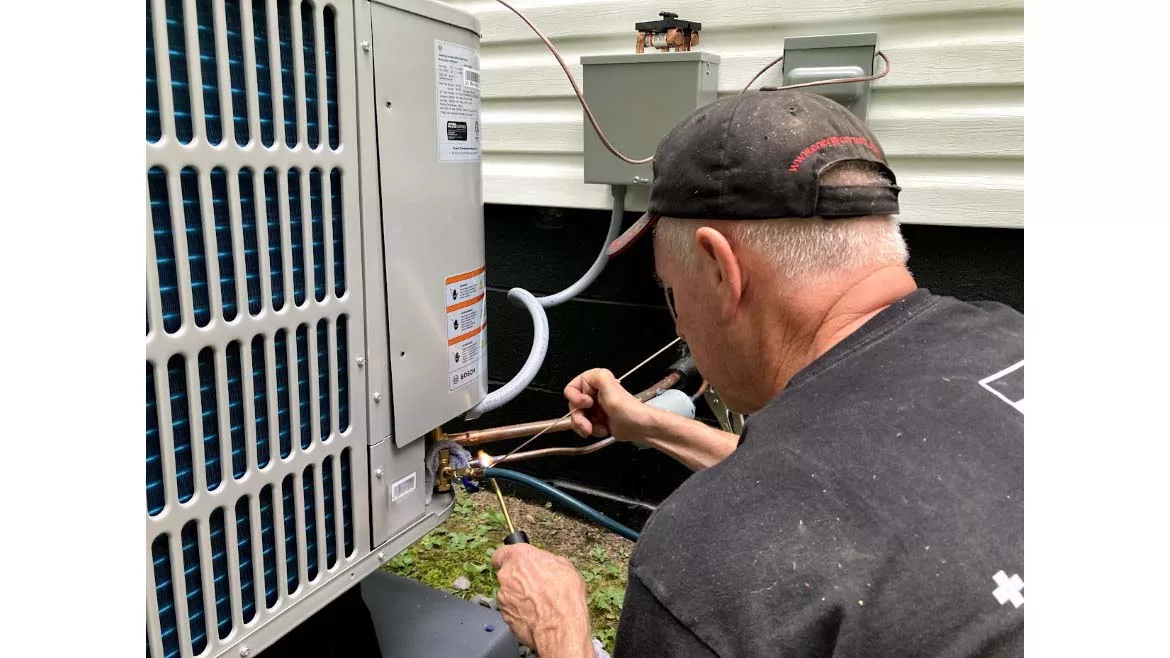
OVERCHARGED TUBE: Refrigerant overcharging is a common issue that occurs when installing heat pumps. (Courtesy of Empire Heating & Air Conditioning)
Kenneth Dean, president, Dean Heating and Cooling Inc., Athens, Ohio, said refrigerant overcharging is a common issue in heat pump projects.
“Technicians often think adding more refrigerant will make the system perform better,” he said. “The easy fix is to simply check subcooling and superheat and adjust the charge accordingly.”
Evacuation and Vacuum
When addressing a heat pump system, techs need to properly evacuate and vacuum the system to ensure it’s free of moisture and other contaminants.
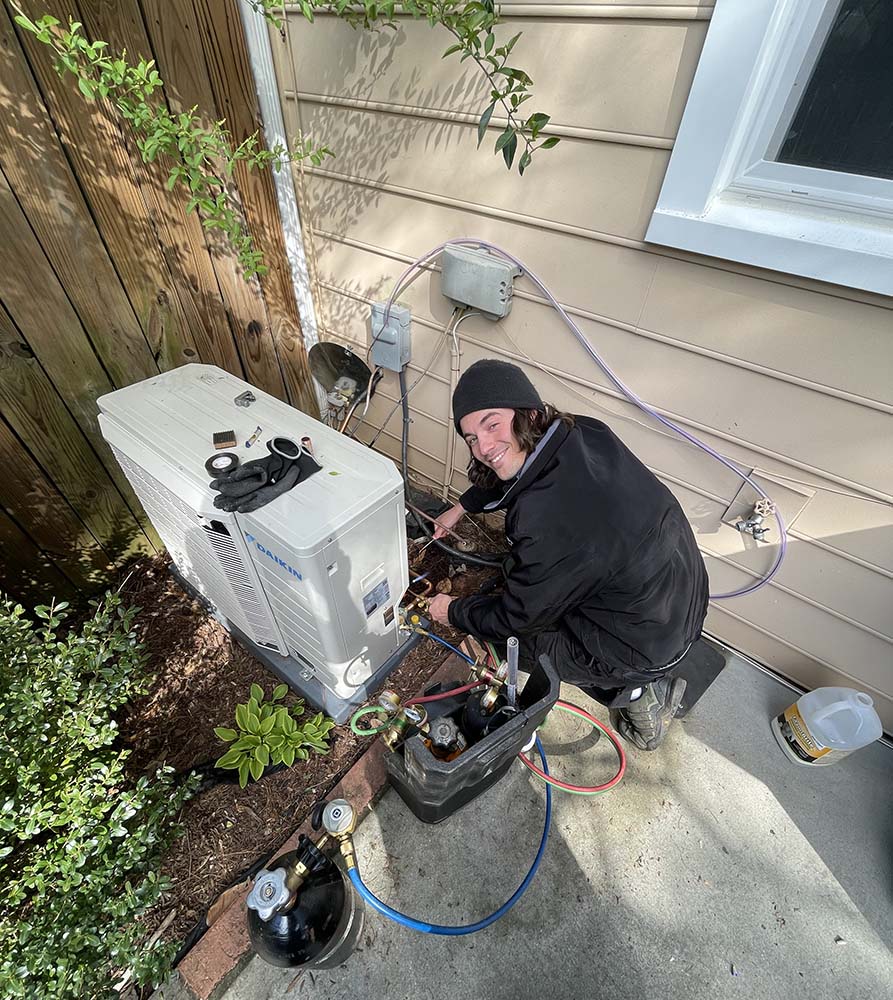
ON THE JOB: When addressing a heat pump system, techs need to properly evacuate and vacuum the system to ensure it’s free of moisture and other contaminants. (Courtesy of Empire Heating & Air Conditioning)
The evacuation process is critically important, as, when done improperly, the equipment’s 20-year lifespan could potentially be cut in half.
“Make sure you’re using large hoses — I use ¾-inch ID hoses — a good pump with clean oil, and remove the valve cores,” said Dickerson. “For brazing, techs should aim to be quick and make sure they’re not overheating anything. Be sure to wrap all components with seals and any expansion valves, like TXVs [thermostatic expansion valves]. Also, it's best to flow nitrogen while brazing. That said, a deep vacuum is far more important than flowing nitrogen. Not that flowing nitrogen isn't useful, but, in terms of priority, it falls underneath evacuation.
For new installs, Dickerson targets a decay holding of 200 microns or less.
“This process comes down to proper tools and the proper sequence of operations,” he said. “If you allow the vacuum pump to run while you’re doing other things, you should have no issue with having enough time.”
Failure to purge and flow nitrogen can create oxide build up inside the tubing, said Dean. This oxide can flake off and cause fouling of screens or the TXV. Either will result in a refrigerant restriction, poor operation, and potential failure of the equipment. An appropriate regulator will flow sufficient nitrogen to displace the oxygen so no oxidation will occur.
“I remove the valve cores before brazing to prevent them from overheating and to prepare for evacuation,” he said. “On new equipment, it’s not uncommon to reach 200 microns and then hold it below 500 during the isolation period of 10 minutes. If the system has been operating and had to be opened, I try to reach 500 microns and hold it below 1,000 during isolation.”
Static Pressure
High static pressure in heat pump systems is often detectable based on how noisy the equipment is as well as premature blower motor and/or compressor failure.
A best practice for measuring static pressure is to actually measure it using the correct static pressure tips in the proper locations, said Ward.
“In my area, duct systems are easily accessed, so that means we can change them out, if necessary,” he said. “If the ductwork is not accessible, then you could start with modifications, such as a big air drop (BAD), which will allow for more air to move through the system. Of course, if that’s not enough, then more duct design and modifications will need to be made.”
Hoover said techs should utilize properly calibrated magnehelic gauges to measure static pressure.
“If total external static pressure is measuring high, then it’s up to the tech to determine why that’s the case,” he said. “High static will often reduce airflow, throwing off other measurements for charging. If there is a good variable-speed motor to compensate for high static and maintain airflow, it will put greater strain on the motor, typically resulting in early motor failure.”
While Hoover said too little static pressure is rare.
“Low static pressure really only happens when a system is extremely downsized and the existing ductwork was left in place,” he said. “If the heat pump is running constantly yet is not properly heating or cooling, that could be a sign of too little static pressure.”
Commissioning
To ensure a system is running optimally, Ward suggests immediately commissioning your work following an install. This process may be difficult when servicing another contractor’s work, as the initial data may be missing or, perhaps, was never recorded at all, he said.
“If the data is missing, the technician practically has to redo the entire install,” he said. “Proper commissioning takes time, yet it is critical to ensure units are prepared to run for their entire life cycle.”
Ward referenced a job where a tech failed to check on a drain line, located in an attic.
“Everything was working fine during heating season, but when cooling season came, the ceiling collapsed from all of the water that was leaking onto it,” he said. “That was a costly mistake on the tech’s part that was completely unnecessary. We suggest technicians use a commissioning sheet with various points of ‘operational proof’ to verify occurrences like these don’t happen.”
Following these tips ensures the heat pumps your team install run efficiently and effectively, granting customers comfort across all seasons for years to come.
Looking for a reprint of this article?
From high-res PDFs to custom plaques, order your copy today!