Improving Your Systematic Troubleshooting Skills
The symptom/cause method is a quick and efficient way to solve even the toughest service call
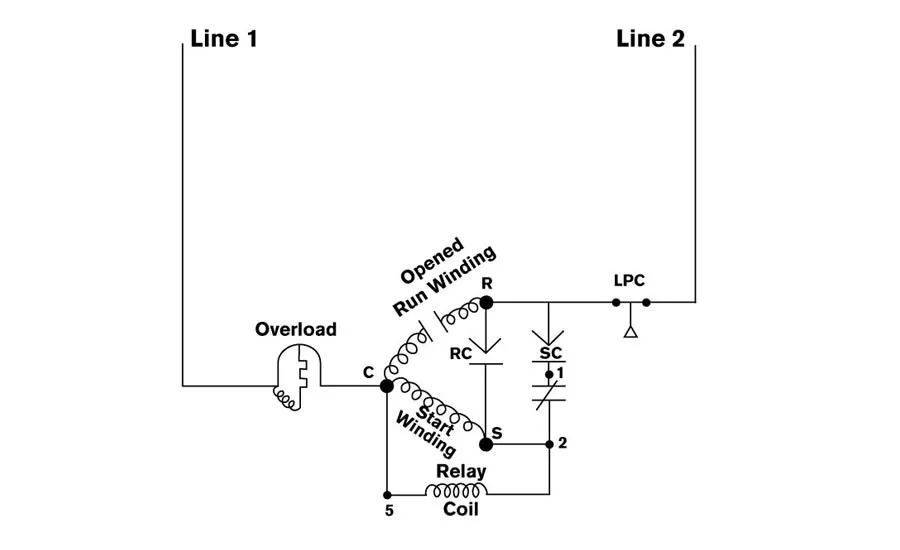
FIGURE 1: This electrical schematic diagram shows the cooler’s single-phase, R-134a capacitor start/capacitor run (CSCR) refrigeration compressor motor, and starting relay circuit section.
Learning the most efficient methods of troubleshooting not only saves the technician’s time, but also the customer’s money. Systematic troubleshooting using the symptom/cause method is a quick and efficient way a service technician can solve even the toughest of service calls. Good systematic troubleshooting skills and techniques are a win-win situation for both customer and technician.
Consider the following example of systematic troubleshooting that incorporates the symptom/cause method. The service call is for no cooling in a medium temperature reach-in cooler in a small town variety store. Figure 1 (top) illustrates the single-phase, R-134a capacitor start/capacitor run (CSCR) refrigeration compressor motor and starting relay circuit section of an electrical schematic diagram for the cooler. Notice in this circuit that the compressor’s run winding has been burnt open from a motor overheating problem.
The technician first looks the system over and listens for any clues as to what the problem may be, then studies the electrical schematic diagram, especially if compressor will not run. Understanding the logic or sequence of operation of the system and circuit is of utmost importance in systematic troubleshooting.
In this scenario, an open run winding will give certain symptoms that will not exist for other possible system problems. For example, the technician listened to and examined the refrigeration system and then studied the electrical schematic drawing. The service technician then lists the symptoms:
- Compressor motor hums but will not turn;
- Compressor motor draws near the nameplate’s locked rotor amps (LRA); and
- Compressor motor’s overload trips soon after drawing LRA, then resets after two minutes.
The technician turns the power off to the refrigeration system to let the motor cool down. After studying the electrical diagram again, the technician lists some possible causes that will correlate to all three symptoms listed above. If a possible cause does not correlate to every symptom listed, it cannot be a possible cause. Listed below are the possible causes noted by the service technician that correlate to all three of the symptoms listed for this service call:
- Open start winding;
- Open run winding;
- Open or defective run capacitor;
- Open or defective start capacitor;
- Compressor mechanically stuck; and
- Potential relay contacts between 1 and 2 are stuck open.
Notice that every possible cause listed correlated to all of the three symptoms. Now, all the service technician has to do is to check the six possible causes to find out which one is causing the problem that correlates to the symptoms, instead of blindly checking out the entire circuit and/or system.
Finding The Cause
With the power off, the technician takes a wire off of the start winding and finds the ohms of the start winding. It has 4 ohms, meaning that it is not open. The technician then takes a wire off of the run winding and finds the ohms of the run winding. It is an open winding because of the infinity reading on the ohmmeter, which means the compressor has to be replaced.
With either winding open, the compressor has no phase shift for starting and will lock its rotor, drawing start winding LRA until the overload trips. Note: When using an ohmmeter on motor windings, always make sure power is turned off, and all wires have been disconnected from at least one of the motor winding terminals being measured for ohms. Shutting the power off prevents damage to the ohmmeter. Disconnecting all wires from the motor terminal being measured for ohms prevents a feedback circuit from forming, which may fool technicians into thinking that the motor winding has continuity.
If either capacitor were open or defective, the motor may not have had enough phase shift to start. This is especially true if the motor was under a high load and/or unequal pressures. In certain cases, like when the motor is under a low load and especially if system pressures were equalized, the motor may start or turn slowly with bad capacitors.
Looking for quick answers on air conditioning, heating and refrigeration topics? Try Ask ACHR NEWS, our new smart AI search tool. Ask ACHR NEWS
If the potential relay contacts between terminals 1 and 2 were stuck open, the start capacitor would be out of the circuit. This would cause the motor to try to start as a permanent split capacitor (PSC) motor and would not have enough torque to turn the rotor when under a load and/or under unequal pressures. LRA amperage would again be experienced.
If the compressor were mechanically stuck, such as something wedged between the piston and cylinder or bearing problems, the motor would lock its rotor and draw LRA. If the contacts between terminals 1 and 2 of the potential relay were stuck open for some reason, the start capacitor would be out of the circuit. This again would probably not cause enough phase shift to start the motor turning. The motor would again draw LRA or near LRA.
Notice that in every case, all symptoms listed were satisfied. Note: Many times compressor motors will not draw exactly nameplate LRA. It all depends on which winding is open. When the run winding is open, the amp draw when the rotor is locked will be through the start winding. Start windings usually have more turns to them and have a higher resistance, and they are also sometimes smaller in diameter. It is for these reasons that the start winding LRA will be different (usually a bit smaller) than run winding LRA. However, if the start winding opens, the locked rotor current will travel through the run winding, which is usually larger in diameter and shorter with less resistance.
What about an open overload or an open potential relay coil between terminals 2 and 5 of the potential relay? If the overload were opened at the beginning, maybe from too high of a compressor amp draw, the compressor would not hum, turn, or draw LRA. This would not correlate with all of the symptoms listed and could not be a possible cause.
If the coil of the potential relay were open, the contacts between 1 and 2 of the potential relay would stay in their normally closed position and never open. This would cause the start capacitor to be in the circuit all the time and the motor would start, draw higher than normal amperage, and eventually open the overload. These symptoms do not correlate with the original symptoms listed, thus cannot be a possible cause.
System Check
Once the service technician replaces the compressor and the system is up and running, it is important to run a system check to see what caused the compressor to overheat and open the run winding in the first place; otherwise, the same problem will recur with the newly installed compressor.
Referring to the system check below, evaporator superheat, total superheat, condenser subcooling, along with suction pressure and head pressure are taken:
| Condenser subcooling | 12°F |
| Evaporator superheat | 40°F |
| Total superheat | 90°F |
| Suction pressure | 4 inches Hg vacuum |
| Head pressure | 90 psig |
This system check shows the evaporator superheat to be very high at 40°F and the total superheat to be very high 90°F. Condenser subcooling is fine at 12°F, but both suction and head pressures were low. The problem that caused the overheating was a faulty thermostatic expansion valve (TXV). The valve would not open enough, and the entire low side of the system was being starved. This caused the refrigerant-cooled compressor to overheat and cycle on its overload until the run winding got very hot and finally burned opened.
Again, without this final system check, the new compressor would surely fail in a short time. Remember, the problem was not the open run winding — the problem was a faulty TXV that would not open that indirectly caused the run winding to burn open. The final system check found the real problem.
Looking for a reprint of this article?
From high-res PDFs to custom plaques, order your copy today!