Industry Disappointed With EPA Rollback Of Leak Repairs
New rule eliminates leak repair provisions but keeps sales restrictions, technician certification
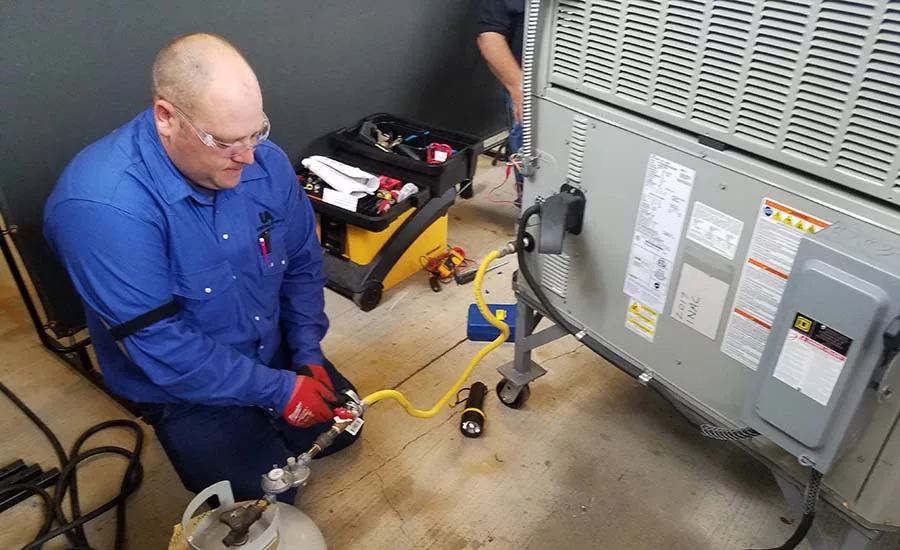
FINAL RULE: EPA recently signed a final rule that eliminated the leak repair and maintenance requirements on appliances containing 50 or more pounds of substitute refrigerants such HFCs. Courtesy, ESCO Group
In February of this year, Environmental Protection Agency (EPA) signed a final rule that eliminated the leak repair and maintenance requirements on appliances containing 50 or more pounds of substitute refrigerants such HFCs. As a result, the leak repair provisions now only apply to class I and class II ozone-depleting refrigerants, as defined in the regulations.
The final rule was not a surprise to most in the HVACR industry, as EPA proposed these changes to Section 608 of its Refrigerant Management Regulations back in 2018, but ACCA members were hoping to maintain the leak repair provisions, said Todd Washam, vice president of public policy and industry relations at ACCA.
“We wanted to maintain those leak repair requirements, because ACCA members care about the environment,” he said. “Not only that, [but] fixing leaks is good for the equipment, as well as for the consumer.”
Rule Summary
While the final rule modifies refrigerant management regulations for substitute refrigerants, such as HFCs, it does not affect the current requirements for ozone-depleting refrigerants or the Clean Air Act prohibition on intentionally venting or otherwise knowingly releasing ozone-depleting and non-ozone depleting refrigerant into the environment. Under the new rule, equipment owners no longer have to:
- Repair appliances that leak above a certain level and conducting verification tests on repairs;
- Periodically inspect for leaks;
- Report chronically leaking appliances to the EPA;
- Retrofit or retire appliances that are not repaired; or
- Maintain related records.
The industry has been unanimously opposed to rescinding these provisions from the time they were proposed, noted Jennifer Butsch, regulatory affairs manager at Emerson’s Commercial and Residential Solutions.
“The industry strongly agrees that it would be better for all stakeholders to keep the leak repair provisions for HFCs in place,” she said. “These provisions are widely considered to be industry best practices. In addition, many stakeholders have already invested in refrigerant management, leak detection, and repair programs to support compliance with the regulation. It’s the industry’s hope that for many of these end users, reversing this provision will have little impact on their already-existing refrigerant management programs.”
Butsch added that it is important to remember that for those still using R-22 in their refrigeration and air conditioning systems, the provisions are still in effect under Section 608.
“Thus, having Section 608 apply to some refrigerants (that are ozone-depleting) and not others (like HFCs) could potentially create some unnecessary confusion throughout the industry; it also adds complexity to the reporting requirements of end users who may now have to differentiate between the two,” she said.
Looking for quick answers on air conditioning, heating and refrigeration topics? Try Ask ACHR NEWS, our new smart AI search tool. Ask ACHR NEWS
The final rule does not rescind the other refrigerant management provisions that were extended to non-ozone depleting refrigerants, including:
- Anyone purchasing refrigerant for use in a stationary appliance or handling refrigerants (such as air-conditioning and refrigeration service technicians) must be section 608 certified;
- Anyone removing refrigerant from a refrigeration or air-conditioning appliance must evacuate refrigerant to a set level using certified refrigerant recovery equipment before servicing or disposing of the appliance;
- The final disposer (such as scrap recyclers or landfills) of small appliances, like refrigerators and window air conditioners, must ensure and document that refrigerant is recovered; and
- All used refrigerant must be reclaimed to industry purity standards before it can be sold to another appliance owner.
That is good news to Washam, as EPA considered rolling back these provisions in its proposed rule from 2018.
“We were happy to see that the purchasing prohibition was maintained,” he said. “We are focused on the safety of those who work with refrigerants, because people have been hurt and scarred from refrigerant burns. No matter what types of refrigerants are being handled, they are dangerous, and only certified people should be handling them.”
John Sheff, director of public and industry affairs at Danfoss, agreed that maintaining the requirements for all those involved in the purchase, handling, recovery, and reclamation of HFCs is good for the industry.
“Right now, the HVACR industry needs harmonized regulations across all non-exempt refrigerants,” he said. “Without such harmonization, refrigerants used in similar applications would be subject to different regulatory regimes, creating confusion and leading to potential mishandling of regulated substances.”
Keeping these HFC refrigerant management provisions in place is very important, noted Butsch, because these are all procedures considered to be best practices.
“This means that technician certification is still required to purchase HFC refrigerants or service an HFC-based system,” she said. “It also means that proper HFC refrigerant recovery, reclamation, and disposal procedures are followed, which will ensure optimum performance in HFC-based systems and reduce the potential for venting HFCs into the atmosphere.”
What It Means
Just because the HFC leak repair provision was rescinded does not mean that contractors and end users should stop their already-established refrigerant management programs or seek to implement less stringent ones, noted Butsch. Many end users already have programs in place, so she contends that there is no reason to abandon responsible refrigerant management as a best practice.
“Keep in mind that most of the industry agreed that this was a best practice, both beneficial for system operation and necessary from an environmental standpoint,” she said. “As a result, end users of these systems adapted, made the necessary investments, and considered compliance measures — such as submitting reports — as ‘business as usual.’”
Sheff added that over the past several years, industry invested in the extended repair rules and was actively in compliance.
“Abandoning the regulatory regime now means that many businesses, including many small businesses, will forfeit that investment,” he said. “These businesses will now have to spend time, energy, and money retraining their workforces on the new rules, utilizing resources that could have gone elsewhere.”
Butsch agrees that reversing these provisions could potentially add costs for the industry in a variety of ways by:
- Forcing contractors and training providers to create new training materials and/or re-train contractors and maintenance technicians;
- Re-working computer systems and recreating compliance documentation;
- Potentially nullifying compliance investments for small and large businesses alike; and
- Introducing opportunity costs for rebuilding compliance mechanisms instead of working on revenue-creating or cost-saving opportunities.
Then there are the damages that can occur to the environment, as well as the equipment.
“Obviously, removing leak repair provisions of HFC refrigerants introduces the risk of increased emissions and GWP,” said Butsch. “In refrigeration equipment above a 50-pound charge, it’s important to remember that properly charged equipment is 5 to 20 percent more efficient than improperly charged equipment — accelerating failure rates, degrading system performance, and decreasing energy efficiencies.”
Washam is optimistic that most ACCA members will abide by the previous regulation and continue to repair leaking systems. And perhaps the rule will be revisited in the future as part of the American Innovation and Manufacturing (AIM) Act, which is currently working its way through Congress.
“The AIM Act would give EPA the authority to regulate those substitute refrigerants, such as HFCs,” he said. “We want to see the bill passed, because we want the EPA to be able to regulate HFCs and strengthen some of these provisions. Not only for HFCs but for the next generation of refrigerants, which will be the mildly flammable A2Ls. Our goal is to protect contractors.”
Looking for a reprint of this article?
From high-res PDFs to custom plaques, order your copy today!