Natural Disasters Highlight Need for HVACR Emergency Planning
Contractors recount emergency experiences, lessons learned
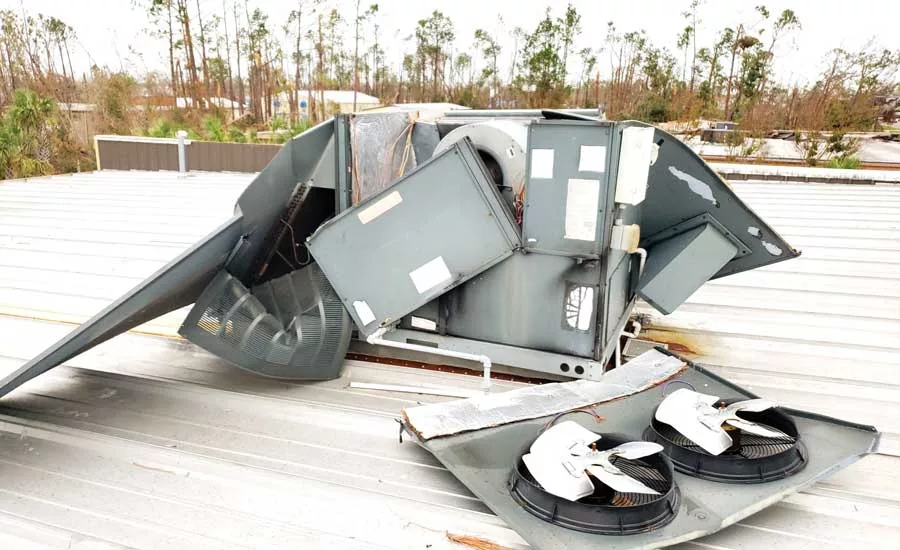
STORM DAMAGE: Natural hazards are one of the more common categories that contractors consider when preparing for emergencies, especially in natural disaster-prone regions of the U.S. where HVAC equipment can end up looking like this.
A year has passed since Hurricane Michael hit Roussos Air Conditioning in Lynn Haven, Florida, and the company is still recovering from the Category 5 storm’s direct hit.
“Being in a coastal community, it is always when, not if, a hurricane is going to hit,” said Pat Boykin, owner of the company. “When we have sufficient warning, we can mitigate impact and reduce damages. When we have no warning, a basic understanding of what is expected afterwards is key to resuming business operations, being a helpful asset to our community, and giving my team members a sense of stability and common cause.”
For the American Weathermakers company in Northbrook, Illinois, it was the 2018 polar vortex that spread across Chicago and much of the Midwest that had Stephen Adamitis, vice president of residential operations, looking for ways to combat the extreme weather.
“We made sure our service center stayed open longer, and that our technicians had plenty of water to stay hydrated and materials so they could fix furnaces,” he said. “We kept install trucks inside at night to keep the diesel trucks ready for the next day, and worked long hours to make customers happy and comfortable.”
These are just a few of the experiences HVAC contractors have had in the wake of natural disasters. Be they natural or man-made, emergency situations test the ability of contractors to protect their employees, businesses, and customers. Doing this successfully requires a plan.
EMERGENCY SOURCES
Ready.gov is a government-sponsored website that delineates what steps families and businesses should take to ensure their safety and well-being in the face of an emergency. There, disasters are placed into four primary categories: natural, health, human-caused, and technology-related.
Natural hazards include floods, hurricanes, tornadoes, earthquakes, wildfires, etc. This is one of the more common categories that contractors consider when preparing for emergencies, especially in natural disaster-prone regions of the U.S. Health hazards include widespread and serious illnesses, such as the flu and other viruses. Human-caused hazards include accidents and acts of violence: for example, a car accidentally careening through a business or an act of terrorism changing the face of a city. Technology-related hazards include power outages and equipment failure.
Looking for quick answers on air conditioning, heating and refrigeration topics? Try Ask ACHR NEWS, our new smart AI search tool. Ask ACHR NEWS
Power outages not only turn the lights out but can put a stop to business if contractors aren’t prepared.
“You never want to be chasing your problems when your client needs you for theirs,” said Steve Harvey, LEED AP and general manager of W.A. Soefker & Son Inc. in Memphis, Tennessee. “You need to answer the phone, email, text, etc.”
To accomplish this feat in the midst of a power outage, Harvey’s company installed a 35kW generator to provide power for its building and computer room.
“We have moved our dispatch program to the cloud so that if we have a server failure, we are able to keep working without disruption,” he explained.
INDUSTRY HELP
After understanding the four primary sources of emergencies, Ready.gov suggests that businesses break their emergency preparations down into four steps: identifying risk, developing a plan, taking action, and being recognized and inspiring others.
ACCA is working with contractors to help them through some of these steps. On the contractor association’s website is information addressing disaster preparedness that includes information from Ready.gov, as well as a members-only sample emergency action plan and more.
“We emphasize being very proactive in emergency situations,” said Todd Washam, vice president, public policy and industry relations at ACCA. “This can help establish you [the contractor] as a source of information and a trusted partner as your community rebuilds.”
When it comes specifically to flooding, ACCA’s Flood Recovery and Customer Relations Guide — which is co-branded with HARDI, AHRI, and the Thermostat Recycling Corp. — breaks down best practices for post-flood conditions. It is a free resource that points technicians to ACCA Standard 6 — Restoring the Cleanliness of HVAC Systems for Residential and Commercial HVAC Applications.
“We are looking at how we update all of our disaster preparedness materials,” said Washam. “We want to make sure that we have visual information that’s easy to be shared from the business owners all throughout their staff.”
One of the top suggestions that he had for contractors preparing for emergencies in advance was to get their computer systems to an area in the business where they will not be susceptible to water and in danger of shutting down.
“Have your local insurance person’s information handy,” Washam said. “Be very attentive to social media so you can be a resource for your customers. Make sure your staff is all safe and home with their families. It’s important to make sure your staff knows that you have their back through all of this and that family comes first.”
DEVISING A PLAN
As business owners, HVAC contractors are responsible for the foundations of their companies and the daily situations that present themselves. That plan begins with identifying the likely and even unlikely hazards that their area faces, according to Ian Schotanus, managing member and lead consultant of The Big Picture Consulting, Plymouth, Minnesota.
“Next, a realistic and functional Emergency Action Plan (EAP) needs to be developed for each identified hazard/risk and provided to all employees,” he explained. “Finally, components of the EAP must be practiced, and the plan itself must be updated as deficiencies are discovered over time. These deficiencies may be the result of overlooking some aspect of preparedness, or as simple as an internal reorganization of the company offices.”
The EAP that Schotanus suggests for contractors to use will vary according to the emergency being planned for, but the basic components should be the same and presented in similar format, he said. Its four basic components are description of the risk; description of possible harm or damage; a list of established preparedness supplies provided by the company; and a list of executable tasks and who is responsible for each.
“The final, compiled EAP should be prominently displayed and physically available in every major area of the office/facility, and overall company training on the program should be conducted at least annually and as part of any new employee’s orientation process,” said Schotanus. “Training or practice of the individual plans are best refreshed at the start of any applicable season, when the odds of any given disaster are at their highest. Plan, practice, prevent complacency.”
Boykin was just one of many contractors who had to employ their version of an EAP in the wake of a natural disaster. According to him, Roussos Air Conditioning had a basic plan for safety and the aftermath of the hurricane that hit the business. The first thing the company did was to send a pre-event instructional email telling employees to set priorities on safety and family first, before addressing their jobs. He then went about securing company and client assets safely out of harm’s way, unless personal safety was compromised. The third piece of the plan was post-event communication.
“Who is available to help in resuming operations, who needs help in meeting basic needs, and when should team members expect to report for emergency or regular duty, were all questions we had to address,” said Boykin. “We learned valuable lessons in having a plan A, B, and C for communications. Internet, cell phones, and landlines are all susceptible to disruption during a natural disaster.”
WHY MAKE A PLAN?
There are several reasons to create an EAP, but according to Schotanus, the three primary reasons are to prevent loss of life, improve company culture, and because it’s the law.
“The Occupational Safety and Health Administration (OSHA)
requires all companies have at least a basic written EAP in place and provide annual training,” he said. “During an inspection, failure to have an EAP in place and failure to provide training (on the plan you do not have) can result in fines up to $26,000 for the first offense, as well as registration on the OSHA ‘Serious Violators’ database. Repeat citations can add up to $132,000 for each violation found.”
See more articles from this issue here!
Looking for a reprint of this article?
From high-res PDFs to custom plaques, order your copy today!