Refrigeration Industry Contends With Refrigerant Uncertainty
Questions arise as EPA offers little guidance
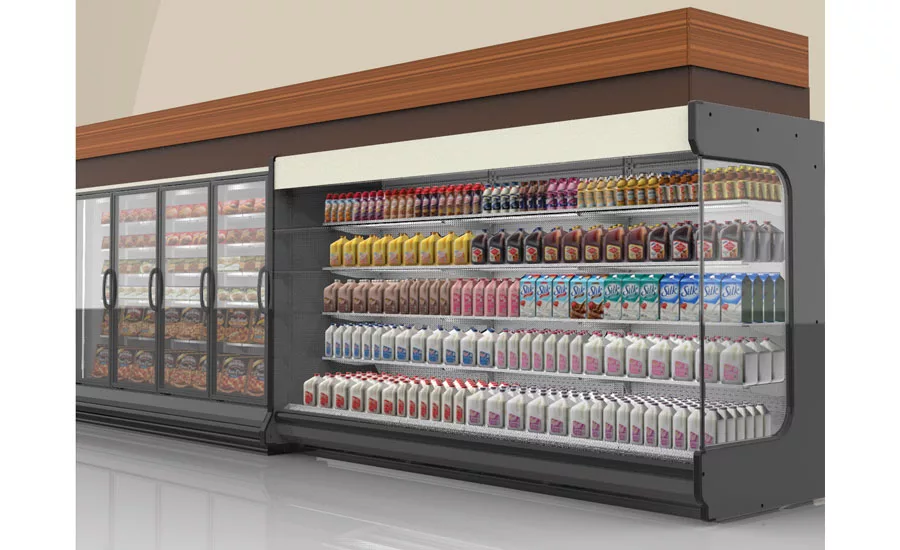
FAST AND EASY: In response to the technician shortage, Hussmann recently launched its microDS systems, which are simplified micro-distributed merchandisers that are fast and easy to install and maintain.
Since the courts ruled that the Environmental Protection Agency (EPA) did not have the authority to phase down HFCs, the commercial refrigeration industry has been in a bit of turmoil. Many manufacturers had already been preparing to transition their equipment to lower-GWP refrigerants, but with no clear guidance coming from EPA, there are questions about which alternatives will emerge as the frontrunners, as well as when this transition will start taking place.
Adding to the confusion are the states — most notably California — that are rolling out their own phasedown schedule of HFCs, which could lead to a patchwork of refrigerant regulations across the U.S. Until EPA issues its final regulations, there will likely continue to be a lot of uncertainty about refrigerant use in commercial refrigeration equipment.
CURRENT STATE
The federal role in leading the phasedown of HFCs is expected to be unclear for some time, said Mark Menzer, director of public affairs at Danfoss.
“We expected to see a proposal [from EPA] by now, but the federal government shutdown earlier this year delayed that,” he said. “Since EPA’s authority seems only to cover the transition from ozone-depleting substances (CFCs and HCFCs, mostly), we might see it focus its rules on users that are still using those refrigerants. EPA might tell those users that ODS replacements can only be low-GWP substitutes. That would be a very different type of regulation from the earlier SNAP [Significant New Alternatives Policy] rules and aimed at a different audience.”
With no clear direction from the federal government about what its long-term approach to managing HFC refrigerants will be, many states — especially California — are developing their own regulations about managing refrigerants, said John Prall, technical support expert for commercial North America, Embraco.
“While it would be ideal to have one regulation across the U.S., we are likely not going to see this in the short term,” he said. “My expectation is that most OEMs will build toward the toughest regulatory environment and consolidate their portfolio around this where they can reasonably do so.”
Richard Gilles, senior product leader of distributed solutions at Hussmann Corp., believes that it will take several years — and perhaps the next presidential administration — before there will be clarity at the federal level regarding HFC refrigerant policies.
Looking for quick answers on air conditioning, heating and refrigeration topics? Try Ask ACHR NEWS, our new smart AI search tool. Ask ACHR NEWS
“There is a certain level of ambiguity with the rescinding of SNAP Rule 20 [EPA regulation that prohibited the use of certain high-GWP HFCs as alternatives], which has led to individual states to act in their best interests,” he said. “The best strategy for OEMs is to focus on a large-scale, countrywide basis to best serve our customers. This does cause extra planning and logistics to handle the changing regulatory environment.”
Even though SNAP Rule 20 has been vacated, EPA still has the authority to phase out R-22, which will occur as planned on Jan. 1, 2020.
“It may surprise some to learn that there are still a large number of operators with older refrigeration systems that are currently charged with R-22,” said Andre Patenaude, director of food retail marketing and growth strategy — cold chain at Emerson Commercial and Residential Solutions.
After the phaseout of R-22 on Jan. 1, these operators will likely either retrofit their systems with lower-GWP refrigerants, or else keep recovering and reusing R-22 until they’ve exhausted their supplies.
“Very similar scenarios will be taking place in California, where R-404A and R-507A are no longer allowable in many new commercial refrigeration applications,” said Patenaude. “These operators can significantly reduce their carbon footprint by moving to lower-GWP gases, such as R-448A and R-449A, and recover, recycle, and/or reuse R-404A as a service-only refrigerant on remaining legacy equipment.”
WHERE TO GO FROM HERE
Not surprisingly, there will be a variety of ways in which store owners will address the phaseout of R-22, as well as the possible phase down of HFCs.
“Store owners are going to do whatever makes the most financial sense for their businesses,” said Prall. “Most independent store owners will likely not pay attention to what refrigerant is currently being used unless they have to purchase more refrigerant to replace leaked refrigerants. For self-contained equipment that is reaching the end of its useful life, it’s a very easy decision to go to a natural refrigerant. With remote systems, the decision on what direction to go is a much more complex decision and many factors need to be considered.”
The location of the retailer will also make a difference, as environmental awareness, as well as state regulations, will feature more prominently in certain parts of the U.S. than in others.
“Operators in California are well aware of the efforts to phase down HFCs and most likely have an alternative refrigerant plan in place,” said Patenaude. “In other parts of the country, we typically find that only the larger and more sustainably minded retailers have begun the process of exploring low-GWP refrigerant options as part of their sustainability objectives. These operators have retrofit plans in place and are even trialing alternative refrigerant architectures in their stores.”
For end users, Patenaude noted that there are essentially two options:
- Retrofit using lower-GWP HFOs, which requires minimal changes. Moving from R-404A to R-448A or R449A may require adding compressor cooling and other relatively minor system changes. Through energy optimization best practices, this will reduce indirect emissions, which lessens the carbon footprint.
- Move to a new and/or natural refrigerant system, either for a new location or a complete refrigerant retrofit of an existing site. In some cases, all-natural systems have been installed in parallel with an existing system, and then a slow transition is made to use only the natural solution.
For option No. 2, there are a growing number of natural solutions for supermarket refrigeration, including low-charge ammonia chillers on the roof, R-290 integrated cases fitted with micro-distributed systems, and CO2 transcritical and/or cascade systems using CO2 for the low temperatures and an HFO (or lower-GWP HFC) for medium temperature, said Patenaude.
“Of course, despite contractors advising otherwise, some operators will keep using refrigerants such as R-404A or R-22 until they’re forced to make a change,” he said.
Most food retail chains have a continued program of reviewing and testing various alternatives in order to be prepared with the best solution for their particular circumstance as the issues become clearer, said James Knudsen, North America sales driver and food retail segment leader at Danfoss.
“There is typically a portfolio of solutions for each application,” he said. “Most are testing and selectively implementing retrofits with lower-GWP blends while testing or at least evaluating natural refrigerant opportunities such as CO2/ammonia cascade, CO2 transcritical, and water-loop systems with hydrocarbon self-contained cases. The food retailers are aware that the environment can change quickly as the political winds shift.”
Contractors obviously play a big role in helping food retail customers stay on top of regulatory changes, and they are instrumental when it comes to choosing the right equipment that will best serve their customers’ needs.
“We encourage contractors to work closely with OEMs such as Hussmann in order to stay current on all available solutions,” said Gilles. “Also, there is a need to be open to meet the customer where they are to work together on a solution. Creativity and exploring new options are a must. Our scientists, engineers, and designers are constantly working collaboratively with our customers to ensure we come up with the best solutions to address their needs now and in the future.”
TECHNICIAN SHORTAGE
The transition to lower-GWP refrigerants is coming at a difficult time for the refrigeration industry, which is already struggling to attract enough technicians to service and install equipment. And it’s going to get worse.
“Not only is there a current need for more qualified refrigeration technicians, the problem is expected to grow even more by 2024, when almost 60,000 HVACR positions are projected to be open,” said Gilles.
Refrigeration systems are also becoming more complex in order to meet refrigerant and energy regulations, leading retailers to be concerned that there won’t be enough technicians who are qualified to service them, said Patenaude.
“Low-GWP natural and synthetic refrigerants come with known caveats — such as higher pressures, potential flammability, and toxicity — and many operators are uneducated about the risks and anxious about the costs to own and maintain these systems,” he said. “From a manufacturer’s perspective, we’re trying to develop smarter systems that help take the burden off contractors.”
These smarter systems are designed with built-in diagnostics, connectivity, analytics, and human machine interfaces to help contractors troubleshoot issues and provide guidance for fast resolution, said Patenaude.
Hussmann is also continuing to develop sophisticated, sensitive, and easy-to-use technology that will help diagnose issues, as well as allow customers to plan the necessary routine maintenance for their equipment. In addition, they are making their equipment easier to use for both the contractor and the end user.
“We’ve recently developed and launched solutions like our microDS systems, which are simplified micro-distributed merchandisers that are faster and easier to install and maintain,” said Gilles. “These systems use propane (R-290) and do not require mechanical rooms or other large changes to the current store layout or even tenant space.”
STAYING INFORMED
For those already in the refrigeration industry, staying abreast of refrigerant regulations and new solutions is becoming even more important. Fortunately, many manufacturers offer a wide array of materials that can help technicians keep their skills current.
Danfoss, for example, provides numerous training opportunities, including sessions at its facility in Baltimore, as well as on-site. In addition, for the past three years, the Danfoss Mobile Training Unit has toured around the U.S., providing training on transcritical CO2 systems.
Knudsen noted that the classes for the mobile training unit have often been over capacity, demonstrating the need for this type of training.
Embraco has created several training videos about proper care of compressors and how to handle systems using R-290, which are free to view online (www.refrigerationclub.com).
Prall noted that the company also conducts multiple webinars throughout the year with various organizations to assist in growing the knowledge base.
Hussmann recently started partnering with Lincoln Tech trade schools in order to provide a program for supermarket refrigeration technician training.
“We sponsor students and cover their tuition, room, and board during their eight-week training program, because it is so important to have well-trained technicians to work in our robust, exciting industry,” said Gilles.
Through its E360 platform, Emerson offers webinars, articles, and live forums regarding the latest regulatory updates.
“As the refrigeration landscape is becoming more complex, many companies are realizing that they don’t have all the expertise and skill sets to solve their problems on their own,” said Patenaude. “This is creating new opportunities for companies to augment their capabilities by partnering with other companies that can help fill their knowledge gaps. Emerson is optimistic that this continued collaboration and industrywide dialogue will transform our current challenge into an opportunity to create the most ... viable refrigeration solutions of the future.”
Publication date: 7/1/2019
Want more HVAC industry news and information? Join The NEWS on Facebook, Twitter, and LinkedIn today!
Looking for a reprint of this article?
From high-res PDFs to custom plaques, order your copy today!