Case Study Explores Environmental, Financial Benefits of Refrigerant Monitors
Getting up to clear requirements
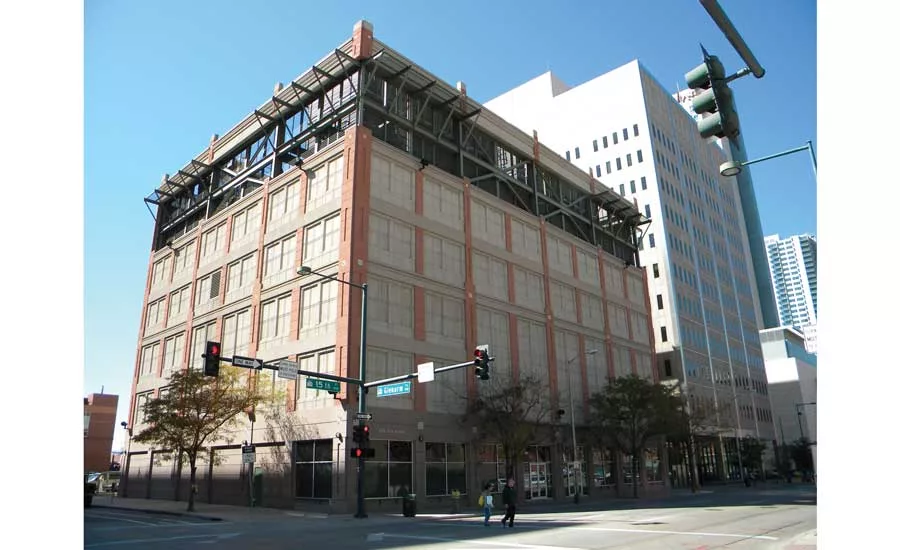
CITY SYSTEM: Michael O’Malley, operations manager at Xcel Energy’s Thermal Energy Department, and his team are responsible for a system that includes five locations, 16 chillers, and 4 miles of underground pipes that distribute chilled water to some of the city’s most important downtown buildings, including the art museum, the public library, the convention center, hotels, courthouses, and the Denver city/county buildings. Pictured is the Denver District Cooling Building.
Xcel Energy, headquartered in Minneapolis, is one of the largest electrical energy providers in Colorado. The company also provides electricity and natural gas to eight states in the upper Midwest and Southeast. Its thermal energy business began in 1998, but its history as an electrical power supplier began more than 100 years ago in many of the states it serves. Xcel Energy serves more than 3.6 million electricity customers and 2 million natural gas customers. It is a forward-thinking energy company when it comes to providing clean power. It has set a carbon reduction goal of 80 percent from 2005 levels by 2030 and has an aspirational goal of offering 100 percent carbon-free electricity to customers by 2050.
Refrigerant monitoring updates were needed at Xcel Energy’s chilled water building in downtown Denver. The different types of refrigerant monitoring systems that were in use offered no communication abilities among plant locations in the city. The thermal energy team was spending time conducting constant walk-throughs of five separate buildings to check the health and functionality of 16 chillers and all related mechanical equipment, including the refrigerant.
There was also inconsistent monitoring and the absence of data that could identify leaking refrigerants. This, plus the lack of consistency and reliability in the refrigerant equipment used throughout the plants, made troubleshooting difficult and finding correct spare parts from manufacturers arduous. The result was suboptimal refrigerant use, monitoring, and communications, along with inefficiencies in maintenance and repairs and potential safety issues.
Today, Xcel Energy uses refrigerant monitors in its five locations to monitor the chillers.
Each plant has its own multi-zone (MZ), halogen gas monitor, and they all communicate with the BAS, which records levels of refrigerant readings while each plant is continually monitoring for potential refrigerant leaks. The MZs use a non-dispersive infrared (NDIR) sensor that enables early refrigerant leak detection to 1 ppm and a pump that allows for fast sequential sampling up to 16 points.
Michael O’Malley is the operations manager for the Thermal Energy Department at Xcel Energy in Denver. He has been with the company for 10 years and has double that experience in operations management. He and his team are responsible for a system that includes five locations, 16 chillers, and 4 miles of underground pipes that distribute chilled water to some of the city’s most important downtown buildings, including the art museum, the main branch of the city’s public library, the convention center, hotels, data centers, courthouses, and the Denver city and county buildings. In each building, heat exchangers have been installed, eliminating the need for owners to provide their own equipment.
CLEAR REQUIREMENTS
After evaluating refrigerant monitoring products and understanding the operation of the legacy system, O’Malley thought it important to find active sampling refrigerant monitoring equipment. A system that used a pump for sequentially monitoring different locations would get air through to the sensor, and the possibility of increasing sampling frequency could help to prevent any serious consequences. To be proactive and quickly counteract any refrigerant leaks, O’Malley wanted to set up alarm sensitivities at levels lower than what a passive refrigerant monitor is able to detect.
Looking for quick answers on air conditioning, heating and refrigeration topics? Try Ask ACHR NEWS, our new smart AI search tool. Ask ACHR NEWS
“The cost of a large refrigerant leak to our organization could range from $10,000 to $100,000 or more, depending on the size of the leak,” said O’Malley.
Since different refrigerant gases such as R-22, R-123, and R-134a were used at multiple locations, it was also important that the same monitoring system within the different buildings look for all these refrigerant types and that all monitors could communicate with the main plant.
A ROCKY MOUNTAIN HIGH IMPLEMENTATION
The implementation of the first new refrigerant monitor involved a collaborative effort between Xcel Energy, Bacharach, and the local representative. A number of refrigerant monitors were installed at different Xcel Energy facilities, so there were some concerns about product reliability. O’Malley wanted to make sure the products would last a long time, be reliable, and not require a lot of maintenance. Once Xcel Energy selected the unit it wanted, the initial installation went great, recalled the local representative. Shortly after, however, they were experiencing issues with filters and false alarms. Due to Denver’s mile-high altitude, the diaphragms in the pump were working much harder. The issue was quickly remedied by replacing the sealed unit with a more robust rubber diaphragm that would not crack or break.
The MZ was installed at a remote plant and, as budgets allowed, a total of 5 MZs were installed.
“It was easy enough for us to try out the first HGM-MZ,” O’Malley said. “During the implementation, we got fantastic technical support, so it was great.”
LATEST TECHNOLOGY
The role of technology is inseparably linked to the Xcel Energy Chilled Water Plant. It remains an important safety factor to the team to have highly sensitive leak detection technology incorporated into the refrigerant monitors. Using a technologically advanced sensor that recognizes a variety of refrigerants, and a system that provides faster cycle times for all monitoring zones, would provide continual sampling to detect any refrigerants that might leak into the mechanical room.
“It’s important that the operations team have confidence that it’s safe to go into the room — that no refrigerant leak happened in the mechanical space and that nothing is leaking into the environment,” O’Malley said. “We need to keep refrigerant inside the chiller. That’s important, so I’m not constantly buying refrigerant.”
The local representative noted that Xcel Energy was not using the same gases in all the chillers and not all those gases were supported in the product they were using. This situation could be addressed by the HGM-MZ’s extensive library of gases built into the monitor, plus the accuracy of the refrigerant readings provided.
The HGM-MZ has a library of over 60 refrigerant gases, solving the refrigerant variety issues within the plant for detecting R-22, R-123, and R-134a. Product standardization keeps maintenance easy by using the same product for spare parts and for quick replacement.
The Xcel Energy operations team has had a significant reduction in the frequency of the walkthroughs they need to conduct.
The multi-zone system also keeps refrigerant emissions at bay by having 1-ppm performance.
CLEAR FINANCIAL ADVANTAGE
“It’s critical we find refrigerant leaks early,” O’Malley said. “Most importantly, we are concerned with the negative effects on the environment. I don’t want refrigerants getting into the atmosphere. The second concern is the financial impact. The machines’ performance will suffer if they don’t have the refrigerant. It’s like gas leaking out of your car.”
Because of the time it took to check the legacy product, it was critical to have a product that would constantly be drawing sequential samples at the chillers and recording refrigerant levels to ensure the product was in operation, no matter the location.
“Having reliable, continuous monitoring that we could see from a central location would allow us to dispatch a technician only when having to make an assessment or deal with a minor issue,” O’Malley said.
The technician’s time alone would save costs. Additional benefits include system performance, lower energy costs, and reduced refrigerant cost.
RELIABILITY
Being able to rely on the equipment in continual operation was another important consideration.
The manufacturer’s representative remembers visiting the Xcel Energy chiller plant in downtown Denver and noted that it was the largest underground chiller plant he had ever visited. He recalled that Xcel Energy wanted a “set it and forget it” type of unit and that they had some concerns surrounding code compliance.
Wanting to focus on refrigerant sensitivity, the representative demonstrated that the refrigerant monitor could detect leaks down to 1 ppm.
“The monitors have been reliable,” O’Malley said. “I don’t recall having to change out the pumps in quite some time. You basically hang them on the wall and will get years and years and years of service out of them.”
BAS AND OTHER COMMUNICATIONS
Looking for a reprint of this article?
From high-res PDFs to custom plaques, order your copy today!


