Three Examples of Hybrid High-End HVAC Systems
Two systems, instead of one, could be the solution for especially complex projects
Two heads are better than one, right? How about two kinds of HVAC systems — or more than two?
Following are three examples of how contractors have combined different high-end systems to create a hybrid that makes it possible for homeowners to hit their heating and cooling demands.
THOSE WHO LIVE IN GLASS HOUSES NEED GOOD HVAC
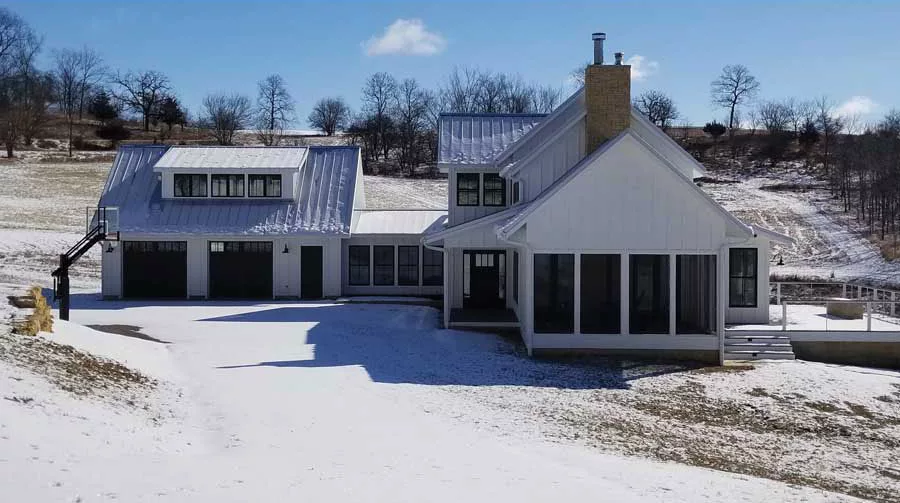
In summer 2016, Doug Schuster, president at Schuster Heating & Pump Co. Inc., installed a hybrid system for a home in Elizabeth, Illinois. The house was out in the country, the driveway was a quarter-mile long, the nearest neighbors were half a mile away, and it had more than 50 windows to take in the rolling view.
“It was almost all glass,” Schuster said.
The house was a little over 2,000 square feet on the main floor, about 600 square feet on the second floor, plus a garage and an office above it, for a total of 5,800 square feet of space.
“Getting around a huge heat loss in the small space, because of all the glass, was the biggest issue,” Schuster said.
The homeowner wanted hydronic radiant floors on the main floor, the basement, and the garage. In the garage and the basement, the PEX tubes were embedded in concrete. On the main floor, the PEX tubes were embedded in Gypcrete. Two water-to-water units served the radiant. However, that wasn’t going to be enough to keep the house warm.
Looking for quick answers on air conditioning, heating and refrigeration topics? Try Ask ACHR NEWS, our new smart AI search tool. Ask ACHR NEWS
“Because of all the glass, and one room had 16-foot ceilings, we could not get enough heat out of the floor alone,” Schuster related. “We had to have cooling anyway; that’s why we went with a water-to-air unit.”
Schuster installed two hydronic air handlers, one serving the second floor and one taking care of the bonus room above the garage.
“What we had was 10 tons of water-to-water geothermal equipment, so basically two 5-ton units, making hot water for the floors, hot water for those two air handlers, and chilled water for those two air handlers,” he said.
There was also a 4-ton water-to-forced-air unit that served as auxiliary heat for the main floor and provided all the air conditioning for the main floor and the basement.
“I think all in all, we had seven zones of radiant heat, two zones of hydronic forced-air heat, and three zones of forced-air cooling with a water-to-air unit.”
The system uses Aprilaire 8820 Wi-Fi thermostats and remote sensors, which allow the homeowners to remotely access the thermostats and monitor usage with a histogram. Average yearly savings on heating and cooling amount to $3,826. In the future, the homeowner plans to add PV solar.
“Basically, it’s going to drop his utility bills to little or none,” Schuster said.
HOME SWEET BARN
In Mount Joy, Pennsylvania, the winter gets down to single digits. Summers can reach 100°F with high humidity on a regular basis — ranging from 80 to 95 percent, to be exact.
It was in this climate where Vincent Youndt, president of Vertex Mechanical, was asked to install heating and air conditioning in a barn-turned-home dating from the 1800s. The total square footage of living space was around 7,500 to 7,800 square feet, and some of the ceilings were as high as 25 feet.
“When we were first introduced, we were worried about some pretty major infiltration problems,” he said. “I think our biggest challenge was just coming up with the solution to the high ceilings and what we felt to be a building that could have some pretty heavy potential, actually, to be an energy hog, and trying to make sure that they didn’t move into something and then regret it because the utility bills were so incredibly high. So with that, we really brought in radiant as our solution to manage the high heating costs of a building like this one.”
Because it was an old barn, parts of the floor were almost 2 or 3 inches thick. A typical radiant installation, tacked up underneath the floor, wasn’t an option; plates ended up going on top of the floor, with a Gypcrete overpour for 1½ inches of lightweight concrete.
“That gave them two things,” Youndt said. “The first was, obviously, a great medium for radiant heat, but it also gave them a flat floor, which they didn’t have prior to that; they were going to do all this build-up work to get everything flat.”
The radiant was “just a given” because of the high ceilings, Youndt said. In addition, there was a tax credit available at the time that made the equipment very viable, and the customer was interested in finding the best long-term solution to manage energy costs, as opposed to basing the decision on the upfront price.
Initially, the customer asked for straight-up geothermal.
“Even though they would have been going to an incredibly efficient medium for trying to get that heat, we were concerned about the comfort because of the very, very high ceilings and trying to get the heat down where we needed it,” Youndt said. “That challenge was definitely met with the radiant — it was beautiful.”
Normally, Youndt wouldn’t recommend geothermal as a backup; it just doesn’t get hot enough, he said. This instance was an exception, as top temperatures were getting up to 95° or 96°.
“Generally, if you try to do geo with radiant, you’re trying to push it through a subfloor,” he explained. “You need temperatures in the 120°, 130° range. That runs the geo very, very hard, and at that point, it’s not very efficient. So you don’t really get the gains of the efficiency that you’re hoping for. But by keeping that temperature down below 100°, all of a sudden, it doesn’t make that unit work super hard. It still has to do some work, but it’s still working in a very efficient state. So we felt that that was a really good avenue to go.”
Youndt’s team backed up the geothermal with a gas boiler, which had two main benefits.
“If they ever had a power outage situation, the geo would shut itself down, and the generator would be able to fairly effectively run the boiler and still allow it to heat the entire building without any trouble,” he said. “Also, they have quite a few showers in this home and were using a lot of high volume and water. With that boiler, we were going to give them pretty much on-demand hot water heating with that same unit.”
The cost of the project was just over $100,000. Watts Radiant plate was used for the radiant work. Hydron Module and ClimateMaster supplied the geothermal equipment. Bradford White was involved in storage tanks, the boiler was from Laars, and Tekmar and Taco were both involved in pumping and controls. The barn had eight or nine sensors, and each zone had a sensor within the Gypcrete.
“We’re doing slab sensing, we’re doing air sensing, and we’re also watching outside temperature,” Youndt said. “The system is making a lot of decisions based upon all that information to determine what kind of water temperature it wants to mix in, and what’s the most efficient temperature at that time, depending what’s happening with all these conditions.”
COLLEGE LOOP
In 2006, Colorado Mesa University, located in Grand Junction, had 3,500 students and encompassed six city blocks. The university was getting ready to expand. At the time, the state was offering a bounty for every 8,800 tons of carbon reduced. The university wanted to take advantage of this and gain some extra money for their campus. That’s when Cary Smith, president/CEO of Sound Geothermal Corp. in Sandy, Utah, started talking to them about a geothermal district energy loop.
Like a ground-source heat pump, the district loop exchanges energy to and from the ground, and between multiple buildings. It can also transfer heat between rooms within the building to reuse that heat instead of dumping to the cooling tower or up the boiler stack. The main difference is that the ground loop becomes a battery — or thermal storage for the system.
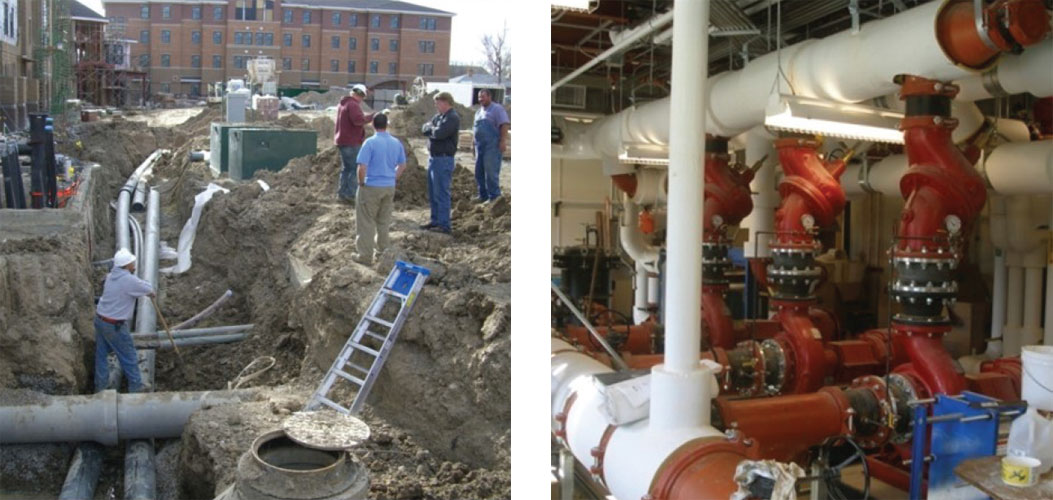
BACKBONE: Colorado Mesa University, located in Grand Junction, has a geothermal district energy loop; its backbone is an 18-inch HDPE single-pipe system. By coupling to the district loop, the resulting system requires about 50 percent of a conventional ground loop and 30 percent of the typical cooling tower capacity.
“Basically, we want to design the system such that we can get the optimal and most effective use out of each one of the components of that system at the highest efficiency that we can,” said Smith. “And by connecting the systems together and creating a hybrid system, we can regulate how much money we have to spend on the ground, versus how much money we connect with the mechanical stuff in the building. The more I’m able to control the temperature of the fluid that I’m taking to the heat pumps, the more efficient the heat pump’s going to be.”
The theory behind this is that the renewable energy equipment will be used for most of the year.
“If I were to measure 50 percent of the peak load of the building, we would use no more than that for about 90 percent of the year,” Smith said.
Using waste energy that would typically be thrown away through a cooling tower triggers the efficiency of the system. Due to the local climate, the peak heating loads and peak cooling loads are similar in Btu needed per hour. Energy is stored in a borefield or transferred to a different building and put to use.
“The net efficiency of the system comes up, because I really haven’t put any more energy into the system, but I’m getting more out,” he said. “Our tagline is, ‘Energy is harvested, moved, and reused.’ That’s the fundamental part.”
The university started with an 18-inch pipeline connecting five buildings and a dorm. By 2019, they’d grown to 11,500 students, 12 city blocks, and about 3 miles of distribution loop, connecting dormitories, classroom buildings, pool, sports center, and software rooms. By coupling to the district loop, the resulting system requires about 50 percent of a conventional ground loop and 30 percent of the typical cooling tower capacity. The diversity of the system is generally sufficient to maintain central loop temperatures that will “keep the heat pumps happy,” Smith said.
“We haven’t had to use a boiler to supplement the central system in the 11 years the system has been operational, resulting in zero combustion-related carbon emissions,” he said.
Under one utility incentive, the university gets a check — somewhere between $5,000 and $10,000 — every time they shed energy and reduce demand, Smith said. Although different sections of the campus have different individual control systems, a single master control system (the Trane Tracer ES system) works across all the buildings.
“We can make one change in the main control system and either set back the outside air, set back the temperature of the buildings … so that I can shed energy as the electric company is asking,” Smith said. “The first time they ever did it, it worked so well, the guy [at the power company] called back five minutes after he requested the shed and said, ‘What did you do? I can see your demand reduction.’ Typically, it would take [the college] two to three hours to send these guys out, running all over campus to set back thermostats. We did it with one click.”
Although the college has increased its footprint by 50 percent, its energy demand now is almost identical to what it was at half the size, due to the geothermal-powered district system. Water use is corralled as well.
“With the borefield we’ve got in the system, we’ve got about 8,200 ton-hours of heat storage. That’s why we don’t have to turn around and have larger cooling towers or boilers,” Smith said.
Publication date: 6/17/2019
Want more HVAC industry news and information? Join The NEWS on Facebook, Twitter, and LinkedIn today!
Looking for a reprint of this article?
From high-res PDFs to custom plaques, order your copy today!