Buildings That Perform at Higher Standards Require Maintenance
With more complexity, these buildings need special attention
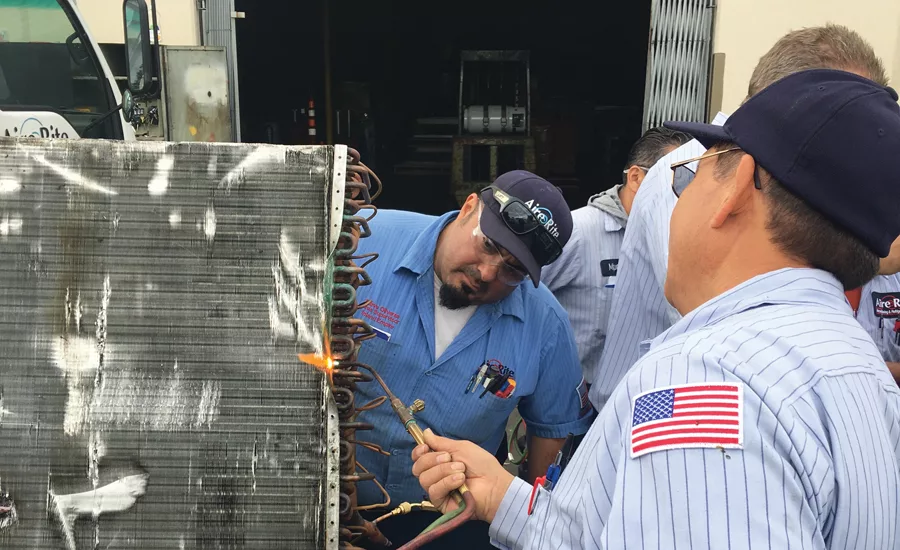
INTEGRATED SYSTEMS: High-performance buildings were defined by Congress in 2005 as buildings that integrate and optimize all attributes, including energy conservation, safety, security, durability, accessibility, costbenefit, productivity, and sustainability considerations.
When it comes to reducing facility downtime, increasing equipment lifespan, and decreasing operational costs, regular HVAC maintenance in commercial buildings is essential. However, best practices for commercial service contractors and technicians may differ when it comes to high-performance buildings.
Most high-performance buildings focus on energy efficiency, comfort, and productivity, according to Dick Starr, senior account executive, Enterprise HVAC Service & Control, Twinsburg, Ohio.
“High-performance buildings are normally ‘owner-occupied’ facilities,” Starr explained. “They include a senior management team that supports a facility manager’s (FM’s) efforts to create a building conducive to productivity, safety, good health, and energy efficiency, all within a cost-effective framework. A supportive executive team will give the FM the resources they need to predictably maintain the facility. Examples of these types of structures can be found in hospitals, tier one industrial plants, research centers, etc.
“They differ from other commercial HVAC maintenance strategies because, oftentimes, a commercial building is a leased facility or, even if owner-occupied, it’s allowed to operate within a commodity mindset,” he continued. “When this happens, ‘low bid’ is the operative, and it can range anywhere from the ‘break/fix’ mentality to only minimum preventive maintenance being performed.”
Unlike traditional buildings, where the focus is typically on a single source component like a chiller or cooling tower, high-performance buildings were defined by Congress in 2005 as buildings that integrate and optimize all attributes, including energy conservation, safety, security, durability, accessibility, cost-benefit, productivity, and sustainability considerations, noted Phil London, vice president of residential services, Thermal Concepts Inc., Davie, Florida.
“Many high-performance buildings are working toward or have achieved LEED-certified green building designations,” London said. “Regular maintenance is essential to maintaining this certification, but equally important is maintaining the key objectives defined in the original building concept — energy efficiency and an environmentally friendly facility.
“High-performance buildings depend on the ability to integrate with all components that make up the very essence of how it was designed,” he continued. “Failure to maintain each of these components has an adverse effect on the entire concept. These buildings incorporate a balance between maximum indoor air quality, energy efficiency, reduced greenhouse gas emissions, optimal lighting and acoustics, comfort cooling, and design humidity levels. Regularly scheduled maintenance in all these areas, with the properly trained technicians and personnel, is the key to maintaining this concept.”
Looking for quick answers on air conditioning, heating and refrigeration topics? Try Ask ACHR NEWS, our new smart AI search tool. Ask ACHR NEWS
Lanny Huffman, president, Hickory Sheet Metal Co. Inc., Hickory, North Carolina, said regular maintenance is determined by industry standards, such as ANSI/ASHRAE/ACCA Standard 180-2012, Standard Practice for Inspection and Maintenance of Commercial Building HVAC Systems.
“The standard explains the basic maintenance of the HVAC system,” Huffman said. “Commercial systems see a lot more run time, and it creates a problem when a system goes down, particularly when you have a central chiller or central unit for the entire building. Then you have several hundred people mad at you.
“And there’s the energy consumption factor for the facility as well,” he continued. “Because most of your big buildings are billed on a demand rate. In other words, the utilities will monitor your building, and if you hit a peak anytime they’re monitoring, that sets your rate for the rest of the year. So that difference could be literally thousands of dollars. The secret is to keep that system at optimum levels, so there’s not a change in your electrical rate. Not to mention, if you don’t maintain the equipment, the life expectancy for that equipment goes down exponentially.”
Traditional HVAC maintenance typically focused on scheduled tasks, such as changing the filters every quarter, according to Joseph Berg, vice president, Comfort Systems USA, Chandler, Arizona.
“What you really see from a high-performance building perspective is a focus on required or needed maintenance to maintain documented or major performance of the system — and I’m emphasizing the word system rather than equipment,” he said. “However, traditional maintenance is an important part of maintaining high-performance buildings as well. For example, coil cleaning is going to be no less important in a high-performance building than it is in a typical building.”
Don Langston, president and CEO, Aire Rite Airconditioning and Refrigeration, Huntington Beach, California, equated the difference between working on a high-performance building and a typical building to working on a basic four-door sedan versus working on a Ferrari or Corvette.
“That sports car is going to go faster and handle better, but it’s probably going to require more maintenance because it’s added more complexity,” he said. “If you have an architect who designs passive cooling and heating, then there’s less moving parts. That’s one thing. But if you have a building that has some level of cogeneration or heat recovery, the systems are dependent upon other systems to work efficiently. That’s going to require more maintenance.
“Sometimes people who design or commission buildings look at first cost and don’t really understand life cycle cost,” Langston continued. “So what happens is that there is a perception that people really don’t want to pay for proper maintenance. It’s hard for business owners or decision-makers to pay for a comprehensive maintenance program. And as you get into higher-performance buildings, I don’t have hard data to back this up, but I think a lot of these buildings that have gone LEED Platinum or Gold over the years, if you were to go back and look at them a couple years later, after all the fanfare, maintenance kind of gets forgotten or pushed by the wayside. So even though they may have started off at a higher energy efficiency state, it requires a lot of fine tuning to keep them in that condition.”
BEST PRACTICES
Lorton, Virginia-based Trademasters Service Corp. does a lot of maintenance work with federal government buildings. Contracts for operation and maintenance services at federal buildings have an array of requirements related to high-performance building maintenance best practices, noted Kathy Townsend, director of government contracts at Trademasters.
“Government agencies like GSA [General Services Admministration], NAVFAC [Naval Facilities Engineering Command], or the USACE [United States Army Corps Engineers] have developed standards for maintenance that are incorporated by reference into their maintenance contracts … as are requirements for experience and training standards for the staff that will work there,” she said. “On our contracts for the GSA, our personnel must have experience and references for operation and maintenance in similar facilities, and they must take specialized training throughout the performance period of our contract related to equipment retuning, sustainability, conservation, and smart building technology. Certifications like LEED, or different facility management certifications, are expected. They want safe, healthy, comfortable indoor environments, delivered as efficiently as possible. As energy prices continue to go up, all commercial facilities will be looking for the same.”
Best practices are developed when a building owner trusts an HVAC service provider and allows them to be a true business partner, engaging in strategic planning sessions, Starr noted.
“These meetings can also be initiated by the contractor as a way of showing the owner the holistic capabilities of the service provider, not to mention a willingness to share cost-avoidance strategies [integrity] that assist an owner with their budgeting,” he said. “Similarly, whenever an opportunity arises for a contractor to disarm an indoor air quality issue, the contractor can be very proactive by sharing these successes in a discretionary environment with the owner.”
Educating technicians and facility managers in principles, procedures, and methods that will reduce system failures is one of the best practices London follows.
“Test systems regularly to ensure energy efficiency is being maintained, and perform energy audits,” he said. “Additionally, recommend the maximum energy efficient replacement systems when applicable and provide support and tools to technicians to calibrate, operate, and maintain facilities in accordance with the original design concept.
“Be cognizant of the interactions of areas that are not directly mechanical in nature that impact the building concept,” London added.
It’s also recommended for contractors to adhere to ACCA technical manuals for commercial buildings.
“The standards give you some guidelines that are industry accepted,” Huffman said. “But it also takes training, especially if you bring in a service tech who is used to doing light commercial or large residential — it’s a different mindset. You have to be a lot more thorough.”
According to Langston, best practices vary from building to building because each one is unique.
“Every building is like a snowflake,” he said. “No two are alike. And it varies by climate. I’m in Southern California, and within a 100-mile radius, we have a variety of different climates, from Palm Springs to the mountains. So what I would do for a maintenance program out in Palm Springs is different from what I would do in Newport Beach. I would start with the minimum, and that’s where Standard 180 comes in. It gives you that foundation on which to build upon.”
Publication date: 7/16/2018
Want more HVAC industry news and information? Join The NEWS on Facebook, Twitter, and LinkedIn today!
Looking for a reprint of this article?
From high-res PDFs to custom plaques, order your copy today!