Many Facets to Chiller Selection
Contractors, consulting engineers can help building owners make the right equipment decisions
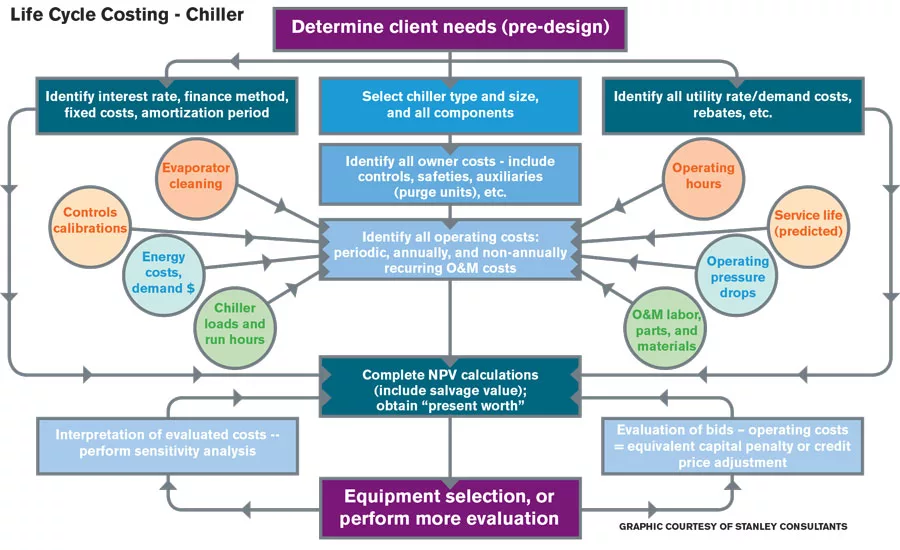
FIGURE 1: This flowchart illustrates the many factors that make up the chiller selection process. GRAPHIC COURTESY OF STANLEY CONSULTANTS
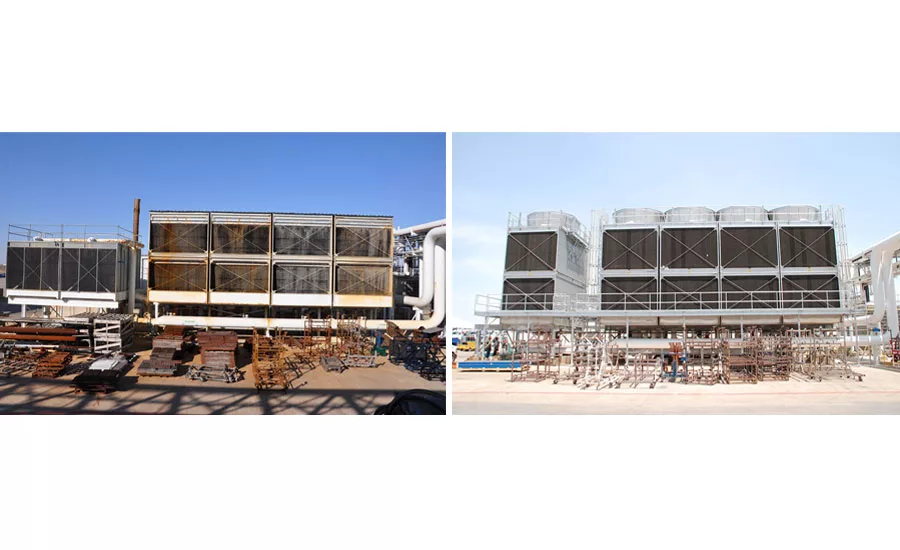
BEFORE AND AFTER: Customers who make the investment required to replace their chiller systems, such as this project at the Peterbilt factory in Denton, Texas, need and appreciate guidance from their contractors. PHOTOS COURTESY OF ENTECH SALES & SERVICE

DISTRICT PLANT: One of 23 pairs of 2,500 nominal electric motor-driven centrifugal chillers located on the Pearl of Qatar, which at the time was the largest district cooling plant in the world. The paired chillers were selected, in part, for their part-load performance. PHOTO COURTESY OF STANLEY CONSULTANTS
An investment in a new chiller is not one that building owners make lightly. Owners typically need and appreciate the guidance of a knowledgeable HVAC contractor when making this purchase as there are a number of factors that go into the selection process, and not all of them are necessarily related to the actual chiller itself.
AIR COOLED VS. WATER COOLED
Sonny Goodwin IV, vice president of engineering and construction, Entech Sales & Service, Dallas, said the first basic decision when it comes to selecting an air-cooled chiller or a water-cooled chiller traditionally has been a first-cost versus operational-cost decision for most building owners. However, with the increasing efficiencies of air-cooled chillers, it is also becoming a preference decision based on the application.
“Data centers and the K-12 market are prime candidates for air-cooled units,” Goodwin said. “Data centers don’t like to be tied to utilities provided by someone else, like the water supply from the city. If there’s a water main break, and they don’t have water for a day, the system is going to go down, and data centers can’t afford that possibility. When it comes to schools, it’s first cost plus the fact that schools typically don’t operate in the heat of the summer when air-cooled chillers are at their least efficient.”
Another factor in the air cooled versus water cooled decision is whether the client needs redundancy. Air-cooled chillers generally have less infrastructure costs, which makes them an attractive option for building owners who need multiple chillers.
When it comes to helping an existing service customer select a replacement chiller, Goodwin said he likes to present the decision-maker with two or three options.
“We try not to give them more than three because they can become mired in minutiae trying to make a decision,” he said. “We narrow the options down and provide them with a comparison of first cost, life cycle costs, and maintenance costs, along with system benefits and drawbacks. In addition, Entech has professional engineers on staff, so our engineering team can review the total system efficiency, including the pumps, fans, controls, etc.
Sometimes, doing a total system renovation can make a certain chiller configuration a better solution when compared to just a chiller replacement.”
Looking for quick answers on air conditioning, heating and refrigeration topics? Try Ask ACHR NEWS, our new smart AI search tool. Ask ACHR NEWS
In the big picture, Goodwin said the goal should be to help clients make the best decisions based not only on first cost but on a system that can meet their comfort and/or efficiency goals. Educate them on alternate solutions, so they can budget and invest in ways that benefit their businesses, he said.
“If you just talk about first cost versus operational cost, I can tell you in the real estate world that first cost tends to win a lot,” Goodwin said, with a laugh. “Architects love beautiful lobbies, and engineers love beautiful mechanical rooms. And we all know who usually wins that battle.”
A NEW PURPOSE
Mark Thompson, service operations manager, TDIndustries, Houston, said a common reason for a chiller replacement is the repurposing of older buildings. In many cases, these buildings were originally designed to be used during the day and then shut down at night.
However, with the new uses of these buildings, the concept has changed. Many are either office buildings converted to data centers or offices that now include rooms filled with sensitive equipment. In either case, these buildings now operate 24/7, and that calls for a different chiller design.
“You may look at a building that was designed with two large chillers: one to run during the day and one redundant,” Thompson said. “Today, you may want to equip that building with three smaller chillers: two to carry the load during the day and a small machine for the nighttime load. So, it’s important for both building owners and contractors to take the new needs of a building into account when replacing and sizing a chiller system.”
Another option in the above example may be to stick with two big chillers but to equip them with variable-speed drives and customized controls to optimize their operation based on the building’s varying needs.
“If you have building owners who want state-of-the-art equipment, the industry is certainly prepared to offer them highly efficient chillers that can dramatically reduce their energy costs,” Thompson said. “Of course, the trade-off is that it becomes a much more technical machine.”
Thompson cited oil-less technology as an example of what contractors can expect as chiller manufacturers constantly strive to create more efficient products.
“The major manufacturers are taking the oil-less approach in some way shape or form — magnetic or ceramic,” he said. “It’s a lot of technology, and although they can be complicated to work on right now, I see that being simplified over the next five to 10 years. Like anything else, as a technology becomes more mainstream, manufacturers work hard to make it simpler and easier to troubleshoot.”
Today’s chillers are also notably quieter and smaller than those made just 10 years ago.
Finally, Thompson said today’s higher-efficiency air-cooled chillers are attracting new attention despite their higher kW-per-ton operational costs compared to a water-cooled plant. So, it’s important to examine all the options to determine what might best serve the changing needs of your customers’ buildings.
“I think many building owners are looking closely at all the moving parts that go into a water-cooled system — the water supply, water treatment, cooling towers and fans, pumps, and so on — and are considering installing multiple air-cooled packaged systems instead,” Thompson said. “They have a shorter life expectancy, but the maintenance and repair costs on air-cooled equipment is less than the cost of a big water-cooled system. This is based on a large corporation’s study of a water-cooled system versus an air-cooled plant over 30 years.”
A CONSULTING ENGINEER’S PERSPECTIVE
A good contractor can make for a good project, said Randy Schrecengost, principal mechanical engineer, senior project manager, and mechanical department manager in the Austin, Texas, office of Stanley Consultants, a global consulting engineering firm based in Muscatine, Iowa. According to Schrecengost, chiller replacement projects often benefit from early contractor involvement.
“Most of my successful projects occurred when I teamed up with good HVAC contractors,” he said. “Having contractors involved during the early design review and constructability review provides an opportunity for everyone to be on the same page in the design approach.”
The best-case scenario when it comes to selecting a chiller occurs when contractors have existing relationships with clients.
“A contractor who has been providing periodic maintenance, such as cleaning tubes and replacing oil for a chiller, should be aware of the maintenance costs,” Schrecengost said. “Contractors need to gather and present that information to owners to justify replacing the chiller. This is also a good time to look at sizing and other factors. Was the current chiller sized correctly in the first place? Is it fully loaded or only partially loaded most of the time? Are there any issues with the chiller that are not allowing it to function efficiently? All those factors need to be considered.”
Once the replacement is justified, the process can move on to the chiller selection criteria (see Figure 1).
CODE REQUIREMENTS
Meeting the minimum code requirements is the first step in selecting a replacement. Schrecengost noted that ASHRAE Standard 90.1, “Energy Standard for Buildings Except Low-Rise Residential Buildings,” and the 2015 International Energy Conservation Code (IECC) specify the minimum efficiencies for chillers. Although some building owners will always be driven by first-cost considerations and select the minimum-efficiency option, the contractor, engineer, and manufacturer’s sales rep should always make sure to inform the owner of life cycle cost savings that can accrue by investing a little more up front.
“The additional incremental costs of efficiency can be calculated to see if it meets an owner’s net present value or return-on-investment criteria,” Schrecengost said.
Chiller replacement also presents an ideal opportunity for contractors and engineers to examine ancillary equipment, such as pumps, to help establish the most favorable overall cost of ownership.
Finally, Schrecengost advised contractors to attend engineering seminars and webinars, such as those regularly conducted by ASHRAE, to stay informed.
“The technology and the world are both changing all the time,” Schrecengost said. “For example, magnetic bearings and ceramic bearings have improved chillers’ efficiencies and saved on maintenance costs. Another example is air cooled versus water cooled. In the past, if you had a water supply, you’d buy a water-cooled chiller because they traditionally have been more efficient. But, air-cooled chillers are becoming increasingly efficient, and clients in the West and Southwest who can’t afford the water costs are switching to air-cooled units.
“Local ASHRAE chapters invite many different people and personnel to their meetings — there’s a mix of contractors, owners, design engineers, and equipment sales reps,” he added. “In any local ASHRAE chapter, you’ll find individuals who design the chillers, individuals who design systems around those chillers, and individuals who purchase those chillers and systems. I strongly encourage contractors to attend regularly and continuously educate themselves.”
Don’t Overlook These Chiller Selection Resources
When helping a customer make an investment in a new chiller, Sonny Goodwin IV, vice president of engineering and construction, Entech Sales & Service, Dallas, recommends turning to two often-overlooked sources of information.
“First, I ask my service technicians,” Goodwin said. “It’s easy to be impressed by the marketing literature and new technology, but it’s the guys servicing the chillers who really know the true quality of the equipment in the real world. Our engineers work closely with our technicians, and we really value the input of the guys who turn the wrenches and keep these systems working properly.”
The second source is to check out what the manufacturer charges for a five-year parts-and-labor warranty.
“Who knows more about chiller failure rates than the company that makes the chillers?” Goodwin asked. “The warranty cost is reflection of the OEMs experience. I always compare the warranty costs and ask myself why this OEM thinks it needs $20,000 to keep the machine operating for five years, when another manufacturer says it only needs $10,000. It’s a litmus test.”
Publication date: 5/22/2017
Want more HVAC industry news and information? Join The NEWS on Facebook, Twitter, and LinkedIn today!
Looking for a reprint of this article?
From high-res PDFs to custom plaques, order your copy today!


