Safely and Securely Putting Big Data to Use
Building management software now analyzes data and provides a course of action
Building management systems have evolved from thermostats on the wall to sophisticated control systems run by advanced software. Today’s systems can precisely monitor and control mechanical systems and building functions from virtually anywhere in the world as well as collect and compute system performance data and trends.
But, much like all technological advancements, questions arise, such as what data are most useful, how should it be analyzed, and how can HVACR contractors best use that information. Also, in the age of cyberterrorism, contractors are tasked with ensuring building control systems and software are secure and safe from the threat of hackers.
DATA: KNOW THE GOAL
When it comes to data, it’s important to understand the type and amount of data that can be gathered by building management software. It’s equally important that contractors comprehend the strategies customers are trying to employ at any given site. If the goal is to monitor simple operational expenses, the system may collect data from the energy meters. At a more complex site, a building operator might want to add lighting status and occupancy counts. Universities and other large campuses may be looking at centralizing or optimizing their overall operating plans and may want to include data, such as pump speeds, refrigerated water flow, operating loads, and other parameters.
“It really comes down to what the building owner or customer is trying to achieve,” said Chris Lane, senior product manager, building automation systems, Johnson Controls Inc.
Building management software is constantly evolving, and the trend clearly is toward more data and smarter devices at every level of a building’s mechanical systems, noted Lane.
A traditional building automation system provided data on temperatures, pressures, humidity, energy consumption, and demands. Antiquated systems may also provide the status of the mechanical systems and run time of the equipment, Lane said. More advanced software can include the status of systems outside the traditional building automation silo, such as fire, smoke, and security. The most recent evolution can allow a building’s systems to interact with other sources of information, such as weather forecasts from the National Oceanographic and Atmospheric Administration.
“All of this data is typically used by the facility manager to operate the building day to day,” Lane said. “When a contractor is enlisted to perform service work or install an expansion or upgrade of the mechanical systems, the contractor will typically request access to some of that data. This presents an opportunity to perform trend studies of temperatures, equipment run time, and other HVAC-related parameters to help troubleshoot and diagnose buildings’ systems and optimize their performance.”
Looking for quick answers on air conditioning, heating and refrigeration topics? Try Ask ACHR NEWS, our new smart AI search tool. Ask ACHR NEWS
Lane added that where the software exists also is evolving.
“Many companies have software-only solutions that can be applied on top of building automation systems, mine the data in those systems, and perform algorithms or analytics to provide insights to users,” he said. “We’re also seeing software embedded in the actual equipment controllers, and we’re starting to see an evolution with the Internet of Things where smaller and smaller devices, such as actuators and meters, have data connectivity.”
That means a growing need for security against system hackers. Lane said Johnson Controls incorporates dozens of features to secure its software and embedded controllers, including user management tools, such as strong password requirements and enabling session time outs, encryption of data to prevent any type of man-in-the-middle or sniffing of data, and tools for system administrators to help them identify and remove the user privileges of employees who have left the company.
In addition to those steps, Lane recommended coordination between the HVAC contractor and the building’s IT department.
“Having a closer alignment typically provides better insight into what security precautions and measures need to be employed to make sure a building automation system is secure,” he said. “An upfront and early alignment with the IT department is usually a good best-practice rule.”
Lane added that contractors also can help by ensuring their building owners and operators keep their systems up to date and make sure patches and updates to the software are done in a timely manner. He noted that these updates often include new security features that have been added to make the software more secure.
THERE’S MORE TO IT THAN DATA
Paul Rauker, vice president and general manager of the systems and controls business at Daikin Applied, said the data gathered from HVACR equipment has traditionally been very simplistic, but that has changed dramatically over the past few years.
“For example, with our intelligent rooftops and chillers, contractors can see 150-160 points of data,” Rauker said. “These data can help them analyze whether there’s an issue with a piece of equipment or an opportunity to improve its performance. The data they’re getting now versus what they were getting just a few years ago is like night and day.”
But there’s more to the equation than just data.
“Everyone can say, ‘Oh, big data's important.’ Yes, it’s important, but what’s even more important is what contractors do with it and how they use it in ways that benefit themselves and their customers,” Rauker said. “That's really the next step in what all this data is about.”
A strong example of turning data into action can be found in monitoring power consumption. Many contractors closely watch the energy usage of their equipment, and that can be an effective way to use data to track and trend equipment performance. However, it’s even more effective to look at the power consumption in relation to the conditions under which the equipment is operating and in the context of the indoor environment you’re trying to achieve.
Rauker noted that good data analysis increases your chance of determining whether a piece of equipment is operating efficiently and effectively. One example would be to trend the internal data, such as power consumption, with external weather data and desired space temperature. This would allow an individual to see different levels of cooling and provide the ability to suggest optimal cooling strategies.
Rauker stressed it’s important for OEMs to ensure contractors can easily and effectively interface with the equipment.
“The interface is potentially more important than the data itself,” he said. “If the interface doesn't provide value, and isn’t easy for a contractor to use, it doesn’t matter how much data is in there. If a contractor doesn’t like the interface, he or she won’t use it. That’s why Daikin has focused a tremendous amount of effort and resources on ensuring our Intelligent Equipment interface is user-friendly and works for the contractor.”
When it comes to security, Daikin strives to ensure that all levels of access — from physical to virtual — are protected.
“We enlist companies, like McAfee, who have completed penetration testing on our user interface and use Intel’s embedded Wind River software gives us board-level security,” Rauker said. “We also have boot-level security, which provides protection against malicious attacks on the operating system. By partnering with industry security leaders, we ensure our focus is on delivering value to contractors in a safe and secure environment.”
MAKING MARKETS SUPER
Sophisticated facility management software isn’t limited to commercial buildings. In fact, it may be even more valuable in supermarkets that include a mix of HVAC and refrigeration equipment.
Paul Hepperla, vice president of North American solution sales, retail solutions for Emerson’s commercial & residential solutions platform, said the company’s ProAct™ software is designed to help contractors monitor and manage all the different systems that interact in a modern supermarket.
“The main capability for our end users and their contractors is the ability to remotely access HVAC and refrigeration systems,” Hepperla said. “Remote access benefits contractors by reducing the need to constantly be in reaction mode and it allows a more planned, informed approach. It also allows supermarket operators to focus more on selling product and less on how their systems are operating.”
Emerson’s ProAct software suite captures thousands of different data points every day. One aspect of this data, according to Hepperla, is tactical: What can be done with it right now? This covers the critical items for managing the day-to-day operation of a store, such as adjusting set points, changing schedules, or understanding and triaging alarms. There also are longer term impacts of the data.
“In many cases, our contractors and end users are leveraging the data to look across a period of time to determine trends,” Hepperla said. “Those trends can help identify how well their systems are operating and identify problems before they occur.”
Hepperla added that the key to trends analysis is twofold: understanding the data and understanding the outliers within that data.
“The trends data might simply reveal the fact that one of the contractor’s technicians is setting up the equipment incorrectly, which could allow for an additional training exercise,” he said. “It also might be that the end user is modifying his or her systems and changing the parameters the technician has set to maximize system performance.”
Hepperla said data security is going to be an increasingly important focus of these systems in the future. Emerson already takes a number of steps to that end, including working with its own band of “white hat” developers.
“Emerson has a group of people who do hack tests and penetration tests against our own systems before we ever release something to the marketplace,” he said.
If a breach does occur, the keys are to identify it quickly and then to mitigate and minimize the potential risk. One way to do this is to focus on the role of the user.
“Many of our users, including store managers, need view-only rights,” Hepperla said. “We want to work with our customers to make sure they’re setting the appropriate access levels within the system to minimize the chance that someone could take a user name and password, get into the system, and then have the ability to make massive changes.”
REAL-TIME AND ACTIONABLE
Danfoss Enterprise Services is a cloud-based service delivery platform tailored to supermarket and other food-retail applications. It’s designed to allow chain and store management, maintenance personnel, and contractors to collect a range of data points from connected devices to provide insight into nearly every aspect of HVACR operations, energy management and usage, benchmarking, and food safety.
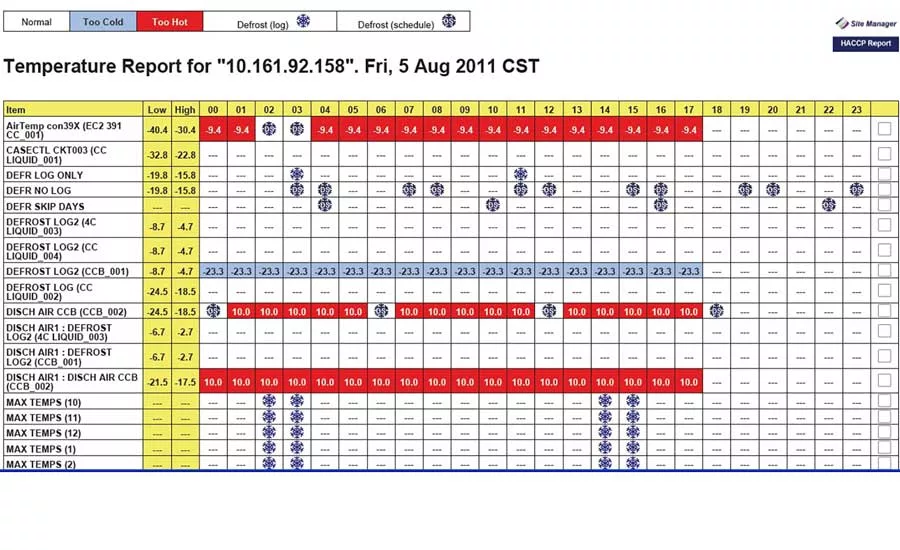
Richard Ruth, product manager – services, Danfoss, said the data collected includes stores’ electrical usage, electrical data on specific equipment as required, temperature and pressure data collected by the refrigeration control system, weather conditions, light monitoring, and humidity monitoring to assess the overall performance of the facilities. Danfoss Enterprise Services also provides users with alarm and refrigerant data as well as product temperatures to minimize food loss and meet hazard analysis and critical control points (HACCP) requirements.
“The data collected provides real-time, actionable information through modules [available à la carte or in structured bundles] to monitor an array of parameters, including alarm management, compressor status, leak detection, refrigerant levels, and temperatures for food safety,” Ruth said. “Services, such as energy information benchmarking, continuous commissioning, and demand response programs, help to promote maximum energy efficiency and savings.”
In addition, by monitoring temperature trends and alarms, Danfoss Enterprise Services can determine failures and dispatch a contractor to the site to correct the problem before there is a food-loss incident. Also, with energy monitoring, food-retail chains can compare store performance and, by learning best practices, improve energy performance and reduce overall costs enterprise wide.
“Danfoss Enterprise Services helps store owners and management to make fast decisions to maximize energy efficiencies and cost savings, optimize food safety, and reduce environmental footprint by utilizing connected devices and data,” Ruth said.
On the security side, to set up Danfoss Enterprise Services, a virtual private network (VPN) connection is required to provide a secure data connection/tunnel between the Danfoss data center and the food retailer’s internal controller network. According to Ruth, this VPN connection ensures a high level of security, privacy, and restricts access from outside intruders. When installed and configured, the connection can help protect against malware, hacking, and data theft.
The building management software being developed for and implemented by HVACR contractors today offers a level of control, energy savings, safety, and value to customers that could only be dreamt of a generation ago. And it will only continue to grow and evolve. It will be interesting to see what the future holds.
Publication date: 1/9/2017
Want more HVAC industry news and information? Join The NEWS on Facebook, Twitter, and LinkedIn today!
Looking for a reprint of this article?
From high-res PDFs to custom plaques, order your copy today!