Safer RTU Service: Field-Tested Ways to Use Sensors and Smart Practices to Cut Ladder Climbs
With fall hazards still leading construction fatalities, remote monitoring is giving technicians new ways to stay safe
NOT JUST PPE: The best way to statistically avoid injuries caused by ladders is to just to use them less. Technicians can leverage remote monitoring and predictive maintenance to do just that.
According to OSHA, falls from elevation remain the deadliest hazard in construction, and RTU installation and maintenance fall squarely into that risk profile. In fact, falls accounted for 421 of the 1,075 reported fatalities in 2023.
Ladders are one of the main ways technicians access RTUs, and they do represent a major source of potential injuries. NIOSH’s ladder safety data shows 161 ladder-related fatalities in 2020, alongside 22,710 ladder-related injuries. A separate NIOSH fact sheet aimed specifically at roofs, ladders, and scaffolds bluntly states that falls are the leading cause of construction worker deaths and focuses its guidance on keeping people off exposed edges and away from unprotected climbs whenever possible.
When it comes to workplace safety, OSHA has created what it calls the “hierarchy of controls.” Sitting atop that pyramid is “elimination of a hazard,” which is above engineering controls, administrative controls, and even PPE. That means the safest ladder climb is the one that doesn’t have to be made.
For RTU work, “elimination” doesn’t mean never going to the roof — it means eliminating the unnecessary climbs just to see what a unit is doing. Remote monitoring and preventative maintenance scheduling play a huge part in eliminating climbs, allowing operators to see how equipment is running without needing to physically visit every unit
Does that mean every trip up a ladder is a potential death sentence? No. But the risk also isn’t non-trivial. Luckily, advances in technologies are helping HVAC technicians to avoid climbs and rooftops “whenever possible.”
To get a field-level view of what makes rooftop work challenging, and where smarter equipment and practices actually help, ACHR NEWS spoke with Josh Souders, HVAC manager at Cardinal Plumbing Heating & Air.
Tips From the Field: Q&A With Josh Souders
ACHR NEWS: Over the past year, which RTU service tasks or aspects have consistently slowed you down or made the job more miserable?
Looking for quick answers on air conditioning, heating and refrigeration topics? Try Ask ACHR NEWS, our new smart AI search tool. Ask ACHR NEWS
Souders: Access is often the biggest challenge. Waiting for building keys, finding roof access, and hauling heavy tools up ladders all take extra time. Poor installation practices also slow things down. When units are installed incorrectly, it leads to extra work and frustration. The weather is another major factor. Heat, wind, cold, and rain all make the job harder and less safe. Older RTUs without proper controls or displays make diagnostics slower and less accurate. Cramped compartments and poor layouts make it difficult to service motors or compressors safely.
ACHR NEWS: What are some of your favorite features you’re seeing on newer RTUs? What features do you want to see in the future?
Souders: Variable-speed compressors and ECM motors reduce energy use and wear. Digital controls and remote monitoring make diagnostics faster and more precise. Tool-less panels and viewports save time during maintenance. Slide-out blower assemblies and modular parts make cleaning and replacements easier. Pressure transducers and built-in filter sensors give early warnings for airflow or pressure problems.
For future models, we’d love to see more standardized control interfaces between manufacturers as well as stronger self-diagnostics that can predict faults and send mobile alerts. Lightweight, corrosion-resistant panels would make installation and service easier. Built-in lift points would make rooftop handling safer. AI-assisted diagnostics that analyze live data could save even more time in troubleshooting.
ACHR NEWS: Any tips or tricks (service, installation, troubleshooting) for other contractors out there?
Souders: Always confirm roof access before leaving the shop. It prevents wasted trips and delays. Check simple things first, like filters, breakers, and wiring. Use remote monitoring tools whenever possible to review system data before climbing up. Label all wiring and components, especially on older systems. It saves time for you and the next technician. Use a rope and bucket to lift heavy tools and parts safely. Keep magnets or trays handy to hold screws and small parts. Always double-check airflow direction and fan rotation after replacing a motor or blower.
ACHR NEWS: What PPE rules do you enforce, without exception, on rooftops? Are there any specific instances where even more precautions are taken?
Souders: Hard hats and safety glasses are required whenever there is a risk of falling tools or debris. Gloves are a must when handling metal, wiring, or refrigerant lines. Non-slip safety boots with ankle support are required for any roof work. Fall protection is mandatory within 6 feet of an unprotected edge. Hearing protection is used when working near running units or generators. Weather gear and sunscreen are important year-round to prevent heat or cold-related injuries.
Extra precautions apply during high winds or storms. Rooftop work should stop until conditions improve. When working alone, technicians must notify the office, maintain communication, and check in regularly. During electrical work, always verify that power is off with a meter and use lockout/tagout procedures. At night or in low light, use a headlamp and take extra care with footing and visibility.
Savings and Safety through Sensors
The safety argument of eliminating unnecessary climbs gets even stronger when you look at what can happen at scale. In one Carrier Abound case study, a national discount retailer with more than 2,000 U.S. locations had, on average, seven to eight rooftop units per store from multiple brands. Their challenge was the same one contractors live with every day: Keep occupants comfortable, cut energy and maintenance costs, and somehow manage all those RTUs from a central location instead of chasing problems store by store.
Carrier’s Abound team tied the chain’s existing BMS, sensors, meters, and rooftop equipment into a cloud platform and staffed it with 24/7 command centers. Data scientists, controls specialists, and HVAC techs monitored alarms and trends, pushed recommendations back to stores, and used automation software to let the system correct some issues on its own. Over time, those predictive insights turned into standardized control strategies, repair-and-maintenance programs for the controls, and even demand-response participation across hundreds of sites.
By 2024, the program had logged more than 160 million kWh of energy savings over five years. More importantly for technicians, about 45% of HVAC and lighting work orders were handled remotely, avoiding an estimated $7.2 million in truck rolls. In practical terms, those numbers mean nearly half of the issues that once triggered a site visit were handled from a command center instead of from the roof. For contractors that deal with RTUs, that’s thousands of climbs that simply never happened.
Constant Communication
Daikin has taken the idea of the “talkative” rooftop unit further than most.
Its Intelligent Equipment platform connects directly to Daikin packaged rooftops and air-cooled chillers and streams data to the cloud, giving owners and service teams more than 150 real-time data points per rooftop unit. Because the sensors are mounted at the unit and tied into an Intel-based gateway, the system can trend performance from commissioning onward, track unit-level energy consumption, and generate preventative maintenance notifications based on actual run time rather than a calendar.
On top of that hardware, Daikin and Intel layer cloud analytics. The Rebel rooftop systems with an embedded Intel IoT Gateway collect data from sensors and actuators and send it over a 3G cellular link to cloud software. That software continuously monitors performance, performs fault detection, and even predicts maintenance needs by watching components like fans and motors degrade over time.
Building staff and technicians are able to see all of this through role-based dashboards. This gives owners a simplified view of comfort and energy, while service managers get a Technician Dashboard where authorized users can adjust setpoints and resolve operational questions remotely, with all points logged and trended for advanced diagnostics. Daikin explicitly pitches Intelligent Equipment as a way to enable “remote diagnostics and smarter truck rolls” compared to a traditional BAS.
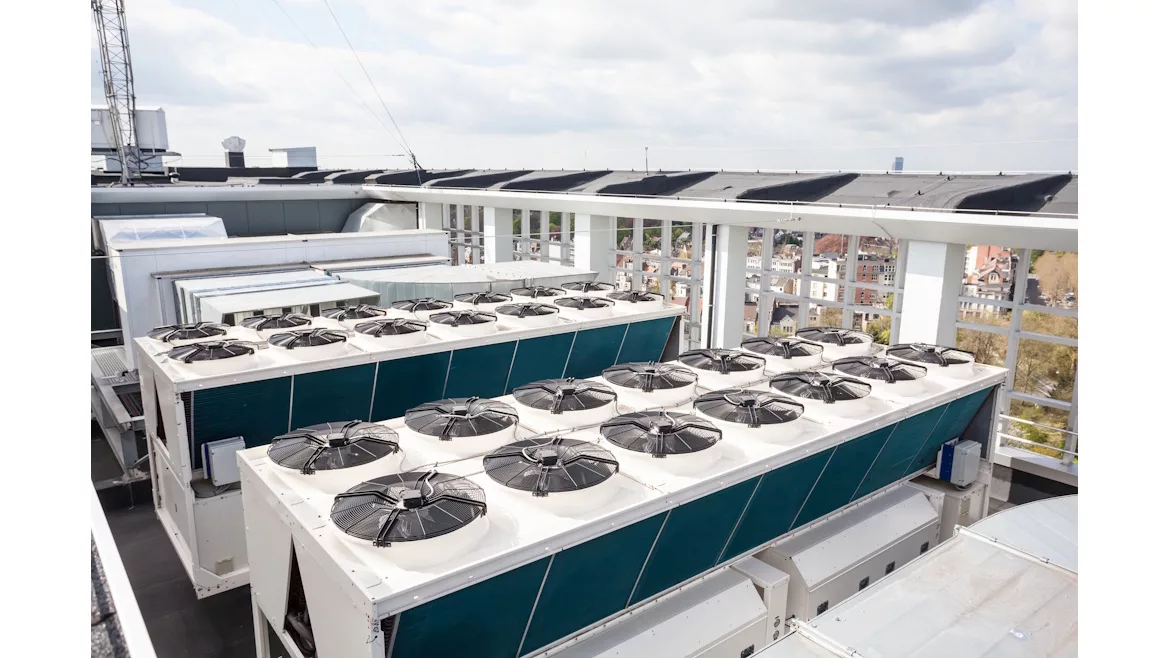
A separate Daikin case study shows how that kind of always-on monitoring plays out on real rooftop equipment. At Heilig Hart Regional Hospital in Leuven, Belgium, Daikin air-cooled chillers sit on the roof of the central building and are tied into the cloud-based Daikin on Site (DoS) platform under a service contract. DoS leak-detection algorithms flagged abnormal behavior based on several months of operating data, prompting a Daikin remote monitoring engineer to review the trend data and then schedule an on-site inspection. The inspection confirmed a small refrigerant leak, about 4 kg out of 39 kg, or roughly 12% of the charge, and the team repaired the unit and refilled the refrigerant within three weeks, without any loss of cooling to the hospital. Daikin notes that without the leak-detection feature, the issue might have gone unnoticed for months.
For contractors who live on rooftops, the pattern is the same whether it’s a Rebel RTU or a hospital chiller: The equipment is instrumented, the data is streamed, and a lot of the early detective work happens on a screen instead of at the unit. The climbs that still have to happen are targeted, scheduled with the right parts and a clear diagnosis, rather than repeated “go see what it’s doing” trips up the ladder.
Looking for a reprint of this article?
From high-res PDFs to custom plaques, order your copy today!