Accelerated Change Disrupting US Commercial Refrigeration Market
Danfoss’ EnVisioneering symposium continues much-needed dialogue
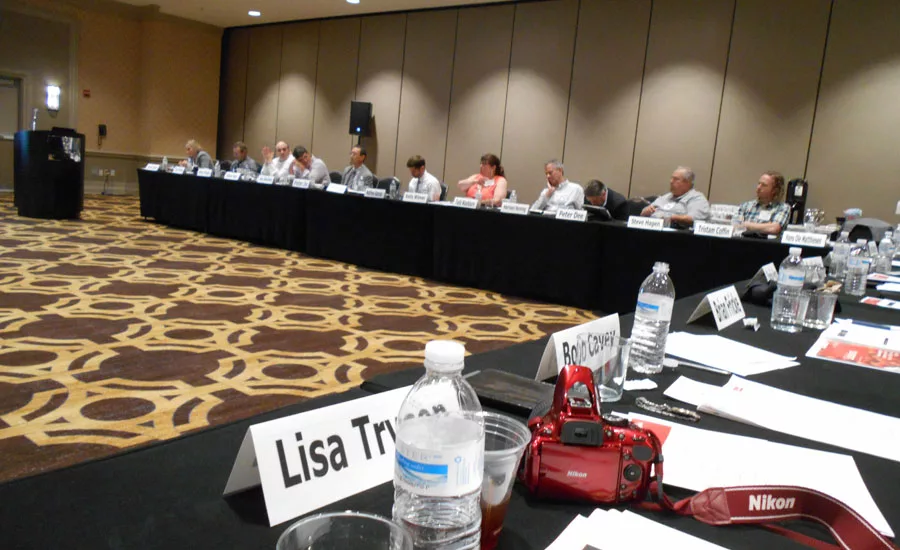
Danfoss held its 28th EnVisioneering Symposium in New Orleans.
Danfoss recently held its 28th EnVisioneering Symposium, Refrigerants2Sustainability, in New Orleans to continue the dialogue among equipment manufacturers, end users, utilities, and regulators on the path ahead for the commercial refrigeration industry.
As the fourth symposium Danfoss has hosted dedicated to issues in commercial refrigeration, the event built upon the discussion from the symposium held in 2015 and was led by presentations from:
• Tom Land, manager, GreenChill Partnership, U.S. Environmental Protection Agency (EPA).
• Mark Menzer, director of public affairs, Danfoss.
• Brian Fricke, R&D staff, Building Equipment Research, Energy & Transportation Science Division, Oak Ridge National Laboratory (ORNL).
• Harrison Horning, director of equipment purchasing, maintenance and energy, Hannaford Brothers/Delhaize America.
• Matthew Aberant, project director, sustainability and energy, WSP Parsons Brinckerhoff.
• John Bush, senior engineer, Electric Power Research Institute (EPRI).
Looking for quick answers on air conditioning, heating and refrigeration topics? Try Ask ACHR NEWS, our new smart AI search tool. Ask ACHR NEWS
• Hans Ole Matthiesen, global segment director – food retail, Danfoss.
REGULATIONS DRIVING TECHNOLOGY AND ADOPTION
According to participants, the accelerated pace of regulatory change remains one of the industry’s biggest hurdles. In the past year alone, changes to federal energy and refrigerant regulations and standards have demanded the attention of equipment manufacturers and retailers, and are compounded by state-level regulations like those from the California Air Resources Board (CARB). Among the regulations:
• The EPA has made updates to Section 608 of the Clean Air Act that would expand beyond ozone-depleting refrigerants to include HFCs, reduce annual leak rates, and add leak repair verification procedures.
• U.S. Department of Energy’s standards for commercial refrigeration equipment raise minimum efficiencies up to 40 percent and go into effect March 27, 2017.
• CARB proposes a 40 percent reduction in emissions by 2030 through bans of high-global warming potential (GWP) refrigerants, exclusive of any national or international regulation.
And there are, Menzer acknowledged, further implications for domestic policy in an international agreement reached under the Montreal Protocol.
This complex and rapidly changing landscape creates challenges for equipment manufacturers trying to identify the next step to compliance, and for retailers and contractors seeking clear guidance to help prepare and train staff. In fact, participants noted, 70 percent of DOE’s budget today is spent on enforcement.
The bigger ‘stumbling block’ for industry, however, is the impact of regulatory change on codes and standards — including ASHRAE Standard 15 and building and fire codes related to flammable refrigerants — and the timeline for their development and deployment.
However, achieving high performance, low-emission systems is possible today. In his presentation, Fricke outlined the results of an ORNL study that tested seven different refrigeration systems to identify their lifetime emissions.
The study found that several valid low-GWP options exist for supermarket refrigeration. The lowest emissions resulted from a CO2 cascade system with either R-717, R-1234yf, R-32, or R-134a; and a transcritical CO2 booster system — compared to a baseline R-404A multiplex direct expansion system, which produced at least 73 percent more emissions.
Verifying the practical use of CO2 refrigeration, Horning addressed the use of case controls, which he noted are an enabling technology for CO2 and facilitate significant levels of efficiency. They are also a logical interim step in making the transition to natural refrigerants because they can be deployed today with an acceptable payback period that makes them economically feasible, even if a full turnover to CO2 is not. He estimated that 20 percent of all refrigeration cases ordered today are being ordered with case controls, which is a dramatic upward trend from a couple of decades ago.
FINANCING AND THE PATH FORWARD
Seeing an opportunity to help expedite the move to low-GWP refrigerants in commercial refrigeration systems, some utilities, like Sacramento Municipal Utility District (SMUD), have started to develop financing programs that make the transition from high-GWP refrigerants more cost effective.
According to Aberant, a consultant working with SMUD, these programs — such as SMUD’s Custom Incentive Program — would help to end the expensive cycle of refrigeration system upgrades and retrofits due to refrigerant phaseouts and replacements, assist with the initial cost of new equipment installation, support emerging technologies that enable customers to improve energy efficiency and reduce direct greenhouse gas (GHG) emissions, and lower energy bills and refrigerant costs.
Bush noted, however, that verifiable data is a critical to establishing well-defined baselines and helping utilities validate to regulatory agencies that the ratepayer is the ultimate beneficiary of any financing program. He emphasized that, to incentivize, utilities are looking at energy savings and avoiding peak demand — and that what they want is known, predictable, repeatable savings.
In the U.S., brownouts and blackouts cost an estimated $150 billion annually, but a fully deployed smart grid could reduce energy use and emissions by 18 percent. Moving forward, the opportunity is significant for commercial refrigeration and supermarket systems to build upon the existing energy-efficiency technologies that can help to unload and better integrate with the grid and take advantage of demand response capabilities. Specifically, Matthiesen outlined ways in which supermarkets can participate in demand side management, including defrost shifting, thermal storage, rail-heat/anti-sweat heaters, and light dimming.
As momentum and interest continues to build on global, national, and state levels for low-GWP refrigerants and greater energy efficiency, it is unlikely the pace of change will slow or the level of disruption diminish in the foreseeable future. However, managing the turbulence and finding a path toward cost-effective, scalable, environmentally friendly commercial refrigeration solutions will require the ongoing collaboration of all industry stakeholders — from store owners and contractors to equipment manufacturers, utilities, and policy makers.
Launched in 2006, Danfoss’ EnVisioneering Symposia Series facilitates an ongoing dialogue among industry, the policy community, and thought leaders in research and development. For more information about the Symposia Series, visit http://www.danfoss.us/industry-outreach-and-engagement/.
Looking for a reprint of this article?
From high-res PDFs to custom plaques, order your copy today!