VRF Making Inroads in Hospital, Intensive Care Markets
Variable refrigerant flow becoming popular due to its ability to optimize zoning capabilities
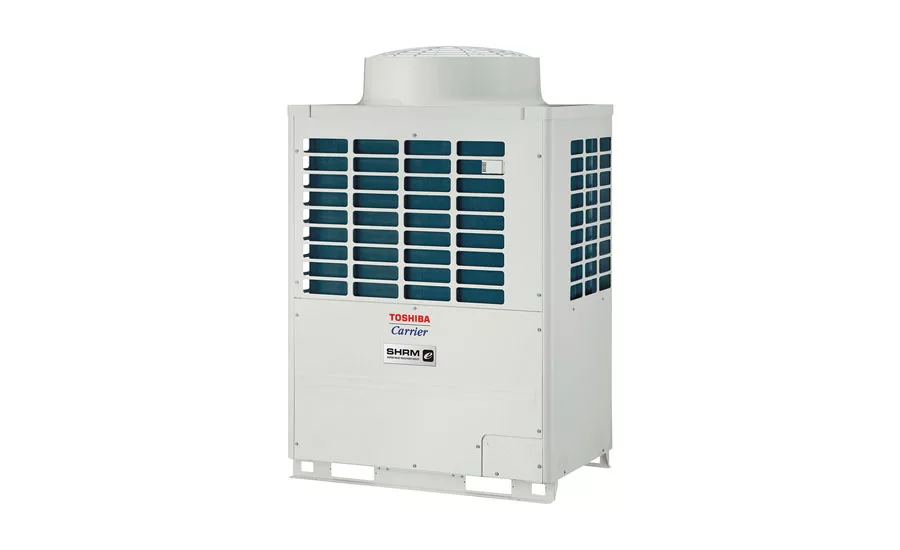
MAXIMUM FLEXIBILITY: The Toshiba Carrier VRF Single or Multiple Module Heat Recovery system is available in 6-, 8-, 10-, 12- and 14-ton single modules, which can be combined up to 38-ton capacity. Additionally, up to 64 indoor units can connect to a triple module outdoor unit. The product features a 3-pipe heat-recovery system, high-performance outdoor units with all inverter driven twin rotary compressor, a DC Inverter condenser fan motor, and a 13 percent smaller footprint with space-saving models available in select sizes.
Hospitals, which are open and operate 24/7, consume considerable amounts of energy. According to the 2007 Commercial Building Energy Consumption Survey (CBECS), major fuels (electricity, natural gas, fuel oil, and district heat) consumed by large hospitals totaled 458 trillion Btu, which is 5.5 percent of the total delivered energy used by the commercial sector in 2007.
In order to reduce energy consumption and save money on operating costs, many hospitals have been looking to replace existing HVAC systems with more energy-efficient equipment. Variable refrigerant flow (VRF) systems are becoming popular options due to their zoning capabilities, which limit energy use in areas not constantly in use.
“Hospital air conditioning systems consume a lot of energy due to the code requirements for high air turnover rates and the fact that that they must operate 24/7,” said Ed Ferrier, senior manager of engineering, LG Electronics USA Inc. “LG VRF systems provide exceptional dehumidification and temperature control by rapidly adapting to changing loads, which results in superior energy savings. Additionally, VRF systems offer exceptional zone control capabilities and are a perfect fit for hospitals wanting to provide individual zone controls for patient rooms and nurses’ stations. Furthermore, LG indoor units operate at low sound levels, which is extremely beneficial to both hospital patients and staff.”
Chris Bellshaw, director, VRV product marketing, Daikin North America LLC, said Daikin’s variable refrigerant volume (VRV) systems are a good fit for the overall health care industry based on their general features and the benefits they provide. “VRV products are being used in applications, such as general and urgent care practices, assisted living facilities, sleep centers, dental practices, and medical office buildings. These health care segments are looking for the ability to provide comfort and individual temperature and humidity control to multiple zones, low sound levels, and zone-by-zone filtration to help reduce cross-contamination between spaces. A VRV system provides the flexibility, reliability, and attributes to meet these needs.”
VRF systems precisely control temperatures to match strict requirements in health care buildings, noted Gabe Weiss, marketing manager, ductless and VRF, Carrier Corp.
“With this tightening of temperature control, VRF systems can help increase the comfort level of the patients, visitors, and staff,” Weiss said. “The turndown capability of the compressors and systems themselves allow for the systems to exactly match the load diversity of hospitals and fluctuating occupancy schedule by only delivering as much or as little capacity as the zones need.”
VRF IN A HYBRID SYSTEM
Not all industry experts believe VRF technology is a good fit in hospital settings.
Looking for quick answers on air conditioning, heating and refrigeration topics? Try Ask ACHR NEWS, our new smart AI search tool. Ask ACHR NEWS
“Based on the current equipment lineup from all the major manufacturers, hospital/critical care applications are not really a great fit for VRF,” said Jade Culbertson, national sales manager, ECOi VRF Systems, Panasonic USA. “However, that is today. This vertical is one that you will begin to see VRF adapt to. VRF systems will need to address such issues as increased accuracy for temperature and humidity control, increased capability for advanced filtration requirements, and the ability to deliver sterile air.”
Culbertson noted that VRF systems working in conjunction with additional HVAC equipment are becoming popular options in hospital applications.
“In terms of hospitals, you’re dealing with three or four different microenvironments,” he said. “You have administrative areas, office areas, and critical care environments, like isolation rooms, surgery centers, etc. All of those areas require high air changes per minute in order to be in compliance with the joint commission, which is the regulatory body for hospitals. In order for a hospital to have accreditation, it has to prove it has an HVAC system that can provide sterile air and very close temperature and humidity control. VRF, conditionally, has been a light commercial HVAC system. The systems you see today don’t inherently meet critical care requirements. VRF is typically used to take care of reception areas, waiting rooms, or office areas. VRF will likely adapt to this market and manufacturers like Panasonic will begin to bring VRF technologies, such as hybrid/hydronic VRF that is capable of delivering chilled and hot water and air-purifying technologies, such as our Nanoe-G system, that effectively suppresses airborne contaminants and micro-organisms, such as bacteria and viruses. VRF certainly has its place in healthcare environments, specifically within assisted living and medical offices. However, systems will need to adapt and be further developed in order to accommodate the critical care and surgery areas of hospital environments.”
Craig Elliott, enterprise account leader, Trane, an Ingersoll Rand brand, said VRF systems are well-suited for small- to medium-sized buildings with multiple relatively small, separate zones.
“In the health care market, VRF systems are typically utilized more in medical office buildings and some assisted living facilities,” Elliott said. “VRF solutions are not widely used in hospital patient spaces or surgical suites because of the stringent regulations regarding refrigerants as outlined in ASHRAE 15. However, VRF systems can be good solutions in some health care applications because they offer energy efficiencies that can help owners realize significant savings on utility bills. In addition, occupant satisfaction can be increased because VRF systems allow individual zones to be heated or cooled as desired, even if nearby zones are at significantly different temperatures.”
Tony Ring, VRF sales manager, Lennox Intl. Inc., agreed, saying VRF is a great addition as a secondary comfort system for parts of a hospital.
“Typically, VRF doesn’t try and tackle things like operating rooms, surgical rooms, or clean rooms that come along with a hospital. What VRF is very good at doing with hospitals, and the health care market in general, is pairing with other mechanical systems so the building can downsize its primary equipment. Things like doctor’s offices, waiting rooms, any sort of emergency care entrance areas, and exam rooms — those are great integrations for VRF.”
AN AFFORDABLE OPTION
When undergoing both new construction or renovating existing buildings, total life-cycle cost of the products, application, and ongoing operating expenses are always a very important part of the decision-making process, Bellshaw noted.
“The total life-cycle cost of VRV systems are exceptional,” he said. “This is true for the majority of health care facilities and the key reason why VRV is a viable solution. When you consider all of the benefits of a VRV solution, it becomes a very affordable choice in both first cost and operational costs.”
Additionally, the modular concept of VRV allows for staged installation, so the entire facility does not need to be shut down. Compact indoor units, outdoor units, and small-diameter refrigerant piping can allow for the existing system to stay in place and operate during installation. And, when decommissioned, VRV units can stay in place to reduce demolition costs, Bellshaw explained.
Once VRF systems can prove they meet the stringent requirements of typical hospital environments, then they will prove to be very viable and cost-effective solutions, Culbertson added. “With VRF, ductwork will be greatly reduced, and available space will most certainly make VRF a very attractive solution for hospital administrators and engineers. In the health care market, it’s most important to focus on things like compliance and safety than on cost and ROI [return on investment].”
Controlling operational costs and ensuring a good return on investment are crucial factors for most hospitals, Elliott said.
“Improving energy efficiency provides hospitals with an ongoing revenue stream, and it doesn’t require a huge investment,” he said. “Even small building energy management projects can yield big results. This idea can be especially helpful for the health care industry as facilities face shifting expectations and challenges, including ever-changing regulations, budget constraints, and competition for capital. As a result, there is increasing pressure to make sure the right facility investments are made. Based upon first costs only, VRF is typically a higher cost option than other solutions. However, because of the zone control and significant energy efficiency VRF systems provide, they can deliver significant savings over the life of the system.”
Ring added that by factoring in VRF, the total application payback period can significantly be reduced from a 10-15 year average payback to about five to seven years.
“Obviously, VRF offers less of an upfront cost than hydronics, but it’s not as low as say a packaged rooftop unit. So, there is a small premium that comes with installing VRF, but it is recouped quickly because the system cuts out the need for natural gas heating and focuses on one energy utility while maximizing peak energy performance.”
Weiss said initial costs and ROI vary per application because each building is unique. “VRF systems can be customized for any given building. Designs with an increased number of zones require more equipment, controls, installation components, etc., and could be several times more expensive than one that has less zones and complexity. For each building, there is a logical and resourceful way to design a VRF system to meet the heating and cooling needs. Due to the flexibility in initial design, first costs will also change along with return on investments. To generate the most reliable and accurate analysis, it is important to look at each case individually.”
BENEFITS OF VRF
There are numerous benefits when applying VRF to health care applications.
“The benefits include lower energy costs, lower installation costs, modular design that allows for phased projects, and integrated controls that may lead to additional cost savings,” said Ferrier. “Additionally, more usable square footage is a benefit as a result of the decreased space required above ceilings and dedicated to mechanical rooms and shafts compared to conventional ducted systems due to the use of refrigerant piping to transfer heat and not ducts.
“Other benefits that enhance the user experience include superior zone control, low indoor unit sound levels, and a variety of aesthetically pleasing options for indoor units, like Art Cool™ Mirror or Art Cool Gallery,” he continued. “Furthermore, LG Heat Recovery, an alternative to the LG VRF Heat Pump system, further enhances energy savings by allowing for simultaneous cooling and heating operation within the same system of indoor units by transferring heat rejected from one space to a different space that may be calling for heat.”
“VRF is one of the fastest-growing heating and cooling technologies in North America because it offers excellent efficiency, improved space comfort through zone control, and a small footprint, which makes these systems a good solution for facilities that don’t have a lot of space,” Elliott added. “Variable-speed technology works by meeting the actual load required during any given time over a wide operational range, meaning the speed and output of the components vary to reflect the conditions and demands of the space. Compressors and fans are able to operate at their fastest levels when demand is high and modulate to slower levels when demand is less, which results in lower annual energy use and, typically, smaller annual energy bills. This makes VRF an energy-efficient option that offers reduced costs and maintenance over the life of a system. In addition, VRF systems provide quiet operation, which is an important factor in applications, such as health care and education.”
“A primary benefit of VRF in conjunction with other mechanical systems is the areas that need true comfort get a system that really focuses on comfort,” said Ring. “VRF was brought to the market and designed for zoned comfort applications. In terms of a waiting room, you get quiet sound with a mechanical system that is constantly maintaining a comfortable temperature. By integrating VRF into any system, hospitals included, you get to take advantage of an extremely high-efficiency system. In the health care market, over the last three years, we’ve seen a 2-3 percent market share gain in VRF. We see it becoming a large part of the VRF business, and we’re hoping to see that trend continue in health care and in hospitals.”
Publication date: 10/31/2016
Want more HVAC industry news and information? Join The NEWS on Facebook, Twitter, and LinkedIn today!
Looking for a reprint of this article?
From high-res PDFs to custom plaques, order your copy today!