ACHR News
search
Ask ACHR NEWS AI
cart
facebook twitter instagram linkedin youtube
  • Sign In
  • Subscribe
  • Sign Out
  • My Account
ACHR News
  • NEWS
    • Breaking News
    • New HVAC Products
    • Featured Products
    • Manufacturer Reports
    • HVAC Data
    • Legislation
    • ACHR NEWS Centennial
  • RESIDENTIAL
    • Air Conditioners
    • Furnaces
    • Residential Heat Pumps
    • Ductless
    • Residential IAQ
    • Testing, Monitoring, Tools
    • Components & Accessories
  • COMMERCIAL
    • Air Handlers
    • Rooftop Units
    • Chillers and Cooling Towers
    • Commercial Heat Pumps
    • Boilers and Hydronics
    • VRF/Ductless
    • Commercial IAQ
  • REFRIGERATION
    • Refrigerants
    • Refrigerant Regulations
    • Leak Management
  • CONTRACTOR PRO
    • Geothermal
    • Homeowner Study
    • VRF and VRV Ductless
    • Unitary Trends
  • EDUCATION
    • Training and Education
    • Business Management
    • Service and Maintenance
    • Continuing Education
    • Market Research >
      • HVAC Brand Awareness Report
      • VRV, VRF, VRVZ Report
      • Unitary Trends Report
      • Water Heat Professionals Report
    • Webinars
    • Sponsor Insights
    • eProducts Info
    • White Papers
  • EVENTS
    • HVAC Contractor Forum
    • Industry Events and Webinars
  • MEDIA
    • Videos
    • AHR Expo 2025 Videos
    • Podcasts >
      • ACHR News Podcast
      • HARDI Podcasts
      • AHR Expo Podcasts
      • ACCA Podcasts
    • Interactive Spotlights
    • Quizzes
    • eBooks
    • HVAC Talkback
  • HVAC GROUP
    • ACHR NEWS >
      • Current Issue
      • Digital Edition
      • Subscribe
    • Distribution Trends
    • SNIPS NEWS >
      • Join SNIPS NEWS
    • Engineered Systems News >
      • Join ES News
    • HVACR Directory
    • Contests
    • Newsletters
    • Contact
    • Advertise
    • My Account
HVAC ContractingService and Maintenance

Leak Testing and Evacuation

Service Tips for Techs
By Mike Taitano
December 9, 2013
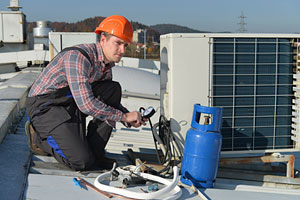
Technician servicing an HVAC unitFor newer technicians on the job, here are a couple of HVAC service tips about leak testing and evacuating after repairing a system.

The best way I've found to leak test a system is to pressurize it with nitrogen to about 125 psi, check the system with a bubble type leak detector, then leave it pressurized overnight.

I'll leave a pressure gauge connected to the system so I can check pressures the next day without having to mess around with any Schraders or isolation valves.

I'll connect the gauge with brass fittings and copper tubing, but I won’t use the hoses from a gauge manifold set.

If the nitrogen pressure holds overnight, I can be pretty sure there’s no leak in the system.

After that I’ll vent the nitrogen, and hook up a vacuum pump.

I use copper tubing, put an isolation valve on the vacuum pump and at both access ports, and I find one more location to attach my micron gauge, also with an isolation valve.

Then I vacuum the system until the micron gauge reads below 500 microns.

Looking for quick answers on air conditioning, heating and refrigeration topics? Try Ask ACHR NEWS, our new smart AI search tool. Ask ACHR NEWS →

What I do is leave the isolation valve on the micron gauge closed during the evacuation, except for when I want to check the micron level.

When I want to check the micron reading, I open the isolation valve and wait for about a minute, then close the isolation valves at the vacuum pump and access ports, and turn off the vacuum pump.

Depending on the size of the system you’re repairing on your HVAC service call, it might take a couple of minutes for the micron reading to steady out.

If the reading steadies out above 500 microns, I close the isolation valve and continue evacuating.

If the reading steadies out below 500 microns, I close the isolation valve, wait for 10 or 15 minutes, then open the isolation valve again and check the reading.

If the reading has stayed the same, I consider the evacuation complete, and start the re-charging procedure.

If the reading has risen above 500 microns, I close the isolation valve and continue evacuating until the micron reading will stay below 500.

Occasionally an isolation valve, flare nut connection, or micron gauge will go bad and start leaking during an HVAC service call, so keep this in mind, and leak test the equipment on a regular basis.

If your system held 125 psi of nitrogen overnight but won’t vacuum down to below 500 microns, carefully check your vacuum pump and all evacuation connections to the system.

Publication date: 12/9/2013

Want more HVAC industry news and information? Join The NEWS on Facebook, Twitter, and LinkedIn today!

KEYWORDS: Repairing HVACR service calls

Share This Story

Looking for a reprint of this article?
From high-res PDFs to custom plaques, order your copy today!


Mike Taitano is a technician with 20 years of experience troubleshooting, repairing, and maintaining air conditioning and refrigeration equipment. He also operates Air-Conditioning-and-Refrigeration-Guide.com. For more information, visit www.air-conditioning-and-refrigeration-guide.com.

Recommended Content

JOIN TODAY
To unlock your recommendations.

Already have an account? Sign In

  • HVAC-enrollment

    The Trades Are Back: HVACR Programs See Nearly 30% Enrollment Spike

    A new wave of future technicians is entering the pipeline.  
    News
    By: Matt Jachman
  • 2025 Top 40 Under 40

    2025 Top 40 Under 40 HVACR Professionals List

    The 11th annual Top 40 Under 40 list highlights those...
    News
    By: Hannah Belloli-Oster
  • LG Ductless Mini-Split Systems

    The 9 Types of Heat Pumps

    As the U.S. moves toward electrification, heat pumps are...
    Ground Source Heat Pumps
    By: Joanna R. Turpin
Subscription Center
  • Create an Account
  • Start a Subscription
  • Manage My Account
  • Sign Up for Newsletters
  • Visit Customer Service
  • Update Preferences

More Videos

Sponsored Content

Sponsored Content is a special paid section where industry companies provide high quality, objective, non-commercial content around topics of interest to The News audience. All Sponsored Content is supplied by the advertising company and any opinions expressed in this article are those of the author and not necessarily reflect the views of The News or its parent company, BNP Media. Interested in participating in our Sponsored Content section? Contact your local rep!

close
  • Piggy Bank
    Sponsored byWatercress Financial

    Energy Prices, Inflation, and HVAC: What Today’s Homeowners Care About

  • Refrigerated Food
    Sponsored bySolstice Advanced Materials

    R-455A Refrigeration: A Cold Storage Solution for the Future

  • Airex Rooftop Units
    Sponsored byAirex Manufacturing Inc

    Consolidating Roof Penetrations: A Growing Trend in Multifamily HVAC Design

Popular Stories

HVAC-Price-Increase-graphic

HVAC Price Increase List: June 2026

Trump-Section-232.jpg

Trump Reduces Section 232 Tariffs on HVAC Equipment to 15%

Refrigerants-and-gauge.jpg

HVAC Industry Warns of Counterfeit Refrigerants Entering U.S. Supply Chain

U.S. Supreme Court building

95% Furnace Efficiency Rule to Get New Hearing

Midea-training.jpg

HVAC Workforce Crisis Expands Beyond Technicians to Instructor Shortages

View The ACHR NEWS
Centennial Anniversary Timeline

The ACHR News Timeline Chart
Submit a Letter
Submit a letter to our editors.

Events

November 6, 2025

Next-Gen Data Center Cooling: HVAC Innovation and Real-World Solutions

On Demand As AI workloads and high-density computing push traditional cooling methods to their limits, the data center industry is accelerating the adoption of next-generation HVAC technologies.

June 17, 2026

Decarbonization Without Disruption

This webinar will explore practical HVAC decarbonization strategies that minimize disruption while maximizing long-term performance and ROI.

View All Submit An Event

Poll

Summer Staff

Are you fully staffed for the summer season?
View Results Poll Archive

Products

BNI Mechanical/Electrical Square Foot Costbook, 2026 Edition

BNI Mechanical/Electrical Square Foot Costbook, 2026 Edition

See More Products
Decarbonization Without Disruption - Free Webinar - 6/17/2026

Related Articles

  • Utilizing SMART Tools to Optimize Leak Testing, Processing, and Manufacturing

    See More
  • McGill AirSeal LLC: Online Leak Testing Selection Tools

    See More
  • Air Conditioning Freezing

    See More

Related Products

See More Products
  • srepm.png

    System Recovery & Evacuation

  • Semi-Hermetic Compressors: Testing, Servicing & Isolating DVD

  • 9781482255676.jpg

    Testing and Balancing HVAC Air and Water Systems, Fifth Edition

See More Products

Events

View AllSubmit An Event
  • January 14, 2026

    Future-ready HVAC Systems: Transitioning to A2L with New Gas Leak Sensors

    On Demand This session will explore how emerging approaches to leak detection and system monitoring are meeting the demands of modern refrigeration and HVAC applications.
View AllSubmit An Event

Related Directories

  • Airserco Mfg. Co.

    Cutting-edge HVACR manufacturing equipment, including automatic leak testing, evacuation, refrigerant charging, and function test equipment, as well as oxyhydrogen brazing systems.
×

Sign Up. Stay Informed.

The #1 trusted source for the HVACR industry since 1926

SUBSCRIBE
  • RESOURCES
    • Advertise
    • Contact Us
    • Advisory Board
    • Classifieds
    • Submit a Letter
    • Directories
    • Store
  • ACCOUNT CENTER
    • Create an Account
    • Start a Subscription
    • Manage My Account
    • Sign Up for Newsletters
    • Visit Customer Service
    • Update Preferences
  • SERVICES
    • Marketing Services
    • Reprints
    • Market Research
    • List Rental
    • Survey/Respondent Access
  • STAY CONNECTED
    • LinkedIn
    • Facebook
    • Instagram
    • YouTube
    • X (Twitter)
  • PRIVACY
    • PRIVACY POLICY
    • TERMS & CONDITIONS
    • DO NOT SELL MY PERSONAL INFORMATION
    • PRIVACY REQUEST
    • ACCESSIBILITY

Copyright ©2026. All Rights Reserved BNP Media, Inc. and BNP Media II, LLC.

Design, CMS, Hosting & Web Development :: ePublishing