ACHR News
search
Ask ACHR NEWS AI
cart
facebook twitter instagram linkedin youtube
  • Sign In
  • Subscribe
  • Sign Out
  • My Account
ACHR News
  • NEWS
    • Breaking News
    • New HVAC Products
    • Featured Products
    • Manufacturer Reports
    • HVAC Data
    • Legislation
    • ACHR NEWS Centennial
  • RESIDENTIAL
    • Air Conditioners
    • Furnaces
    • Residential Heat Pumps
    • Ductless
    • Residential IAQ
    • Testing, Monitoring, Tools
    • Components & Accessories
  • COMMERCIAL
    • Air Handlers
    • Rooftop Units
    • Chillers and Cooling Towers
    • Commercial Heat Pumps
    • Boilers and Hydronics
    • VRF/Ductless
    • Commercial IAQ
  • REFRIGERATION
    • Refrigerants
    • Refrigerant Regulations
    • Leak Management
  • CONTRACTOR PRO
    • Geothermal
    • Homeowner Study
    • VRF and VRV Ductless
    • Unitary Trends
  • EDUCATION
    • Training and Education
    • Business Management
    • Service and Maintenance
    • Continuing Education
    • Market Research >
      • HVAC Brand Awareness Report
      • VRV, VRF, VRVZ Report
      • Unitary Trends Report
      • Water Heat Professionals Report
    • Webinars
    • Sponsor Insights
    • eProducts Info
    • White Papers
  • EVENTS
    • HVAC Contractor Forum
    • Industry Events and Webinars
  • MEDIA
    • Videos
    • AHR Expo 2025 Videos
    • Podcasts >
      • ACHR News Podcast
      • HARDI Podcasts
      • AHR Expo Podcasts
      • ACCA Podcasts
    • Interactive Spotlights
    • Quizzes
    • eBooks
    • HVAC Talkback
  • HVAC GROUP
    • ACHR NEWS >
      • Current Issue
      • Digital Edition
      • Subscribe
    • Distribution Trends
    • SNIPS NEWS >
      • Join SNIPS NEWS
    • Engineered Systems News >
      • Join ES News
    • HVACR Directory
    • Contests
    • Newsletters
    • Contact
    • Advertise
    • My Account
HVAC ContractingService and Maintenance

Furnace Installation Safety

By Leo A. Meyer
August 6, 2012
This article deals with your personal safety — and the safety of those who work with you.

Emergency Procedures

On construction jobs, the general contractor is required to have a first aid kit and at least one person trained in first aid. You should always know where the fire extinguishers are located.

If you work in homes, have a first aid kit and a fire extinguisher in your truck. Keep a fire extinguisher next to you when brazing a line set. Have a list of emergency numbers where help can easily be located. It is good idea for you to be trained in first aid.

Clothing and Safety Gear

A neat appearance is important when working in someone’s home. Many contractors think that it is so important that they supply company uniforms for all their employees. Always follow these safety rules:

• Wear high top, leather work shoes, preferably with steel toe protection.

• Wear long pants. Shorts are not acceptable.

• Wear protective sleeves when cutting sheet metal.

• Avoid loose clothing, which can increase your chances of being caught by moving machinery.

Looking for quick answers on air conditioning, heating and refrigeration topics? Try Ask ACHR NEWS, our new smart AI search tool. Ask ACHR NEWS →

• If your hair is long, tuck it up under a hat or cap.

• Always carry safety goggles and use them whenever there is danger to the eyes, especially when working on electricity, when pounding or sawing, or when working overhead or in a dirty, dusty environment.

• You are required to wear a hard hat on any construction project.

• Wear ear protection if you are working in a noisy area. Prolonged exposure to noise leads to hearing loss.

Fall Protection
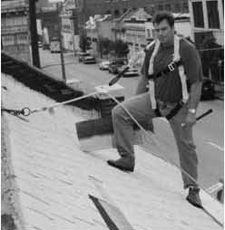
fall protection gear
Figure 1. Fall protection gear.

Some installations are on roofs. The Occupational Safety and Health Administration (OSHA) requires that anyone working on a pitched roof over 10 feet above the ground must wear fall protection gear. This consists of a safety harness and a lanyard that is attached to an approved attachment point (Figure 1).

Electricity

When installing a residential furnace, you will normally be working with 120 volt circuits. However, if an air conditioning unit is part of the system, the circuit may be 240 volts.

Never work on a live circuit. An electrical shock is never pleasant. Under certain conditions, even a 120 volt shock can stop the heart. Be aware that you can get a shock from the neutral wire as well as the hot wire.

Always carry a volt-ammeter to measure the circuit voltage and also to check that a circuit is dead. Even though you have thrown a switch or a circuit breaker, always test the circuit to be sure that it is dead before you work on it. If a switch has been wired improperly (with the neutral wire through the switch) the circuit may still be live.

Electricity always seeks the easiest path to ground. If you receive an electrical shock and are well grounded, the shock will be severe. Water is an excellent conductor of electricity, so if your shoes are wet, you will receive a severe shock. The same is true if you are touching steel in a structure. On the other hand, if you are standing on a dry board or wearing dry shoes with insulating soles, the shock will be minimal.

Lock Out, Tag Out

electrical outlet
Figure 2. An outlet for an extension cord should be a GFCI.

You may have to turn the power off at the circuit breaker panel in order to kill the furnace electrical circuit. Many residential breaker panels do not have each breaker switch properly labeled to show what circuit each controls. This means a trial and error process of switching off a breaker and checking to see what circuit is dead.

 Before turning off breaker switches, make everyone in the home aware that there may be a temporary power outage for some house circuits.

If you shut off a switch or breaker, tag it so that no one will turn it on while you are working on equipment. On a construction job, lock the switch handle with your padlock and attach a warning tag. On a residential job, attach a warning note to the breaker switch so that no one will activate the breaker.

GFCI

A ground fault circuit interrupter (GFCI) is an electrical outlet that provides the surest protection against electrical shocks. The GFCI senses an electrical short by detecting an imbalance of the current between the hot and neutral lines of the circuit. When a short is detected, the GFCI shuts down the circuit instantly.
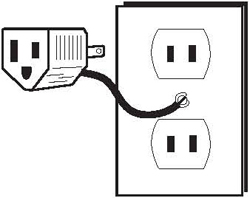
GFCI adaptor
Figure 3. GFCI adaptor that plugs into a wall outlet.

An outlet for an extension cord should be a GFCI (Figure 2). If it is not, use a GFCI adaptor that plugs into a wall outlet (Figure 3), or use a “pig tail” adaptor (Figure 4). You should never use extension cords or power tools without a GFCI.

Do not take chances with damaged cords or defective tools. Have them replaced immediately. Even 120 volts can kill. Even if a shock does not kill, it could cause you to jerk, which could cause you to fall or contact moving equipment.
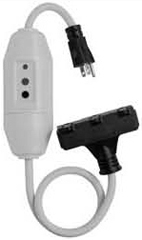
 

"pig tail" adaptor
Figure 4. A “pig tail” adaptor for a GFCI. (Courtesy Tower Mfg. Corp.)

Fuel Safety

You may have to shut off the main fuel supply to the residence in order to connect the piping to the furnace. Notify the homeowner before you do. Determine what other appliances (such as water heaters and stoves) operate from the same fuel. You will have to relight these when you turn the fuel back on.

Test all new pipe connections with a detector or soapy water to be sure there are no leaks.

Natural gas can accumulate in closed spaces, such as in the furnace. If there is any possibility that leakage has occurred, shut off the gas service and allow at least five minutes for the gas to disperse before attempting any ignition.

LPG is heavier than air. If there is a leak, the gas will settle to the lowest area and remain there until it is removed by ventilation.

If you have to use any type of lighted torch, it is critical to have a fire extinguisher close at hand. Insulation or other parts of the house could catch fire.

Confined Spaces

Working in areas that have little or no ventilation can be dangerous:

• Inadequate oxygen in a space can result in unconsciousness and even death.

• Toxic chemicals (such as paint thinners and cleaners) are especially dangerous in a confined space.

If you must work in a confined space, use a fan for ventilation.

Excerpted and reprinted from Installing Residential Forced Air Furnaces by Leo A. Meyer with Michael Bugaeff, one of the books in the Indoor Environment Technician’s Library series published by LAMA Books.

Publication date: 8/6/2012

KEYWORDS: safety training

Share This Story

Looking for a reprint of this article?
From high-res PDFs to custom plaques, order your copy today!


For over 30 years, Leo A. Meyer has written and published training materials for the HVAC industry. His books cover a wide range of topics, including heating and cooling, indoor air quality, sheet metal work, electricity basics, safety, and others. For more information, visit www.lamabooks.com.

Recommended Content

JOIN TODAY
To unlock your recommendations.

Already have an account? Sign In

  • HVAC-enrollment

    The Trades Are Back: HVACR Programs See Nearly 30% Enrollment Spike

    A new wave of future technicians is entering the pipeline.  
    News
    By: Matt Jachman
  • 2025 Top 40 Under 40

    2025 Top 40 Under 40 HVACR Professionals List

    The 11th annual Top 40 Under 40 list highlights those...
    HVAC Residential Market
    By: Hannah Belloli-Oster
  • LG Ductless Mini-Split Systems

    The 9 Types of Heat Pumps

    As the U.S. moves toward electrification, heat pumps are...
    HVAC Residential Market
    By: Joanna R. Turpin
Subscription Center
  • Create an Account
  • Start a Subscription
  • Manage My Account
  • Sign Up for Newsletters
  • Visit Customer Service
  • Update Preferences

More Videos

Sponsored Content

Sponsored Content is a special paid section where industry companies provide high quality, objective, non-commercial content around topics of interest to The News audience. All Sponsored Content is supplied by the advertising company and any opinions expressed in this article are those of the author and not necessarily reflect the views of The News or its parent company, BNP Media. Interested in participating in our Sponsored Content section? Contact your local rep!

close
  • Piggy Bank
    Sponsored byWatercress Financial

    Energy Prices, Inflation, and HVAC: What Today’s Homeowners Care About

  • Refrigerated Food
    Sponsored bySolstice Advanced Materials

    R-455A Refrigeration: A Cold Storage Solution for the Future

  • Airex Rooftop Units
    Sponsored byAirex Manufacturing Inc

    Consolidating Roof Penetrations: A Growing Trend in Multifamily HVAC Design

Popular Stories

Outdoor-condensing-units.jpg

EPA Removes R-410A Installation Deadline

Trump-Section-232.jpg

Trump Reduces Section 232 Tariffs on HVAC Equipment to 15%

cooling-habits.jpg

50 Percent of Americans Have Skipped HVAC Maintenance

ACHR NEWS Editor Chris Gray Presenting HVAC Minute 5-18-2026

HVAC Manufacturers Fight Pricing Lawsuits

tim-brooks.jpeg

2026’s Best Distributor Partners With Customers

View The ACHR NEWS
Centennial Anniversary Timeline

The ACHR News Timeline Chart
Submit a Letter
Submit a letter to our editors.

Events

November 6, 2025

Next-Gen Data Center Cooling: HVAC Innovation and Real-World Solutions

On Demand As AI workloads and high-density computing push traditional cooling methods to their limits, the data center industry is accelerating the adoption of next-generation HVAC technologies.

June 9, 2026

Before You Go All In on AI: Set Up Your Business to Actually Win

In this webinar, we'll walk you through exactly what to get in place before you add AI to your business. You'll leave with a clear picture of where you stand today and a practical action plan to set yourself up for real results.

View All Submit An Event

Poll

EPA Decision

Are you happy the EPA decided contractors can continue to install R-410A equipment?
View Results Poll Archive

Products

BNI Mechanical/Electrical Square Foot Costbook, 2026 Edition

BNI Mechanical/Electrical Square Foot Costbook, 2026 Edition

See More Products
A2L Refrigerants - Free Webinar - May 21, 2026

Related Articles

  • gas-furnace.jpeg

    Gas Furnace Installation: Safety and Performance Best Practices

    See More
  • gas-furnace-install.jpg

    Gas Furnace Installation: What Every HVAC Technician Must Get Right

    See More
  • May 20, 2010: ACCA Releases Gas Furnace Installation Video Training Program

    See More

Related Products

See More Products
  • HPOIS.png

    Heat Pump Operation, Installation, Service

  • 1819.gif

    Fire, Smoke and Radiation Damper Installation Guide for HVAC

  • The ACHR News - February 2, 2026

    ACHR NEWS February 2, 2026, Issue

See More Products

Related Directories

  • MSA Safety (Manufacturer)

    MSA Safety Incorporated (NYSE: MSA) is the global leader in advanced safety products, technologies, and solutions. For the HVAC-R industry, MSA Safety provides gas and refrigerant analysis, detection, monitoring, and tracking solutions. Their FieldServer IIoT gateways are ideal for enabling 24/7 cloud-based monitoring solutions.
×

Sign Up. Stay Informed.

The #1 trusted source for the HVACR industry since 1926

SUBSCRIBE
  • RESOURCES
    • Advertise
    • Contact Us
    • Advisory Board
    • Classifieds
    • Submit a Letter
    • Directories
    • Store
  • ACCOUNT CENTER
    • Create an Account
    • Start a Subscription
    • Manage My Account
    • Sign Up for Newsletters
    • Visit Customer Service
    • Update Preferences
  • SERVICES
    • Marketing Services
    • Reprints
    • Market Research
    • List Rental
    • Survey/Respondent Access
  • STAY CONNECTED
    • LinkedIn
    • Facebook
    • Instagram
    • YouTube
    • X (Twitter)
  • PRIVACY
    • PRIVACY POLICY
    • TERMS & CONDITIONS
    • DO NOT SELL MY PERSONAL INFORMATION
    • PRIVACY REQUEST
    • ACCESSIBILITY

Copyright ©2026. All Rights Reserved BNP Media, Inc. and BNP Media II, LLC.

Design, CMS, Hosting & Web Development :: ePublishing