ACHR News
search
Ask ACHR NEWS AI
cart
facebook twitter instagram linkedin youtube
  • Sign In
  • Subscribe
  • Sign Out
  • My Account
ACHR News
  • NEWS
    • Breaking News
    • New HVAC Products
    • Featured Products
    • Manufacturer Reports
    • HVAC Data
    • Legislation
    • ACHR NEWS Centennial
  • RESIDENTIAL
    • Air Conditioners
    • Furnaces
    • Residential Heat Pumps
    • Ductless
    • Residential IAQ
    • Testing, Monitoring, Tools
    • Components & Accessories
  • COMMERCIAL
    • Air Handlers
    • Rooftop Units
    • Chillers and Cooling Towers
    • Commercial Heat Pumps
    • Boilers and Hydronics
    • VRF/Ductless
    • Commercial IAQ
  • REFRIGERATION
    • Refrigerants
    • Refrigerant Regulations
    • Leak Management
  • CONTRACTOR PRO
    • Geothermal
    • Homeowner Study
    • VRF and VRV Ductless
    • Unitary Trends
  • EDUCATION
    • Training and Education
    • Business Management
    • Service and Maintenance
    • Continuing Education
    • Market Research >
      • HVAC Brand Awareness Report
      • VRV, VRF, VRVZ Report
      • Unitary Trends Report
      • Water Heat Professionals Report
    • Webinars
    • Sponsor Insights
    • eProducts Info
    • White Papers
  • EVENTS
    • HVAC Contractor Forum
    • Industry Events and Webinars
  • MEDIA
    • Videos
    • AHR Expo 2025 Videos
    • Podcasts >
      • ACHR News Podcast
      • HARDI Podcasts
      • AHR Expo Podcasts
      • ACCA Podcasts
    • Interactive Spotlights
    • Quizzes
    • eBooks
    • HVAC Talkback
  • HVAC GROUP
    • ACHR NEWS >
      • Current Issue
      • Digital Edition
      • Subscribe
    • Distribution Trends
    • SNIPS NEWS >
      • Join SNIPS NEWS
    • Engineered Systems News >
      • Join ES News
    • HVACR Directory
    • Contests
    • Newsletters
    • Contact
    • Advertise
    • My Account

Smart Customers Can Google Energy Use

By Joanna R. Turpin
December 13, 2010
TED home monitors interface with Google PowerMeter, allowing customers to obtain a full picture of their energy use. (Courtesy of Energy Inc.)

While most homeowners have a vague idea of how much they pay for utilities each month, few are aware of just how much electricity they use on a daily or weekly basis. Nor do they know which appliances contribute the most to their electricity bill or exactly when most of the electricity in their home is being consumed. Homeowners seeking to fill in this knowledge gap can now turn to home energy monitors, which provide real-time information about their electricity usage.

Becoming more aware of energy usage is the first step consumers need to take if they are to become smarter, greener homeowners, said, Hugh A. Joyce, president, James River Air Conditioning, Richmond, Va. “We believe that what gets measured gets done. If there’s a radar gun on your car all the time, you won’t speed. If you measure the performance of your technicians and post it, they tend to perform better. And if you measure how much juice you’re using in your home, you tend to figure out ways to use less.”

While there are many different types of home energy monitors available, Joyce likes those that can be linked to Google PowerMeter, which is a free energy monitoring tool that enables customers to view their energy consumption online or via a Smartphone. By monitoring electricity use - and modifying their behavior - Joyce noted that most homeowners should be able to recoup the cost of their energy monitor in one or two years.

DRIVING DOWN ENERGY USE

Joyce has offered customers home energy monitors coupled with Google PowerMeter for about six months as a way to encourage customers to become smarter energy users. “What we love about Google PowerMeter is that wherever they are, homeowners can always check their home’s energy usage. It provides hourly, daily, weekly, and monthly energy-efficiency ratings, but even more importantly, Google looks at the house all the time and creates an ‘always-on’ graph.”

The always-on graph reports the phantom load that is always on in a house, such as refrigerators and computers. The always-on load is where the rubber meets the road in energy savings, noted Joyce, as this is an area that can easily be modified by homeowners.

“By monitoring peak loads and the always-on numbers through Google, homeowners can tweak their houses to drive those two numbers lower,” said Joyce. “Google PowerMeter actually walks customers through how to drive their power usage to its lowest level, then it’s possible to share that data with friends and family. The collaborative effect of sharing the data is very powerful because it can incentivize others to be smart about energy use in a non-punitive way.”
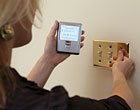
Customers can personalize TED by entering in their specific utility rates, and creating load profiles for specific appliances in their home. (Courtesy of Energy Inc.)

On the hardware side, Joyce offers The Energy Detective (TED) home monitor because of its price point, its ease of installation, and its ability to interface with Google PowerMeter. “TED has developed some very good algorithms and approaches to monitoring the watts that a house is pulling at any given time. We are very comfortable with the product, and it’s worked great for us,” he noted.

TED has three main components - the measuring transmitting unit (MTU)/current transformers (CT) set, the gateway, and the optional wireless display. The two CTs clamp around the two main incoming conductors into the breaker panel and are connected to an MTU, which is a small black plastic box that is mounted into the breaker panel. The MTU is wired into both an A and B phase breaker and sends a power line carrier (PLC) signal to the gateway, which is a black box that plugs into any outlet. The gateway picks up the PLC signal from the MTU and can communicate via Zigbee wireless (to the wireless display) or Ethernet (to an existing Internet router or directly to a computer).

Customers can personalize TED by entering in their specific utility rates, and creating load profiles for specific appliances in their home. A load profile works by recognizing the unique start-up signature load of large appliances (such as a HVAC, hot water heater, pool pump, etc.).

“TED users can create a load profile for up to five appliances, including their HVAC, by using the Load Profile Wizard on the Footprints software,” said Melissa Lacas, director of marketing, Energy Inc. (manufacturers of TED), Charleston, S.C. “Many third-party studies have shown that using real-time electricity monitors reduces electricity bills by an average of 10 to 15 percent.”
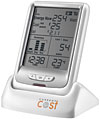
The Envi monitor interfaces with Google PowerMeter and is capable of measuring up to 10 devices. (Courtesy of Power Save, Inc.)

MAKING SMART DECISIONS

The Envi home energy monitor from PowerSave Inc. also uses Google PowerMeter to help customers drive down energy usage. The basic Envi monitor consists of a screen device that displays real-time energy usage along with a transmitter and clamps that are installed around the electric cables in the breaker panel.

“The clamps sense the magnetic field around the cables that is produced because of the energy going through it. That information is then sent, via the wireless transmitter, directly to the display,” said Robin Pearl, general manager, PowerSave Inc., Fort Lauderdale, Fla.

The Envi monitor is capable of measuring up to 10 devices and provides detailed information about energy patterns. When coupled with Google PowerMeter, homeowners can receive weekly e-mails detailing whether energy use is up or down. This information is critical in allowing homeowners to make smart decisions about their energy use.

“When you go to the supermarket, you don’t just throw stuff in your shopping cart, walk out the door, and expect to get a bill from Wal-Mart at the end of the month,” said Pearl. “Instead, you look at the prices of products and decide which ones you want to buy. We make decisions every single day based on price, and with the energy usage in our home, we do not have a clue.”

A home energy monitor is a tool that can be used by homeowners to make smart decisions about their energy usage. For HVAC contractors, monitors can be a profitable accessory to sell, or they can be included as part of a package. “Many of our contractor customers include one of our energy monitors when they install a new heating or cooling system,” said Pearl. “They install the monitor before the new system goes in, so customers can see how much energy the old system is using compared to the new one. This gives confidence to the customer that the contractor really knows what he’s talking about.”

Joyce currently sells the home energy monitor as a separate accessory, but he is considering offering it as part of a whole-house capacitor/surge protector package. “Customers love the energy monitor - it’s really the ultimate in green. You measure what you’re using, drive it down, and make what you have work better. We’re seeing very positive results.”

Publication date: 12/13/2010

Share This Story

Looking for a reprint of this article?
From high-res PDFs to custom plaques, order your copy today!


Tn joanna 2017
Joanna Turpin is a Senior Editor at The ACHR NEWS. She can be contacted at 248-786-1707 or joannaturpin@achrnews.com. Joanna has been with BNP Media since 1991, first heading up the company’s technical book division before moving over to The ACHR NEWS, where she frequently writes about refrigerants and commercial refrigeration. She obtained her bachelor’s degree in English from the University of Washington and worked on her master’s degree in technical communication at Eastern Michigan University.

Recommended Content

JOIN TODAY
To unlock your recommendations.

Already have an account? Sign In

  • HVAC-enrollment

    The Trades Are Back: HVACR Programs See Nearly 30% Enrollment Spike

    A new wave of future technicians is entering the pipeline.  
    Training and Education
    By: Matt Jachman
  • 2025 Top 40 Under 40

    2025 Top 40 Under 40 HVACR Professionals List

    The 11th annual Top 40 Under 40 list highlights those...
    HVAC Commercial Market
    By: Hannah Belloli-Oster
  • LG Ductless Mini-Split Systems

    The 9 Types of Heat Pumps

    As the U.S. moves toward electrification, heat pumps are...
    Air Source Heat Pumps
    By: Joanna R. Turpin
Subscription Center
  • Create an Account
  • Start a Subscription
  • Manage My Account
  • Sign Up for Newsletters
  • Visit Customer Service
  • Update Preferences

More Videos

Sponsored Content

Sponsored Content is a special paid section where industry companies provide high quality, objective, non-commercial content around topics of interest to The News audience. All Sponsored Content is supplied by the advertising company and any opinions expressed in this article are those of the author and not necessarily reflect the views of The News or its parent company, BNP Media. Interested in participating in our Sponsored Content section? Contact your local rep!

close
  • Piggy Bank
    Sponsored byWatercress Financial

    Energy Prices, Inflation, and HVAC: What Today’s Homeowners Care About

  • Refrigerated Food
    Sponsored bySolstice Advanced Materials

    R-455A Refrigeration: A Cold Storage Solution for the Future

  • Airex Rooftop Units
    Sponsored byAirex Manufacturing Inc

    Consolidating Roof Penetrations: A Growing Trend in Multifamily HVAC Design

Popular Stories

HVAC-Price-Increase-graphic

HVAC Price Increase List: June 2026

Trump-Section-232.jpg

Trump Reduces Section 232 Tariffs on HVAC Equipment to 15%

R410A-Refrigerant-Cylinder.jpg

Refrigerant Recovery is a Revenue Opportunity

Heat-pump-cutaway.jpg

PFAS Rules and A2L Building Codes Continue to Evolve

Midea-training.jpg

HVAC Workforce Crisis Expands Beyond Technicians to Instructor Shortages

View The ACHR NEWS
Centennial Anniversary Timeline

The ACHR News Timeline Chart
Submit a Letter
Submit a letter to our editors.

Events

November 6, 2025

Next-Gen Data Center Cooling: HVAC Innovation and Real-World Solutions

On Demand As AI workloads and high-density computing push traditional cooling methods to their limits, the data center industry is accelerating the adoption of next-generation HVAC technologies.

June 17, 2026

Decarbonization Without Disruption

This webinar will explore practical HVAC decarbonization strategies that minimize disruption while maximizing long-term performance and ROI.

View All Submit An Event

Poll

Summer Staff

Are you fully staffed for the summer season?
View Results Poll Archive

Products

BNI Mechanical/Electrical Square Foot Costbook, 2026 Edition

BNI Mechanical/Electrical Square Foot Costbook, 2026 Edition

See More Products
Decarbonization Without Disruption - Free Webinar - 6/17/2026

Related Articles

  • server room

    Cutting Back on Energy Use in Data Centers

    See More
  • June 10, 2009: Google Partners With Utilities to Allow Consumers to Monitor Energy Use

    See More
  • Feb. 15, 2007: Delmarva Power Unveils Plans to Help Customers Manage Energy Use

    See More

Related Directories

  • Google Nest

    Nest reinvents unloved but important home products, like the thermostat and smoke alarm. The company focuses on delighting customers with simple, beautiful and thoughtful hardware, software and services.
×

Sign Up. Stay Informed.

The #1 trusted source for the HVACR industry since 1926

SUBSCRIBE
  • RESOURCES
    • Advertise
    • Contact Us
    • Advisory Board
    • Classifieds
    • Submit a Letter
    • Directories
    • Store
  • ACCOUNT CENTER
    • Create an Account
    • Start a Subscription
    • Manage My Account
    • Sign Up for Newsletters
    • Visit Customer Service
    • Update Preferences
  • SERVICES
    • Marketing Services
    • Reprints
    • Market Research
    • List Rental
    • Survey/Respondent Access
  • STAY CONNECTED
    • LinkedIn
    • Facebook
    • Instagram
    • YouTube
    • X (Twitter)
  • PRIVACY
    • PRIVACY POLICY
    • TERMS & CONDITIONS
    • DO NOT SELL MY PERSONAL INFORMATION
    • PRIVACY REQUEST
    • ACCESSIBILITY

Copyright ©2026. All Rights Reserved BNP Media, Inc. and BNP Media II, LLC.

Design, CMS, Hosting & Web Development :: ePublishing