What Is Energy-Efficient Design?
U.S.
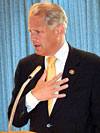
Rep. Steve Israel opens the 13th EnVisioneering Symposium by tying the need for
increased and regulated energy efficiency to issues of national
security.
More than 50 industry professionals participated in the 13th Danfoss EnVisioneeringSM Symposium, which included presentations from:
• U.S. Rep. Steve Israel, D-N.Y.;
• U.S. Rep. C.A. “Dutch” Ruppersberger, D-Md.;
• James Rannels, supervisor, Commercial Building Integration and Deployment Project, U.S. Department of Energy (DOE), Bureau of Energy Efficiency and Renewable Energy;
• Richard Lord, engineering fellow, Carrier Corp.;
• Drake Erbe, vice president, market development, Airxchange, Inc.;
• Karen Penafiel, CAE, vice president for advocacy, Building Owners and Managers Association International (BOMA);
• Godfried L. Augenbroe, associate professor, School of Architecture, Georgia Institute of Technology; and
• James McClendon, director of engineering, Wal-Mart.
Israel - who serves on the House Appropriations Subcommittees on Energy and Water; State and Foreign Operations; and Military Construction and Veterans Affairs - told attendees, “It is within our national interest to conserve energy.”
He tied the need for increased and regulated energy efficiency to issues of national security, charging that the U.S. Department of Defense spends billions of dollars each year on heating, cooling, and power - resources that are supported through foreign oil and funds borrowed from overseas.
Robert Wilkins, president, Danfoss North America, noted, “The current trajectory of technology-based energy-efficiency improvements seems unlikely to meet important energy-savings goals related to cost, global security, energy security, and climate change. Progress is being made, but the trend does not match the challenge.
“Energy is a critical and urgent issue related to national security and our national and world economy and is a global environmental issue that is not likely to be solved in a business-as-usual fashion. We, at Danfoss, are increasingly convinced that it is time to ask some big, practical questions - about limits, basic definitions, possibilities, roles, and requirements - that will help us to evaluate the potential of an approach to energy efficiency that would constitute a serious departure from today’s standards.”
SYSTEMS APPROACH
Sticking to the symposium’s theme, “Rx: Systems Approach to Net Zero,” Erbe introduced the idea of a systems approach to energy efficiency by saying, “The building delivery system must be driven by more than just manufacturing.”Erbe emphasized that components have been nearly maxed out in terms of energy efficiency. Each building needs to be approached from a systems level, and, more importantly, building components and systems need to be integrated to work together and to improve energy efficiency.
“If the desire is to be at net zero by 2030, efficiency requirements also need to change,” said Lord. “As they stand today, they do not recognize or reward innovative designs. The fact is that operations cannot be controlled independently. For example, heating systems should recover energy that can then be used for other building systems. We are currently defining efficiency based on components, and we need to develop a different approach to reach efficiency goals.”
“A systems approach,” commented Wilkins, “requires us to look at more than just individual pieces of equipment. By integrating heat recovery technologies that match output to load and renewable sources - located both onsite and remote, such as solar PV panels, wind, and geothermal - we then can add energy-efficient equipment to a system designed to maximize building function.”
As the symposium’s participants pointed out, most buildings are not operated as intended, which ultimately affects energy efficiency. Instead, operations and maintenance need to go hand-in-hand with energy engineering. In order to achieve this partnership, the industry needs more than voluntary standards; enforceable standards should be used to achieve and guarantee maximum results.

The
13th Danfoss EnVisioneering Symposium was held at the Library of Congress in
Washington, D.C., with more than 50 HVACR industry professionals in attendance.
EMERGING ENERGY POLICY
Rannels of the DOE defined net zero energy buildings (NZEBs) as buildings that produce as much renewable energy as the building uses annually. This includes energy-efficient improvements that reduce energy consumption by 60 to 70 percent over existing standards and implements renewable sources to supply the balance of any energy needs.“The greatest potential for energy savings is in commercial buildings,” Rannels highlighted. In 2006, buildings accounted for 40 percent of U.S. energy use, 18 percent of which was in commercial buildings.
Today, the DOE has partnered with more than 20 companies in the retail, hospital, and commercial real estate arenas to form the Commercial Building Energy Alliances (CBEAs), which have jointly agreed to each build one new building at 50 percent less energy than American Society of Heating, Refrigerating and Air-Conditioning Engineers Standard 90.1 and retrofit one building that uses 30 percent less energy.
Penafiel approached the issue of creating NZEBs from the perspective of the building owner/operator and raised concerns about the cost of building codes and benchmarking energy efficiency.
“National building codes can be very restrictive to many building owners and managers,” she said. “When specific energy-efficiency standards are mandated - for example, a 30 percent reduction in energy use - building owners who are unable to fully meet those strict requirements can, as that information is made public, actually become vulnerable to scrutiny and additional costly mandates such as energy audits.”
Both Penafiel and Israel expressed concern that, while the country has been focused on top-down investments in energy efficiency, the focus should be on bottom-to-top investments, encouraging Americans to realize a need for energy-efficient technologies in their own homes first and foremost. PACE (Property-Assessed Clean Energy) bonds, Israel said, could play an important role in incentivizing Americans to upgrade their homes to include these energy-efficient technologies through government-funded loans.
He said true energy efficiency and net zero will require more than just policy; it will require the architect and the engineering teams to work as a whole to design buildings that ensure optimum systems are put into place.
“Getting to net zero will require a focus on more than just component scale optimization,” said Augenbroe, of the Georgia Institute of Technology. “Architects and engineers will need to rely on the concept and how systems work optimally together in order to achieve net zero building design.
“The key, though, is to not overengineer the energy model. Think about uncertainties in your assumptions, and then model these uncertainties explicitly, tying them to risk analyses and cost analyses. Separate systems - such as energy, controls, airflow, and communications - create failing buildings. Figuring out how these total systems integrate, through design, function, and control will help to achieve maximum energy results.” This raised the question of existing and pending LEED-certified buildings that either cease or fail to meet performance requirements and whether the problem lies within the building or the model itself.
As an example of a systems integration approach to energy efficiency, Wal-Mart’s McClendon introduced the retail giant’s “unconventional approach to building and campus design.”
He said Wal-Mart’s new prototype stores include high-efficiency lighting, doors on refrigerator cases, solar panels, and onsite wind turbines, which have proven a 27 percent reduction in energy use and significant reductions in refrigerant use over the company’s existing stores.
“In evaluating our stores globally, Wal-Mart has relied heavily on benchmarking as a critical first step in developing high-performance buildings,” said McClendon. “But the real key to success has been the ability to look beyond programs for buildings and instead create building programs. Component optimization is a must, but it will only take us so far in the goal of energy efficiency and net zero.”
In his concluding remarks, Wilkins said, “While net zero might sound like a far-fetched concept, this symposium has helped to lay the groundwork for a convincing story that serves as a practical long-term target, and that, even today, we’re capable of making dramatic steps in that direction. American innovation is resilient, but political gridlock is hampering progress and change. Innovation within our industry has proven its ability to rebound and prevail time and time again, but regulatory government support is needed if we truly wish to see greater strides made in energy efficiency and the goal of achieving net zero energy buildings as an everyday reality.”
Publication date: 11/29/2010
Looking for a reprint of this article?
From high-res PDFs to custom plaques, order your copy today!