Don't Get Flighty About Pest Cleanup

The placement of this outdoor equipment - shielded and partially enclosed by walls - makes it an ideal nesting/roosting environment for pest birds. Before cleaning it, a professional makes sure his face is protected and the HVAC system is sealed. (Courtesy of Bell Environmental.)
“That young man contracted a fever right away,” Kobie said. “He had to go into the ER within an hour.” He also was treated for Legionella, but the additional exposure to the bird waste made it much worse.
A lot of people who work on HVAC systems outdoors seem to dismiss the risks associated with their own exposure to contaminants from birds, specifically “pest” birds (wild pigeons, starlings, sparrows, and seagulls). They could be exposing themselves to potentially serious health risks.
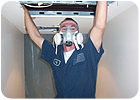
Who is that masked man? It’s Kobie Kooling Technician Tom Moore. His personal protective equipment includes the respirator seen here, disposable masks, exam gloves, Tyvek disposable suits, shoe covers, and coverall jumpers. He and other Kobie techs receive decontamination training for exposures. (Courtesy of Kobie Kooling.)
GET SERIOUS
When it comes to using PPE, Kobie’s company is a minority among HVAC professionals. “I’ve never seen other companies, other than remediation companies, wear them.” Because of Kobie’s involvement with the Indoor Air Quality Association (IAQA) and knowledge of mold remediation, he is more aware of the risks associated with so-called pest birds.According to some sources, up to 60 diseases are associated with bird infestations. Some of these contaminants come directly from feces and urates, others grow with moisture, and still others (parasites) can be carried in by the birds.
Add to that the growing public concern over the spread of H5N1, avian influenza, and it’s a good idea for HVAC professionals to be aware of this aspect of their work environment - not only to prevent the release of these biological contaminants into the air-handling systems, but also to protect themselves against possible illness.
Kobie Kooling now makes its employees wear appropriate PPEs in all suspect circumstances. “We get exposed to a lot of stuff,” he said. “We deal with moisture exposure, plus other animals underneath mobile homes. Rabies is a very real possibility.
“I use a respirator often,” Kobie said. “We’re also using disposable surgeon-type gloves. If [the waste] touches you, you can absorb it through your skin. My men carry Tyvek suits in their trucks.”
If Kobie’s employees see signs of birds or other pests around mechanical systems, “they have to photograph and document it right there. They are trained to put on respirators. I want to know what it is,” he continued. “When they open something and they see feathers, I want pictures.”
RECOGNIZING THE RISKS
The risks involved with pest birds have been largely unacknowledged by the HVAC community because they are underreported, Kobie said. “It’s flulike. They don’t necessarily know why they’re getting sick. If I splash coil cleaner in your eyes, you’re gonna know what happened. If you start coughing after you’ve worked in an area with bird droppings, you might not make that connection.”Pete Chaney is the safety director for the Mechanical Contractors Association of America (MCAA). He creates safety materials that are distributed among the association’s members. “I’m anticipating needing to come up with a model program on how to respond to pandemics and bird flu,” he said. However, the association doesn’t have safety information related to working in and around bird droppings and similar biocontaminants, he said, because so far the membership has not reported it as a hazard.
The Centers for Disease Control and Prevention (CDC) has identified HVAC as one of the occupations at risk for exposure to one of the main biological threats contained in bird-infested areas: a fungus called Histoplasma capsulatum (H. capsulatum), which leads to an infection called Histoplasmosis.
“Histoplasmosis is not contagious,” explained the Centers’ National Institute for Occupational Safety and Health (NIOSH); It lives in ordinary dirt, particularly if that dirt is high in nitrogen, and “especially those enriched with bird manure or bat droppings,” writes NIOSH. “The organism can be carried on the wings, feet, and beaks of birds, and infect soil under roosting sites or manure accumulations inside or outside buildings.”
Histoplasmosis develops when H. capsulatum is inhaled. A few days after exposure, “Histoplasmosis can appear as a mild, flu-like respiratory illness with a combination of symptoms, including malaise (a general ill feeling), fever, chest pain, dry or nonproductive cough, headache, loss of appetite, shortness of breath, joint and muscle pains, chills, and hoarseness. A chest X-ray can reveal distinct markings on an infected person’s lungs,” said NIOSH.
“It’s nothing that doctors are really trained to look for,” said Heath Waldorf, vice president of operations, Bell Environmental Services Bird Control Specialist, Parsippany, N.J. “They’re proactive about treatment, not cause.”
Cryptococcosis is another significant risk involving pest birds, writes CEO Phil Waldorf in Health Hazards From Pigeons, Starlings and English Sparrows (Diseases and Parasites Associated With Pigeons, Starlings and English Sparrows which affect Man and Domestic Animals). “The organisms become serious, infectious air pollutants.” Symptoms from Cryptococcosis (Cryptococcus neoformans) are similar to those of histoplasmosis.
A nonrespiratory, gastrointestinal infection involving pigeons is called “systemic candidiasis.”
In addition, “The dust from pigeon roosting or nesting areas incriminates pigeons as a carrier of chlamydiosis,” he writes, “without the necessity of a person coming in direct contact with the pigeons.”
WHO IS AT RISK
“People with weakened immune systems are at the greatest risk for developing severe and disseminated histoplasmosis,” NIOSH said. This can have a direct impact on occupants of buildings that have accumulations of bird waste near air-handling systems.“Pigeons have been associated with histoplasmosis in many cases involving old buildings,” writes Waldorf. “Documented cases include Mandin, N.D., Cincinnati; Ft. Levenworth, Kan.; Pittsburgh; New York; and Warrentown, N.C. In some cases, men had been working on air conditioning in attics where pigeons had been roosting.”
Just being close to large amounts of bird waste is enough to raise a person’s risk level. According to the Cedar County (Iowa) Public Health Dept., “large populations of roosting birds may present the risk of disease to people nearby. The most serious health risks arise from disease organisms that can grow in the nutrient-rich accumulations of bird droppings, feathers, and debris under a roost - particularly if roosts have been active for years.
“External parasites also may become a problem when infested birds or bats leave roosts or nests. The parasites then can invade buildings and bite people.”

This type of protective netting discourages birds from nesting on rooftop HVAC units, or near HVAC air intakes. Waste from birds and other pest species has been linked to a number of human ailments. (Courtesy of Bell Environmental.)
PROTECTION AND CLEANLINESS
What should you do if you go up to rooftop equipment and see feathers and droppings? “Back up and walk away,” said Heath Waldorf of Bell Environmental. “You don’t want to go near the stuff without wearing rubber gloves and at least a simple filter mask. Be careful not to touch your eyes.”If you decide to clean the waste yourself, seal off the air-handling system from the inside, Waldorf said. “Then make sure you wet the droppings first,” Waldorf said. “You don’t want to inhale the dust.” Dampen the area but don’t hose it down hard; this could release a contaminant-laden spray.
“Use a hospital-grade disinfectant in solution. Scrub it down, hose it down, but not too hard. The last thing you want to do is push the stuff in or create a spray of water droplets.”
If you don’t want to do it yourself, or if the customer wants to remove the pest population, Waldorf said contractors should call a professional pest control firm that specializes in birds. Specialized products include netting, spike systems, and even a system that produces a mild electric shock, but it’s important to know which products work in specific circumstances, and on which species.
“I have a couple of different HVAC companies that call me every time they have a problem,” Waldorf said. “I work as a subcontractor.” For air-handling equipment, “typically we net over the top to exclude the bird population, and screen up underneath the ductwork.”
Don’t try to kill them yourself. Some states require licensing to kill pests. Risks include secondary poisoning and the risk of potentially killing an endangered species (which can carry heavy penalties).
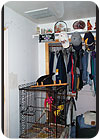
Putting a birdcage underneath an air intake vent is a bad idea. The waste from these pet parrots caused viral and bacterial exposures through the returns, said Fred Kobie, owner of Kobie Kooling. “Three children became very sick from long-term exposure related to the birds.” (Courtesy of Kobie Kooling.)
PETS, NOT PESTS
The risk to HVAC contractors isn’t limited to commercial outdoor applications. “People with pets have a similar exposure,” said Kobie. “In one of the worst environmental conditions I ever dealt with, pet parrot cages were placed under the intake going into the air conditioner. The system had a bacteria growing in it that we couldn’t get a lab to identify.”Kobie can’t emphasize enough the need to wear PPE. “When you open the system to service it, you get that rush coming back out. When you take a blower door panel off, you get a face full of it.
“For less than $50 you can buy a good, rubber sealant mask,” he said. “That costs a lot less than going to the emergency room or being sick for weeks.”
Publication date: 03/26/2007
Looking for a reprint of this article?
From high-res PDFs to custom plaques, order your copy today!