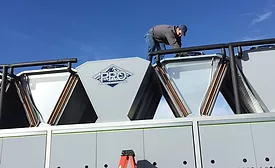
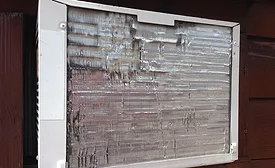
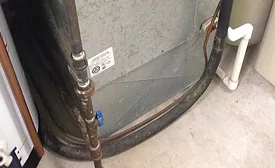
The function of coils in heating and cooling systems is to transfer heat from one medium to another, either extracting heat from a building and expelling it outside or vice versa. Depending on the application, different technologies are available to ensure thermal energy is transferred as efficiently and cost-effectively as possible.
One of the main components of any refrigeration or air conditioning system is the condenser. As its name indicates, the condenser condenses refrigerant vapor sent to it from the compressor. However, the condenser also performs other important functions, too.
Training center recognized for its exceptional efficiency and eco-friendly design
May 17, 2016
Bitzer’s Schaufler Academy has received the Deutscher TGA-Award 2016 in the New Building category for its energy efficient and eco-friendly design. The international training center of the compressor manufacturer is located in Rottenburg-Ergenzingen, Germany.
An undercharge of refrigerant will cause low head and suction pressures, but that is not the only thing that will cause both pressures to be low. An undercharge will have low condenser liquid subcooling readings on the high side, where a dirty air filter for the evaporator will not produce low condenser liquid subcooling readings.
Grand prize winner will receive an all-expense paid trip to Orlando, Florida
May 2, 2016
Tecumseh Products Co. has announced its Big Chill 2016 Condensing Unit Promotion, which includes a chance for commercial refrigeration contractors/installers to win any one of three prizes.
Diagnosing an air conditioning system isn’t easy. A service technician must be a trained professional to diagnose a system efficiently and correctly — no longer can a tech rely on rules of thumb for coil temperatures or pressures.
A total of 148 exhibitors showed off their latest advances in all types of industrial refrigeration at the International Institute of Ammonia Refrigeration (IIAR) 2016 Industrial Refrigeration Conference and Exhibition in Orlando, Florida. Here are a few of the highlights.
Some contractors have used leak-stop agents successfully for years and consider them practical and cost-effective ways to seal small, hard-to-find leaks in systems. Other contractors feel strongly that only two things belong in a system: refrigerant and oil.
 RSS
RSS