Music Hall Air Handlers Get Rave Reviews For Acoustics
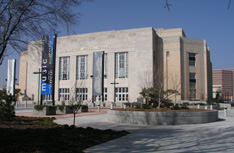
The Music Hall has been a focal point in Oklahoma City for over six decades. It was a classic art deco design, inside and out. Constructed of a very pale, fine-grained limestone, the building exterior is a strongly rectangular design with massive fluted pilasters, large lobby windows and medallion-like relief carvings along the upper facade. Like the exterior, the building's interior was also a study in art deco. However, by the 1990s the facility was no longer meeting the community's needs for a performance center.
Renovation Becomes An Option
In the early 1990s, Oklahoma City had enacted a program called Metropolitan Area Projects (MAPS) to authorize a sales tax to fund civic renovation projects. The MAPS funding program has assisted a number of downtown renovation projects. In 1996, planning began for a complete makeover of the Music Hall, with a goal of preserving its handsome exterior and many of the classic indoor appointments, but bringing it up to contemporary performance and audience comfort standards.The architectural firm Polshek Partnership of New York was selected to direct the design of the renovation. An Oklahoma City firm, Richard Brown & Associates, developed an innovative design that kept the exterior shell and the smaller Freede Little Theatre, and the second story reception hall, the Meinders Hall of Mirrors. The design preserved many of the details that retained the building's art deco character.
However, the design resulted in an entirely new lobby with a soaring atrium and an entirely new Thelma Gaylord Performing Arts Theatre. The new large theatre included main floor, balcony and box seats, and enclosed suites. The plan also included a new main stage, including a hydraulic orchestra pit and backstage accommodations for major theatrical, dance, and musical groups. The project also included development of the Joel Levine Rehearsal Hall.
Acoustic Performance A Priority
Selected as the consulting engineer of record for the project was PSA Consulting Engineers of Oklahoma City, and the general contractor was FlintCo Inc. of Tulsa. The mechanical contractor was T.J. Boismier of Oklahoma City. A major part of the challenge facing PSA was the goal of creating an acoustically superior venue, one that would rival the best performance halls in the country. A firm that is recognized in the area of performance hall acoustics, Jaffe Holden Acoustics Inc. of Norwalk, Conn., was retained to work with the architects and engineers to optimize the acoustic performance of the hall.James Stewart is executive vice president of PSA. His firm has extensive experience in managing acoustics in challenging mechanical plant applications. He noted that the acoustic challenge in the Music Hall project was significant. "What we were asked to do is to design a very efficient and extensive system for building comfort and ventilation, and at the same time completely avoid introducing outside noise into the rehearsal and performance areas."
According to Stewart, "The special challenge in this situation was that we were working within an existing structure, and space was at a premium." Stewart said that the acoustic standard for ambient sound set for the large performance hall was PNC-15, an extremely low level, equivalent to the allowable sound level in a high-quality recording studio.

Air Handlers Require Attention
The building receives chilled water service from a local district cooling utility operated by Trigen Energy Corporation, so chiller plant sounds would not be a factor. However the airside equipment would be a challenge. The mechanical design for the building as it developed called for a total of 13 new air handlers. Seven of these could be standard cataloged air handlers, but an additional six air handlers were needed for sensitive acoustic areas, including the main theatre hall, the stage, and the rehearsal hall.Stewart said that the air handlers serving the sensitive areas would have to meet four criteria: minimum pressure drop within the equipment, extra-quiet fans, heavy-wall casings to minimize sound transmission, and integral sound absorbers (silencers) to minimize acoustic transfer into the ducts. Additionally, according to Stewart it was understood that ducts and diffusers would need to be oversized to minimize air transfer noise.
Originally Stewart's firm believed that for the acoustically sensitive parts of the project, only custom air handlers could meet the acoustic standard. In discussions with Trane's representatives, the idea of using Trane's cataloged modular Climate Changerâ„¢ for all of the applications was suggested. Bryan Garcia from Trane's Oklahoma City commercial sales office pointed out there would be potential savings from using a cataloged product, with special adaptations to meet the acoustic requirements. According to Stewart, "We told Trane they would have to prove that it would meet the standard, and they accepted the challenge."
Looking for quick answers on air conditioning, heating and refrigeration topics? Try Ask ACHR NEWS, our new smart AI search tool. Ask ACHR NEWS
Lexington Plant Involved In Design
Garcia and the Oklahoma City commercial sales office worked closely with Rob Lilkendey from Jaffe Holden, Trane's air handler plant in Lexington, Ky., and with Stewart, to demonstrate the feasibility of using the cataloged Modular Climate Changer. Art Hallstrom, Trane's airside applications manager, recommended using a double wall unit for all of the applications.In order to reduce sound transfer through the unit walls, Hallstrom recommended a heavier gauge skin. Each unit would have a rectangular silencer section, plus a round silencer on the supply fan. The supply and return fans would be Trane's Enhanced Q-Fanâ„¢ with the built-in zero pressure drop silencer. All of the air handlers would be of a sufficiently large cabinet size, with large enough coil size, that internal pressure drop would be minimal. With these modifications, the design team calculated that the acoustic performance standard was achievable.
Duct Design Also Critical
Stewart's firm worked on the balance of the airside design, specifying large ducts of increasing diameter as they approached the discharge point. In this way the air velocity is actually diminishing as the moving air reaches the diffuser. The main duct serving the stage area actually measures eight by eight feet at the discharge point. The mechanical room housing the critical air handlers was located as far as possible from the performance area, although the shape of the building prevented it from being a great distance away. Much would depend on the performance of the air handlers.As part of the design process, Trane transported two of the most critical units to the acoustic laboratories of the Air Movement and Control Association (AMCA) in Arlington Heights, Ill. Charles Francis, Lexington applications engineer, conducted ARI 260 acoustical witness tests for the design team. Garcia said, "The AMCA tests were worst case, with the air discharge going straight into and out of the unit, with no acoustic benefit from duct turns."
Units Pass Laboratory Tests
The two units were tested at 1/3 octave bands at all levels of fan operation. As a result of the testing, the units were deemed to entirely meet the rigorous Music Hall PNC-15 criterion. Stewart said, "I remember standing inside the reverb room looking into the air handler and we couldn't hear a sound. It was impressive." As a result of the testing, no changes in the air handler configuration were needed, and the units could be installed as designed.Meanwhile, work was proceeding on the rebuilding of the Music Hall. Garcia noted that the building looked mostly unchanged on the outside, but inside, almost everything was different. Despite extensive changes, the architect was successful in keeping the period feel of the building intact. The new sections of the building flow smoothly into the unchanged areas, creating an extremely attractive environment. The project was complete in 2002.
Performers Rave About Results
The ultimate test of the acoustic success of the building is the reaction by audiences and performers. Stewart stated, "We have received no negative feedback on acoustics. None at all. And the performers absolutely rave about it." He indicated that this is a credit both to the performance acoustics of the hall, as specified by Jaffe Holden Acoustics Inc., and the complete attenuation of ambient sound by the airside system. These results are achieved together with a high level of comfort in the hall. "That's the other side of the equation. The hall also has to have a high comfort level. Thus, even with a full occupancy of 2,000, audience members expect complete climate control. We are also achieving that."Stewart pointed out, "With acoustics we tend to err on the side of being very conservative. Results like this show the value of this approach." He notes that the first time he attended a performance in the large hall, he listened very critically for background sound. He was very pleased . . . with what he didn't hear. The Civic Center Music Hall is opening eyes - and ears - to what is possible in a performance hall renovation.
Publication date: 11/10/2003
Looking for a reprint of this article?
From high-res PDFs to custom plaques, order your copy today!