ACHR News
search
Ask ACHR NEWS AI
cart
facebook twitter instagram linkedin youtube
  • Sign In
  • Subscribe
  • Sign Out
  • My Account
ACHR News
  • NEWS
    • Breaking News
    • New HVAC Products
    • Featured Products
    • Manufacturer Reports
    • HVAC Data
    • Legislation
    • ACHR NEWS Centennial
  • RESIDENTIAL
    • Air Conditioners
    • Furnaces
    • Residential Heat Pumps
    • Ductless
    • Residential IAQ
    • Testing, Monitoring, Tools
    • Components & Accessories
  • COMMERCIAL
    • Air Handlers
    • Rooftop Units
    • Chillers and Cooling Towers
    • Commercial Heat Pumps
    • Boilers and Hydronics
    • VRF/Ductless
    • Commercial IAQ
  • REFRIGERATION
    • Refrigerants
    • Refrigerant Regulations
    • Leak Management
  • CONTRACTOR PRO
    • Geothermal
    • Homeowner Study
    • VRF and VRV Ductless
    • Unitary Trends
  • EDUCATION
    • Training and Education
    • Business Management
    • Service and Maintenance
    • Continuing Education
    • Market Research >
      • HVAC Brand Awareness Report
      • VRV, VRF, VRVZ Report
      • Unitary Trends Report
      • Water Heat Professionals Report
    • Webinars
    • Sponsor Insights
    • eProducts Info
    • White Papers
  • EVENTS
    • HVAC Contractor Forum
    • Industry Events and Webinars
  • MEDIA
    • Videos
    • AHR Expo 2025 Videos
    • Podcasts >
      • ACHR News Podcast
      • HARDI Podcasts
      • AHR Expo Podcasts
      • ACCA Podcasts
    • Interactive Spotlights
    • Quizzes
    • eBooks
    • HVAC Talkback
  • HVAC GROUP
    • ACHR NEWS >
      • Current Issue
      • Digital Edition
      • Subscribe
    • Distribution Trends
    • SNIPS NEWS >
      • Join SNIPS NEWS
    • Engineered Systems News >
      • Join ES News
    • HVACR Directory
    • Contests
    • Newsletters
    • Contact
    • Advertise
    • My Account

Oil Safety Controllers and Their Circuits

May 1, 2006
Fig. 1
Oil safety controllers often come in two types: bellows (mechanical) and transducer (electronic). Remember, net oil pressure (NOP), sometimes referred to as useful oil pressure, is the difference between the oil pump discharge pressure and the crankcase pressure. Bellows-type controllers sense both crankcase pressure and oil pump discharge pressure usually through some type of tubing and then transmit the pressure to flexible bellows (Fig. 1).

The tubing connected to the bellows is usually copper capillary tubes, high-pressure rubber hose, or a type of high-pressure plastic with a braided aluminum shrouding. Fig. 2 illustrates the internal action of the bellows-type controller.

Transducer-type controllers use a pressure transducer that senses a combination of oil pump discharge pressure and crankcase pressure. The pressure transducer has two separate ports to sense both crankcase pressure and oil pump discharge pressure. The subtraction or difference between these two pressures (NOP) is accomplished by the transducer mechanically. The pressure transducer is connected to an electronic controller by wires. It then transforms a pressure signal to an electrical signal for the electronic controller to process.

Both types of oil safety controllers are referred to as differential-type controllers. The nomenclature comes from the fact that they sense two different pressures; crankcase pressure and oil pump discharge pressure.
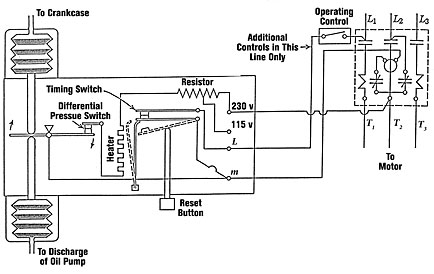
Fig. 2

BELLOWS CONTROLLER

Notice in Fig. 2 that the oil pump discharge pressure acts to open the differential pressure switch. Conversely, the crankcase pressure acts to close the switch. One has to remember that the difference between these two pressures is the NOP as shown in the equation: Oil pump discharge pressure minus crankcase pressure equals NOP.

If there is a fall in net oil pressure below 9 pounds per square inch differential (psid), the pressure differential switch will close and a heater in series with the pressure differential switch will be energized. There is usually a two-minute (120-second) delay before the heater will warp a bimetallic strip.

This warping action opens the timing switch contacts, which are in series with the motor starter or contactor coil. This action takes the motor out of service and must be manually reset on most controls.

Notice that manually pushing the reset button will reset (close) the timing switch contacts once the bimetal strip cools down. The reason for the two-minute time delay is to prevent nuisance trips of the oil safety controller.

Often there are times when the crankcase may have liquid refrigerant in it from an imperfect system. The two-minute delay gives the crankcase time to clear any unwanted refrigerant during periods when refrigerant migration or flooding has occurred. It also avoids shutdowns during short fluctuations in NOP on startups.

Remember, when the compressor is off, the NOP is 0 psi and the differential pressure switch contacts are closed. The heater in the oil safety controller will not be energized during the off-cycle because it is wired to the line side of the motor starter contacts.

Looking for quick answers on air conditioning, heating and refrigeration topics? Try Ask ACHR NEWS, our new smart AI search tool. Ask ACHR NEWS →

When the motor starter contacts are opened, this action takes L2 out of the heater circuit. At startup, when the motor starter contacts close and the compressor starts, the differential pressure switch contacts will stay closed and the heater will be energized until at least 9 psid of NOP is developed.

INTERNAL OVERLOADS

If a motor is equipped with both an internal inherent motor protector and an oil safety controller, the oil safety controller may trip due to a motor overheating or overloading problem on some systems.

When the internal overload opens, the motor is shut off but the motor starter coil remains energized with contacts closed. This will trip the oil safety controller in a matter of two minutes because of lack of NOP.

The addition of a current relay on one of the legs of the compressor will tell the electronic controller, however, that the compressor is not running and will open a circuit to the safety heater on the oil safety controller.

John Tomczyk is a professor of HVACR at Ferris State University, Big Rapids, Mich. He can be reached by e-mail at tomczykj@tucker-usa.com.

Publication date: 05/01/2006

Share This Story

Looking for a reprint of this article?
From high-res PDFs to custom plaques, order your copy today!


Recommended Content

JOIN TODAY
To unlock your recommendations.

Already have an account? Sign In

  • HVAC-enrollment

    The Trades Are Back: HVACR Programs See Nearly 30% Enrollment Spike

    A new wave of future technicians is entering the pipeline.  
    News
    By: Matt Jachman
  • 2025 Top 40 Under 40

    2025 Top 40 Under 40 HVACR Professionals List

    The 11th annual Top 40 Under 40 list highlights those...
    HVAC Residential Market
    By: Hannah Belloli-Oster
  • LG Ductless Mini-Split Systems

    The 9 Types of Heat Pumps

    As the U.S. moves toward electrification, heat pumps are...
    Air Source Heat Pumps
    By: Joanna R. Turpin
Subscription Center
  • Create an Account
  • Start a Subscription
  • Manage My Account
  • Sign Up for Newsletters
  • Visit Customer Service
  • Update Preferences

More Videos

Sponsored Content

Sponsored Content is a special paid section where industry companies provide high quality, objective, non-commercial content around topics of interest to The News audience. All Sponsored Content is supplied by the advertising company and any opinions expressed in this article are those of the author and not necessarily reflect the views of The News or its parent company, BNP Media. Interested in participating in our Sponsored Content section? Contact your local rep!

close
  • Piggy Bank
    Sponsored byWatercress Financial

    Energy Prices, Inflation, and HVAC: What Today’s Homeowners Care About

  • Refrigerated Food
    Sponsored bySolstice Advanced Materials

    R-455A Refrigeration: A Cold Storage Solution for the Future

  • Airex Rooftop Units
    Sponsored byAirex Manufacturing Inc

    Consolidating Roof Penetrations: A Growing Trend in Multifamily HVAC Design

Popular Stories

HVAC-Price-Increase-graphic

HVAC Price Increase List: June 2026

Trump-Section-232.jpg

Trump Reduces Section 232 Tariffs on HVAC Equipment to 15%

R410A-Refrigerant-Cylinder.jpg

Refrigerant Recovery is a Revenue Opportunity

Heat-pump-cutaway.jpg

PFAS Rules and A2L Building Codes Continue to Evolve

Kroger.jpg

Kroger to Spend $100 Million to Reduce Refrigerant Leaks

View The ACHR NEWS
Centennial Anniversary Timeline

The ACHR News Timeline Chart
Submit a Letter
Submit a letter to our editors.

Events

November 6, 2025

Next-Gen Data Center Cooling: HVAC Innovation and Real-World Solutions

On Demand As AI workloads and high-density computing push traditional cooling methods to their limits, the data center industry is accelerating the adoption of next-generation HVAC technologies.

June 9, 2026

Before You Go All In on AI: Set Up Your Business to Actually Win

In this webinar, we'll walk you through exactly what to get in place before you add AI to your business. You'll leave with a clear picture of where you stand today and a practical action plan to set yourself up for real results.

View All Submit An Event

Poll

Summer Staff

Are you fully staffed for the summer season?
View Results Poll Archive

Products

BNI Mechanical/Electrical Square Foot Costbook, 2026 Edition

BNI Mechanical/Electrical Square Foot Costbook, 2026 Edition

See More Products
A2L Refrigerants - Free Webinar - May 21, 2026

Related Articles

  • The Professor: Oil Safety Controllers and Their Circuits

    See More
  • Oil Safety Controllers and Their Circuits

    See More
  • The Mystery Of The Oil Safety Trip

    See More

Related Products

See More Products
  • Using Schematic Diagrams to Troubleshoot HVAC/R Electrical Circuits

  • low grade.png

    Low GWP Refrigerant Safety: Flammable & Mildly Flammable Refrigerants Manual

  • 0-88069-032-1-228x228.jpg

    HVAC Security & Safety for Vulnerability Assessment

See More Products

Related Directories

  • MSA Safety (Manufacturer)

    MSA Safety Incorporated (NYSE: MSA) is the global leader in advanced safety products, technologies, and solutions. For the HVAC-R industry, MSA Safety provides gas and refrigerant analysis, detection, monitoring, and tracking solutions. Their FieldServer IIoT gateways are ideal for enabling 24/7 cloud-based monitoring solutions.
×

Sign Up. Stay Informed.

The #1 trusted source for the HVACR industry since 1926

SUBSCRIBE
  • RESOURCES
    • Advertise
    • Contact Us
    • Advisory Board
    • Classifieds
    • Submit a Letter
    • Directories
    • Store
  • ACCOUNT CENTER
    • Create an Account
    • Start a Subscription
    • Manage My Account
    • Sign Up for Newsletters
    • Visit Customer Service
    • Update Preferences
  • SERVICES
    • Marketing Services
    • Reprints
    • Market Research
    • List Rental
    • Survey/Respondent Access
  • STAY CONNECTED
    • LinkedIn
    • Facebook
    • Instagram
    • YouTube
    • X (Twitter)
  • PRIVACY
    • PRIVACY POLICY
    • TERMS & CONDITIONS
    • DO NOT SELL MY PERSONAL INFORMATION
    • PRIVACY REQUEST
    • ACCESSIBILITY

Copyright ©2026. All Rights Reserved BNP Media, Inc. and BNP Media II, LLC.

Design, CMS, Hosting & Web Development :: ePublishing