ACHR News
search
Ask ACHR NEWS AI
cart
facebook twitter instagram linkedin youtube
  • Sign In
  • Subscribe
  • Sign Out
  • My Account
ACHR News
  • NEWS
    • Breaking News
    • New HVAC Products
    • Featured Products
    • Manufacturer Reports
    • HVAC Data
    • Legislation
    • ACHR NEWS Centennial
  • RESIDENTIAL
    • Air Conditioners
    • Furnaces
    • Residential Heat Pumps
    • Ductless
    • Residential IAQ
    • Testing, Monitoring, Tools
    • Components & Accessories
  • COMMERCIAL
    • Air Handlers
    • Rooftop Units
    • Chillers and Cooling Towers
    • Commercial Heat Pumps
    • Boilers and Hydronics
    • VRF/Ductless
    • Commercial IAQ
  • REFRIGERATION
    • Refrigerants
    • Refrigerant Regulations
    • Leak Management
  • CONTRACTOR PRO
    • Geothermal
    • Homeowner Study
    • VRF and VRV Ductless
    • Unitary Trends
  • EDUCATION
    • Training and Education
    • Business Management
    • Service and Maintenance
    • Continuing Education
    • Market Research >
      • HVAC Brand Awareness Report
      • VRV, VRF, VRVZ Report
      • Unitary Trends Report
      • Water Heat Professionals Report
    • Webinars
    • Sponsor Insights
    • eProducts Info
    • White Papers
  • EVENTS
    • HVAC Contractor Forum
    • Industry Events and Webinars
  • MEDIA
    • Videos
    • AHR Expo 2025 Videos
    • Podcasts >
      • ACHR News Podcast
      • HARDI Podcasts
      • AHR Expo Podcasts
      • ACCA Podcasts
    • Interactive Spotlights
    • Quizzes
    • eBooks
    • HVAC Talkback
  • HVAC GROUP
    • ACHR NEWS >
      • Current Issue
      • Digital Edition
      • Subscribe
    • Distribution Trends
    • SNIPS NEWS >
      • Join SNIPS NEWS
    • Engineered Systems News >
      • Join ES News
    • HVACR Directory
    • Contests
    • Newsletters
    • Contact
    • Advertise
    • My Account
HVAC ContractingService and Maintenance

Btu Buddy 14: Fixing A Chronic Leaking Residential A/C Unit

May 14, 2004
Bob is a service technician who is well trained and nationally certified. However, he sometimes suffers from the same confusion that all technicians occasionally do - the facts that he gathers may or may not point to the obvious cause of the problem or the best solution. But Bob has something that no one else has. He recalls his long-time HVACR mentor and imagines him accompanying him as "Btu Buddy," someone who reminds him to take time to stop and think before rushing to judgment, helping keep him on the right track, even with facts that are confusing.

In this edition of the Btu Buddy series, the dispatcher calls Bob to do a spring checkup for a new customer. The dispatcher remarks that the customer wanted his annual refrigerant fill-up.

Bob is on the way to the job thinking about the call when Btu Buddy makes an appearance. He asks Bob, "What do you think about the customer calling it a spring checkup and annual refrigerant fill-up?"

Bob says, "It sounds like there is a leak that has never been fixed, and his previous service company just charged it every year and never tried to find the leak."

Btu Buddy says, "That sounds about right. Some customers think that their A/C unit consumes refrigerant because the service company has been charging it for so many years. What do you think about approaching the customer about a repair rather than a refill?"

Bob agrees.

When they get to the job, Bob talks to the customer about the past service. The customer explains that the prior service company kept saying that it was cheaper to charge the unit rather than to find and repair the leak. He says they only added about 3 or 4 pounds of refrigerant per year.

Bob explains, "That is true this year; it would be cheaper for me to add refrigerant than to find the leak and repair it, except that someone will have to add refrigerant again next year and the year after that. It is not good for the unit to run with a low refrigerant charge, because the refrigerant is what cools the compressor. The unit is not as efficient and uses more power per Btu output with a low charge of refrigerant.

"If it were my own unit, I would repair it and have a more efficient unit that will last longer with a correct refrigerant charge that stays in the unit. You wouldn't have to keep adding refrigerant every year. You would also be protecting the environment. Service technicians are allowed to keep charging a system of residential size, but when it is done to hundreds of systems each year, a lot of refrigerant is unnecessarily vented."

Looking for quick answers on air conditioning, heating and refrigeration topics? Try Ask ACHR NEWS, our new smart AI search tool. Ask ACHR NEWS →

The customer says, "It makes sense to go ahead and fix it. Find the leak and repair it."

Finding And Fixing The Leak

Bob says to Btu Buddy, "You got me into this. What should we do first?"

Btu Buddy responds, "Let's think about this and itemize the possibilities:

1. Run the unit and make sure it really has a low charge.

2. If the charge is low, let's look for the leak by shutting the unit down and testing the obvious places. Shutting the unit down will register the maximum pressure on the low side components. You cannot use an electronic leak detector while the unit is running because of the draft created by the fans. Service technicians leave all sorts of leaks around the service ports. We will do that part of the leak test before applying gauges. If we apply the gauges first, we may cover up the service port leaks.

3. If we don't find the leak, we will remove the charge and pressure the entire system up with trace refrigerant and nitrogen to the working pressure of the weakest link in the system. This is usually the compressor housing with a working pressure for R-22 of 150 psig. If the compressor can be valved out of the circuit, we can raise the pressure of the system up to 250 psig without concern.

4. If we still do not find the leak, we will divide the system into two components and pressure each half for an overnight standing pressure test. This can be done by cutting the tubing, isolating the indoor system from the outdoor system, and installing test ports in the indoor section. The test ports on the outdoor unit can be used for testing that section. Let it stand overnight and see which one leaks down. This is a last ditch sort of test. Usually the leak can be found before this is used. The advantage of this test is that you can apply more pressure to the low-pressure side, which will amplify the leak."

Bob then asks, "Why is the compressor the weak link in the system? It pumps high-pressure refrigerant."

Figure 1. The internal piping of a compressor. (All figures are from Refrigeration & Air Conditioning Technology, by William Whitman, William Johnson, and John Tomczyk, published by Delmar Publishers.)
Btu Buddy explains, "The compressor is suspended inside the shell with the discharge line piped to the outside of the shell with reciprocating compressors (Figure 1). To really be safe, you should check with the compressor manufacturer for the working pressure of the shell. Newer refrigerants and scroll or rotary compressors will have different working pressures."

Bob starts the unit without the gauges so the gauge ports will not be disturbed. He goes to the evaporator section in the garage and notices there is ice on the short length of pipe between the expansion device and the coil. He says, "There is refrigerant in the system, but the charge must be low because of the ice."

Btu Buddy tells Bob, "Let it run for a few minutes to see if the ice clears up. Block some of the condenser airflow and see if the ice clears up. It is only 70 degrees outside; low head pressure may cause most of the refrigerant to be in the condenser. Block the airflow until you can feel warm air coming out the top of the condenser. You will then be assured of enough head pressure to move the liquid out of the condenser. When a unit has just been started for the first time, liquid refrigerant can be laying in the suction accumulator or the condenser. You must allow a little running time for it to redistribute to the proper places in the system."

Bob gives the unit 15 minutes of running time while changing the filter and looking over the rest of the job. Then he says, "The system definitely has a low charge. There is still ice on the line before the coil."

Btu Buddy tells Bob to shut the unit down and says, "We will let the pressures equalize and then leak check."

Bob gets his electronic leak detector and says, "I don't seem to be able to use this detector with confidence. Would you give me some pointers?"

Btu Buddy explains, "The electronic leak detector's best quality makes it difficult for some people to use; it is super-sensitive. Most detectors will detect a leak rate of 1/4 ounce of refrigerant per year. If there is any refrigerant in the vicinity, it will sound off. Then you have to find where it came from. Here are some tips to improve your leak detecting abilities:
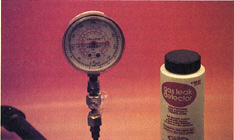
  • Stop any drafts of air. You can use a piece of cardboard when outside to prevent the winds from blowing the refrigerant away from the leak.

  • Start high and move low. Refrigerant is heavier than air and will move downward. If you start low and get under a leak, you can't tell where it came from.

  • Move very slowly, about 1 inch per second. I have seen technicians leak detect an entire unit in 5 minutes and declare there was no leak. They may be moving past the leak and not knowing.

  • Move over each field connection first, as that is the most likely place to find a leak.

  • Pay attention for oil spots or dust spots. There is often a thin film of oil near a long-time leak and it will collect dust over time. There is almost always oil around the service valve connections from where the gauge hoses are connected.

  • Make sure you do not let water get into the leak detector nozzle. When you get to the evaporator section, you can disconnect the condensate line and hold the detector probe up high out of the water stream and let the probe stay there for 2 or 3 minutes. If there is refrigerant detected, then remove the coil panels so you can check the piping and the coil tube turns.

    Figure 2. Using professional quality soap bubbles to find a leak.
  • When you find the leak area, if it needs to be located exactly, use soap bubbles (Figure 2). There are special soaps used for leak detecting that are very elastic and blow big bubbles. They will not dry out like household detergents. Remember: After using soap on piping, wash it off with water and a rag. If you don't, oxidation will begin at that point. If the pipe is copper, there will soon be a large green stain. Professionals do the job correctly and don't engage in bad habits."

    Bob uses the electronic leak detector and goes over the gauge ports and the field connections on the outdoor unit. He then places the leak detector probe under the insulation for the suction line and finds no leaks. There are no connections between the outdoor unit and the indoor unit, so he moves on to the indoor unit. He first checks the field connections and finds no leak. He places the probe for the electronic leak detector in the condensate drain line in such a way that no water can enter the probe and holds it there for about a minute when the probe picks up a leak.

    Bob then removes the panels for the coil and starts the search. He has to first wipe off the moisture from operating the coil. Then as he checks the suction line leaving the coil, he detects the leak. A little soap is applied and the leak is detected at a faulty factory connection that can be easily repaired.

    Bob then recovers the refrigerant and repairs the leak. He tells Btu Buddy, "That wasn't bad. The customer can now have confidence in the unit providing good service."

    Btu Buddy asks, "How do you know that is the only leak?"

    Bob says, "I found a leak and repaired it. Is there more that should be done?"

    Btu Buddy explains, "You have probably found the only leak, but to be sure, lets evacuate the unit to about 25 inches of vacuum and pressure the system to 150 psig and let it stand overnight. When we come back tomorrow and the pressure is still there, you can be certain. We must remove the refrigerant and use only nitrogen to be sure that the temperature is not affecting the pressure."

    Bob completes the process, leaving a set of gauges on the system. He then informs the customer what he is doing. The customer understands and gives approval.

    Bob was not able to come back the next day, but the following day when he arrives at the job, he heads straight for the gauges and finds them reading 150 psig. He is very pleased because he was afraid the pressure may have dropped.

    Bob charges and starts the unit, then explains what he has done to the owner.

    The owner says, "I'm glad that you fixed it correctly. That gives me a lot of confidence in you and your company."

    As Bob is driving away from the job, Btu Buddy appears again and says, "It really makes you feel good when a customer says that to you. You did another professional job."

    Bill Johnson has been active in the HVACR industry since the 1950s. He graduated in gas fuel technology and refrigeration from the Southern Technical Institute, a branch of Georgia Tech (now known as Southern Polytechnic Institute). He taught HVAC classes at Coosa Valley Vocational & Technical Institute for four years. He moved on to become service manager for Layne Trane, Charlotte, N.C. He taught for 15 years at Central Piedmont Community College, part of this time as program director. He had his own business for five years doing installation and service work. Now retired, he is the author of Practical Heating Technology and Practical Cooling Technology, and continues as a co-author of Refrigeration & Air Conditioning Technology, 5th Edition, all published by Delmar Publishers. For more information, he can be reached at 704-553-0087, 704-643-3928 (fax), or bmj@myexcel.com.

    Publication date: 05/17/2004

  • Share This Story

    Looking for a reprint of this article?
    From high-res PDFs to custom plaques, order your copy today!


    Recommended Content

    JOIN TODAY
    To unlock your recommendations.

    Already have an account? Sign In

    • HVAC-enrollment

      The Trades Are Back: HVACR Programs See Nearly 30% Enrollment Spike

      A new wave of future technicians is entering the pipeline.  
      Training and Education
      By: Matt Jachman
    • 2025 Top 40 Under 40

      2025 Top 40 Under 40 HVACR Professionals List

      The 11th annual Top 40 Under 40 list highlights those...
      News
      By: Hannah Belloli-Oster
    • LG Ductless Mini-Split Systems

      The 9 Types of Heat Pumps

      As the U.S. moves toward electrification, heat pumps are...
      HVAC Residential Market
      By: Joanna R. Turpin
    Subscription Center
    • Create an Account
    • Start a Subscription
    • Manage My Account
    • Sign Up for Newsletters
    • Visit Customer Service
    • Update Preferences

    More Videos

    Sponsored Content

    Sponsored Content is a special paid section where industry companies provide high quality, objective, non-commercial content around topics of interest to The News audience. All Sponsored Content is supplied by the advertising company and any opinions expressed in this article are those of the author and not necessarily reflect the views of The News or its parent company, BNP Media. Interested in participating in our Sponsored Content section? Contact your local rep!

    close
    • Piggy Bank
      Sponsored byWatercress Financial

      Energy Prices, Inflation, and HVAC: What Today’s Homeowners Care About

    • Refrigerated Food
      Sponsored bySolstice Advanced Materials

      R-455A Refrigeration: A Cold Storage Solution for the Future

    • Airex Rooftop Units
      Sponsored byAirex Manufacturing Inc

      Consolidating Roof Penetrations: A Growing Trend in Multifamily HVAC Design

    Popular Stories

    HVAC-Price-Increase-graphic

    HVAC Price Increase List: June 2026

    Trump-Section-232.jpg

    Trump Reduces Section 232 Tariffs on HVAC Equipment to 15%

    R410A-Refrigerant-Cylinder.jpg

    Refrigerant Recovery is a Revenue Opportunity

    Heat-pump-cutaway.jpg

    PFAS Rules and A2L Building Codes Continue to Evolve

    Kroger.jpg

    Kroger to Spend $100 Million to Reduce Refrigerant Leaks

    View The ACHR NEWS
    Centennial Anniversary Timeline

    The ACHR News Timeline Chart
    Submit a Letter
    Submit a letter to our editors.

    Events

    November 6, 2025

    Next-Gen Data Center Cooling: HVAC Innovation and Real-World Solutions

    On Demand As AI workloads and high-density computing push traditional cooling methods to their limits, the data center industry is accelerating the adoption of next-generation HVAC technologies.

    June 9, 2026

    Before You Go All In on AI: Set Up Your Business to Actually Win

    In this webinar, we'll walk you through exactly what to get in place before you add AI to your business. You'll leave with a clear picture of where you stand today and a practical action plan to set yourself up for real results.

    View All Submit An Event

    Poll

    Summer Staff

    Are you fully staffed for the summer season?
    View Results Poll Archive

    Products

    BNI Mechanical/Electrical Square Foot Costbook, 2026 Edition

    BNI Mechanical/Electrical Square Foot Costbook, 2026 Edition

    See More Products
    A2L Refrigerants - Free Webinar - May 21, 2026

    Related Articles

    • Btu Buddy 149: Bob’s Home A/C Unit Is Not Working

      See More
    • Troubleshooting Challenge: A Modular A/C Unit That’s Not Cooling

      See More
    • Troubleshooting Challenge: A Modular A/C Unit That's Not Cooling

      See More

    Related Products

    See More Products
    • UnderstandingJCOVER ONLY.jpg

      Understanding Manual J® - A Companion Guide

    • The ACHR News - July 14, 2025

      ACHR NEWS July 14, 2025, Issue

    See More Products

    Events

    View AllSubmit An Event
    • October 14, 2014

      Failure Avoidance & System Technologies-A/C INLD FAST

      Air conditioning system technology has evolved to take advantage of new compressor technologies and environmentally-friendly refrigerants, so the course will provide attendees with the knowledge needed to be proficient and successful with the advanced technology. Proper service techniques and failure avoidance practices are presented in the Emerson Educational Services class.
    View AllSubmit An Event

    Related Directories

    • United A/C Supply

    • Century A/C Supply

      Founded in 1973, Century A/C Supply is a wholesale distributor of HVAC products serving residential and commercial air conditioning contractors throughout the Houston area.
    ×

    Sign Up. Stay Informed.

    The #1 trusted source for the HVACR industry since 1926

    SUBSCRIBE
    • RESOURCES
      • Advertise
      • Contact Us
      • Advisory Board
      • Classifieds
      • Submit a Letter
      • Directories
      • Store
    • ACCOUNT CENTER
      • Create an Account
      • Start a Subscription
      • Manage My Account
      • Sign Up for Newsletters
      • Visit Customer Service
      • Update Preferences
    • SERVICES
      • Marketing Services
      • Reprints
      • Market Research
      • List Rental
      • Survey/Respondent Access
    • STAY CONNECTED
      • LinkedIn
      • Facebook
      • Instagram
      • YouTube
      • X (Twitter)
    • PRIVACY
      • PRIVACY POLICY
      • TERMS & CONDITIONS
      • DO NOT SELL MY PERSONAL INFORMATION
      • PRIVACY REQUEST
      • ACCESSIBILITY

    Copyright ©2026. All Rights Reserved BNP Media, Inc. and BNP Media II, LLC.

    Design, CMS, Hosting & Web Development :: ePublishing