Efficiency And Indoor Air Quality In Relocatable Classrooms
Lawrence Berkeley National Laboratory, Davis Energy Group, American Modular Systems (a manufacturer of RCs), and two California school districts collaborated to perform a field study of four new, high-performance RCs. The results of this study indicate that it is possible to engineer solutions that simultaneously increase the indoor environmental quality (IEQ) and energy efficiency of RCs.
The benefits of energy efficiency are well known, and energy-efficient design is becoming increasingly important as building codes and standards require it. High IEQ in buildings is expected to improve occupant health and work performance and reduce absenteeism.
This study of high-performance RCs demonstrates technologies that can simultaneously improve energy efficiency and IEQ, and quantifies the results. RCs are well suited to this demonstration because they are self-contained and have dedicated heating, ventilation, and air conditioning (HVAC) systems and well-defined occupancies.
Design Considerations
Operating costs, electricity demand, and other constraints influence HVAC design decisions, including equipment configuration, energy efficiency, and fuel source. HVAC systems must also be capable of providing adequate outdoor air ventilation because natural ventilation is often infeasible and may be inadequate. The American Society of Heating, Refrigeration, and Air-Conditioning Engineers (ASHRAE) Standard 62-1999 (ASHRAE 1999), as well as the State of California Building Standards and Occupational Safety and Health Codes (CCR, 1995; CCR, Title 8) specify a minimum ventilation rate of 7.5 liters per second (L/sec) per person in non-residential buildings. Ventilation delivered at this rate will typically maintain indoor-occupant-generated carbon dioxide (CO2) at less than 1,000 parts per million (ppm).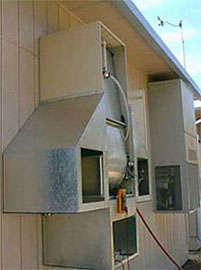
Design Of The High-Performance RCs
The design for the high-performance RCs used in this study incorporated currently available energy-efficient construction materials and methods, including additional wall, floor, and ceiling insulation; ceiling vapor barrier; "Cool Roof" reflective roof coating; low-emissivity window glazing; and efficient (T8) fluorescent lighting. Each of the four study RCs is equipped with two HVAC systems: a standard 10 seasonal energy efficiency ratio (SEER) heat pump air conditioner (HPAC) system and an energy-efficient hybrid system with an indirect/direct evaporative cooler (IDEC) and a natural gas heating system (see Figure 1).The IDEC supplies continuous ventilation at âä¥7.5 L/sec per person even when heating or cooling is not required. Compared to the standard heat pump system, the IDEC consumes as much as 70 percent less cooling energy, and, because it has a quieter fan and no compressor, its noise output is lower. The IDEC hybrid system includes an 85-percent-efficient (annual fuel utilization efficiency) gas-fired hydronic space-heating system and an efficient inlet filter system.
The Field Study
To test the high-performance RC designs in different climates, we located RCs at schools in two distinct regions: the California Central Valley (extreme climate) and the San Francisco Bay area (moderate climate). The manufacturer placed two high-performance RCs at an elementary school in the Modesto school system in the Central Valley and two RCs at a school in the Cupertino Unified School District (CUSD) in the San Francisco Bay area.The high-performance RCs were sited side by side at each of the schools prior to the fall 2001 semester and used during the semester by 3rd- and 4th-grade classes of 20-30 students; each class had one teacher. During nine weeks of the 2001 summer/fall cooling season (August to October 2001) and nine weeks of the heating season (January-March 2002), the two RCs at each school were simultaneously operated with either the standard heat pump or the IDEC unit; the systems in use were switched weekly. Each RC was instrumented to measure a range of IEQ and energy parameters, including humidity, temperature, air velocity, sound level, indoor and outdoor CO2 concentrations, particulate matter (PM) counts, volatile organic compound (VOC) and formaldehyde concentrations, and energy use.
Results
The patterns of HVAC system operation by the teachers directly influenced classroom IEQ parameters during the school day. As currently designed, both systems must be turned on to provide the required ventilation. The control requirement for the IDEC hybrid system is simply that the system be on when the space is occupied because the fan provides continuous 100 percent outside air when it is operating. The teachers reported that the IDEC system was quieter in operation than the HPAC system. In some cases, the decision to not turn on the HVAC system is based on a desire to save energy. For example, one teacher in the study regularly opened the RC windows during the morning instead of running the HVAC. In general, doors and windows were left open more frequently during the cooling season.Table 1 summarizes indoor CO2, indoor-outdoor formaldehyde, and indoor PM concentrations. Indoor sound level and daily HVAC operation costs are also shown. These data are averaged across the study RCs by cooling and heating seasons and by HVAC system type. The PM concentrations are presented as mass concentrations in three nested size bin ranges: 0.3 µm, 0.3 - 1.0 µm, and 0.3 - 5.0 µm. These ranges were chosen to facilitate assessment of the inlet filter effectiveness and system operation.
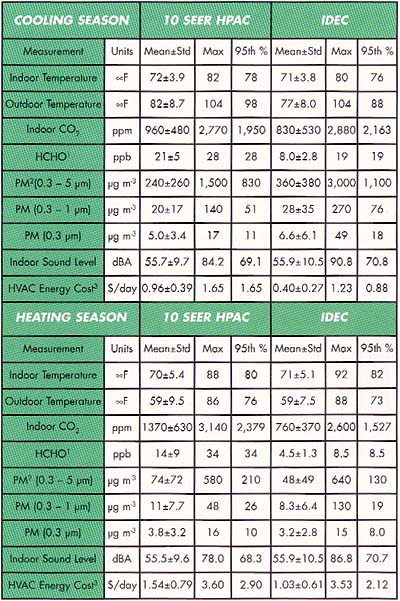
1 - Indoor/outdoor formaldehyde concentration.
2 - PM = particulate matter in given instrument bin sizes, mass concentration calculated from particle count concentration, based upon bin size diameter and assumed density of 2 g/cc. Outdoor PM concentrations (0.3 - 5 µm) were 130±140 µg/cubic meter and 30±40 µg/cubic meter in the cooling and heating seasons, respectively.
3 - Assuming electricity cost of $0.14/kWh and natural gas cost of $0.60/therm.
During the cooling season, average school-day indoor CO2 concentrations across study RCs were 960±480 ppm (average±standard deviation) and 830±530 ppm for HPAC and IDEC weeks, respectively. We observed that teacher operation of the HVAC systems was not based solely on thermal demand. Teachers did not always turn on the IDEC in the morning as instructed. When they did not, the CO2 concentrations in the classrooms were observed to rise well above 1,000 ppm, with peaks reaching almost 3,000 ppm, irrespective of the type of HVAC system designated for operation. During periods of window-only use, indoor CO2 levels often exceeded 1,000 ppm, indicating that windows alone may not provide adequate ventilation. The substantially lower CO2 concentrations during IDEC operation weeks demonstrate the benefits of continuous adequate or enhanced ventilation.
The continuous ventilation provided by the IDEC system was effective for controlling the concentrations of indoor-generated pollutants, as demonstrated by the formaldehyde data. School-day formaldehyde concentrations in both the cooling and heating seasons were higher during HPAC weeks than during IDEC weeks.
Looking for quick answers on air conditioning, heating and refrigeration topics? Try Ask ACHR NEWS, our new smart AI search tool. Ask ACHR NEWS
The teachers' usage of the HVAC system during the heating season was similar to usage during the cooling season, but morning heating demands led to more consistent use of the IDEC. Mean heating season indoor CO2 concentrations were 1,370±630 ppm and 760±370 ppm for HPAC and IDEC weeks, respectively.
Indoor PM concentrations were generally higher than outdoor concentrations, indicating that occupant activities were a source of particles. During the cooling season when doors and windows were frequently open, there was increased infiltration of PM from outdoors. Indoor PM concentrations were lower on average during HPAC operation across the particle-size distribution, but concentrations occasionally reached high levels with both HVAC systems.
Sound levels in the RCs were consistent across HVAC system and season, averaging about 56 A-weighted decibels (dBA). A comparison of occupied and unoccupied time periods showed that most of the noise increase above background in the occupied classrooms was from the occupants themselves, with HPAC and IDEC system operation contributing up to 14 dBA and 8 dBA, respectively.
Classroom total energy use and HVAC energy consumption were measured throughout the field study, and the energy data were used to calibrate a DOE-2 energy simulation model. Using the calibrated DOE-2 model for 16 California climate zones, we compared the energy use of the HPAC and IDEC, assuming that each HVAC system was operated to meet minimum ventilation standards. The resulting statewide average energy impacts per classroom included an 80 percent reduction in annual electricity use, more than 70 percent reductions in peak electricity requirements during both summer and winter, an increase in natural gas use (for winter heating), and a $220 annual energy cost savings.
These results overall suggest that it is possible to use efficient engineering solutions to simultaneously reduce energy consumption and improve indoor environmental quality.
This study was conducted by: M.G. Apte, D. Dibartolomeo, T. Hotchi, A.T. Hodgson, S.M. Lee, D.G. Shendell, D.P. Sullivan, and W.J. Fisk of the Indoor Environment Dept., Lawrence Berkeley National Laboratory, Berkeley Calif.; S.M. Liff of Massachusetts Institute of Technology, Boston; and L.I. Rainer of Davis Energy Group, Davis, Calif.
Reprinted from the Environmental Energy Technologies Division News #15, Lawrence Berkeley National Laboratory, Berkeley, Calif. For more information, contact Michael G. Apte at 510-486-4669; 510-486-6658 (fax); MGApte@lbl.gov.
The full report may be downloaded at http://buildings.lbl.gov/hpcbs/s_arc.html.
This study was sponsored by the California Energy Commission through the Public Interest Energy Research program.
Publication date: 05/17/2004
Looking for a reprint of this article?
From high-res PDFs to custom plaques, order your copy today!