ACHR News
search
Ask ACHR NEWS AI
cart
facebook twitter instagram linkedin youtube
  • Sign In
  • Subscribe
  • Sign Out
  • My Account
ACHR News
  • NEWS
    • Breaking News
    • New HVAC Products
    • Featured Products
    • Manufacturer Reports
    • HVAC Data
    • Legislation
    • ACHR NEWS Centennial
  • RESIDENTIAL
    • Air Conditioners
    • Furnaces
    • Residential Heat Pumps
    • Ductless
    • Residential IAQ
    • Testing, Monitoring, Tools
    • Components & Accessories
  • COMMERCIAL
    • Air Handlers
    • Rooftop Units
    • Chillers and Cooling Towers
    • Commercial Heat Pumps
    • Boilers and Hydronics
    • VRF/Ductless
    • Commercial IAQ
  • REFRIGERATION
    • Refrigerants
    • Refrigerant Regulations
    • Leak Management
  • CONTRACTOR PRO
    • Geothermal
    • Homeowner Study
    • VRF and VRV Ductless
    • Unitary Trends
  • EDUCATION
    • Training and Education
    • Business Management
    • Service and Maintenance
    • Continuing Education
    • Market Research >
      • HVAC Brand Awareness Report
      • VRV, VRF, VRVZ Report
      • Unitary Trends Report
      • Water Heat Professionals Report
    • Webinars
    • Sponsor Insights
    • eProducts Info
    • White Papers
  • EVENTS
    • HVAC Contractor Forum
    • Industry Events and Webinars
  • MEDIA
    • Videos
    • AHR Expo 2025 Videos
    • Podcasts >
      • ACHR News Podcast
      • HARDI Podcasts
      • AHR Expo Podcasts
      • ACCA Podcasts
    • Interactive Spotlights
    • Quizzes
    • eBooks
    • HVAC Talkback
  • HVAC GROUP
    • ACHR NEWS >
      • Current Issue
      • Digital Edition
      • Subscribe
    • Distribution Trends
    • SNIPS NEWS >
      • Join SNIPS NEWS
    • Engineered Systems News >
      • Join ES News
    • HVACR Directory
    • Contests
    • Newsletters
    • Contact
    • Advertise
    • My Account

ERVs, The Contractor's Standard Accessory

By Mark Skaer
January 13, 2005
As the requirements for larger amounts of outside air supplied to a building space become a reality under ASHRAE standards, energy recovery ventilators (ERVs) are gaining more popularity. One could argue that an ERV for commercial applications is well on its way to becoming a standard accessory for those contractors and specifying engineers who need to meet these new fresh air requirements.

An ERV is designed to supply a predetermined amount of outside air into the space through roof or sidewall penetration or tie into an existing packaged or split air conditioning system.

The ERV brings in fresh air from the outside and is designed to transfer sensible and latent energy from the exhaust airstream to the outside air. This process provides fresh air into the building at a lower heat/energy content level during the cooling season and higher heat/energy level during the heating season.

The ERV cools and dries the incoming outside air during the summer months and heats and humidifies the incoming outside air during the winter months.

Which do you need for your applications, a stand-alone or bolt-on ERV? According to a survey of some manufacturers, that depends on many factors.

"Both stand-alone and unitized ERVs have their place in the market and are designed to meet many types of applications," said Brian Wathen, commercial product manager for York International (Norman, Okla.)
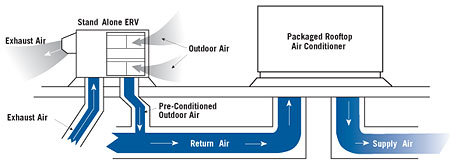
Figure 1. A stand-alone ERV system. (Illustrations courtesy of Greenheck.)

Stand-Alone Systems

In the eyes of Aaron Gotham, general manager for ERVs for Greenheck (Schofield, Wis.), most applications favor the stand-alone system, although the bolt-on ERV (or other integrated ERV and air conditioning products) can be a good solution for systems without exhaust, or where the exhaust airstream is remotely located.

"In most cases, a system design that incorporates the stand-alone ERV is superior to the bolt-on system," said Gotham. "The fundamental reasons for this can be found by taking a look at more than just the outdoor air requirements. If we consider both the outdoor air and exhaust air requirements of commercial buildings, the advantages of the stand-alone system become apparent."

Gotham commented that the stand-alone ERV system provides the most efficient method of ventilating a building "because it steals energy from air that has to be exhausted anyway.

Looking for quick answers on air conditioning, heating and refrigeration topics? Try Ask ACHR NEWS, our new smart AI search tool. Ask ACHR NEWS →

"The bolt-on ERV is not tied into the exhaust system, allowing the conditioned air to escape into the atmosphere.

"In many commercial buildings, the exhaust air code required is roughly half of the outdoor air volume. This means compared to the bolt-on unit, the stand-alone ERV can recover energy from twice as much air leaving the building. The net impact is nearly double the effectiveness for the stand-alone system."

In his estimation, stand-alone ERV systems inherently remind the HVAC engineer to perform the building balance check, "because the outdoor air and exhaust air volumes are located on the same equipment schedule."

Gotham also maintains that the installation cost of a stand-alone ERV system is typically less than the installation cost of a bolt-on ERV. "With the stand-alone ERV, the ERV is performing the function of an exhaust fan, eliminating the need to purchase one," he stated.

"No additional roof or wall penetrations are needed for stand-alone ERVs. The same penetrations that are needed for the ERV were needed for the exhaust fans as well. In some cases, the ERV takes the place of several exhaust fans, and penetrations are reduced.

"Additionally, because the stand-alone ERV has a greater system efficiency (recovering energy from more exhaust air volume), more air conditioning equipment downsizing is available," he said.

"This is another first-cost advantage compared to bolt-on ERVs when a system includes exhaust air."

According to Russell Smith, sales manager at Berner Energy Recovery Inc. (New Castle, Pa.), there are still more cost-saving advantages to the stand-alone system.

"When introducing 100-percent outside air by incorporating a stand-alone energy recovery unit, one can design and limit the amount of impact to an existing HVAC system by implementing and making use of an independent set of coils within the ERV," said Smith.

"These coils can then produce the desired conditions, which can be ducted directly to the space."

Wathen pointed out that several key items need to be considered when applying either a stand-alone or bolt-on unit.

"Stand-alone ERVs are de-signed to supply fresh air into a space external of an HVAC unit," he said. "This type of ERV will supply a predetermined amount of fresh air into the space. Supply ductwork is usually required and in many cases the stand-alone ERV is tied to the air conditioning system's supply ductwork."

Figure 2. A bolt-on ERV system.

Benefits Of Both

Wathen continued: "Most stand-alone ERVs that have their supply air connected to the return of an air conditioning system have them connected to multiple air conditioning systems. This means that the ERV must be balanced with all of the air conditioning systems operating, and multiple balancing dampers adjusted accordingly. All of the air conditioning systems must operate with continuous blowers or air balance for all systems will vary."

In his estimation, a bolt-on system has the advantage of running when the air conditioning unit operates. "This allows the ERV and air conditioning system to remain balanced," he said.

As for the efficiency, Wathen contended that both the stand-alone and the bolt-on system can have the same efficiency depending upon the efficiency of the wheel. "The benefit of the bolt-on system is that it provides precooling or preheating for the air conditioning unit," he said, "thus making the unit more efficient."

That's not to say that Wathen believes in the superiority of one over the other. "Stand-alone models will allow fresh air to be supplied to large common areas and can be tied into existing air conditioning ductwork, thus becoming a separate entity from the air conditioning units themselves," he said.

"They can also be used on applications that do not have an air conditioning system." Bolt-on models are designed to allow fresh air to be supplied to the space in either large common areas or individual spaces served by individual air conditioning systems, he said.

"In most cases, return and supply air ductwork is provided from the air conditioning system," he added, "thus having a lower ERV installation cost over a stand-alone model that requires separate ductwork in many cases."

Does a stand-alone ERV inherently remind the HVAC engineer to perform the building balance check? Wathen doesn't think so. "A stand-alone system is difficult to determine a good air balance," he said. "The fact that it has an independent duct system builds in a typical 10-percent leakage, which requires the balancing contractor to ‘eliminate' the true amount of air.

"Also, most stand-alone ERVs that have their supply air connected to the return of an air conditioning system have them connected to multiple air conditioning systems," he said.

"This means that the ERV must be balanced with all of the air conditioning systems operating, and multiple balancing dampers adjusted accordingly. All of the air conditioning systems must operate with continuous blowers or the balance for all systems is shot.

"The bolt-on system has the advantage of running when the air conditioning unit operates. This keeps the system balanced."

In the end, Wathen said the overall goal of an ERV is to supply fresh air into a space without greatly increasing the sensible and latent load in the space. "Both stand-alone and bolt-on ERVs provide this function.

Sidebar: One Example - Stand-Alone System vs. Bolt-On System

To back up his point concerning the stand-alone ERV, Aaron Gotham of Greenheck provided a comparison based upon the following criteria:

  • A commercial building requires 3,000 cfm of outdoor air based on ASHRAE Standard 62.

  • Based on codes, the minimum exhaust is 1,500 cfm from areas such as restrooms and conference rooms.

  • The building is to have a slight positive pressure and specifies total exhaust/relief air of 2,700 cfm (10 percent positive).

  • Outdoor air design is 95 degrees dry bulb (db) / 78 degrees wet bulb (wb) and room air is specified at 75 degrees db / 50 percent relative humidity.

    Gotham drew the following conclusions:

  • Stand-alone system - "Because we can exhaust the restrooms and conference rooms with the ERV, we can recover energy from the total 2,700 cfm of exhaust/relief air.

    The resulting effectiveness at 3,000 cfm outdoor air and 2,700 cfm exhaust air is 75 percent. This pre-conditions the outdoor air from 95 degrees db / 78 degrees wb to 80 degrees db / 67 degrees wb. The air conditioning load is reduced by more than 11 tons."

  • Bolt-on system - "Because we cannot recover air from the restrooms and conference rooms, there is only 1,200 cfm of relief air left to recover energy from. The resulting effectiveness of 3,000 cfm outdoor air and 1,200-cfm exhaust air is only 40 percent. Outdoor air is only preconditioned to 87 degrees db / 72.5 degrees wb and the load is only reduced by 6 tons."

    - Mark Skaer

    Publication date: 01/17/2005

  • Share This Story

    Looking for a reprint of this article?
    From high-res PDFs to custom plaques, order your copy today!


    Mark Skaer Senior Editor. E-mail him at markskaer@achrnews.com.

    Recommended Content

    JOIN TODAY
    To unlock your recommendations.

    Already have an account? Sign In

    • HVAC-enrollment

      The Trades Are Back: HVACR Programs See Nearly 30% Enrollment Spike

      A new wave of future technicians is entering the pipeline.  
      Training and Education
      By: Matt Jachman
    • 2025 Top 40 Under 40

      2025 Top 40 Under 40 HVACR Professionals List

      The 11th annual Top 40 Under 40 list highlights those...
      HVAC Commercial Market
      By: Hannah Belloli-Oster
    • LG Ductless Mini-Split Systems

      The 9 Types of Heat Pumps

      As the U.S. moves toward electrification, heat pumps are...
      News
      By: Joanna R. Turpin
    Subscription Center
    • Create an Account
    • Start a Subscription
    • Manage My Account
    • Sign Up for Newsletters
    • Visit Customer Service
    • Update Preferences

    More Videos

    Sponsored Content

    Sponsored Content is a special paid section where industry companies provide high quality, objective, non-commercial content around topics of interest to The News audience. All Sponsored Content is supplied by the advertising company and any opinions expressed in this article are those of the author and not necessarily reflect the views of The News or its parent company, BNP Media. Interested in participating in our Sponsored Content section? Contact your local rep!

    close
    • Piggy Bank
      Sponsored byWatercress Financial

      Energy Prices, Inflation, and HVAC: What Today’s Homeowners Care About

    • Refrigerated Food
      Sponsored bySolstice Advanced Materials

      R-455A Refrigeration: A Cold Storage Solution for the Future

    • Airex Rooftop Units
      Sponsored byAirex Manufacturing Inc

      Consolidating Roof Penetrations: A Growing Trend in Multifamily HVAC Design

    Popular Stories

    HVAC-Price-Increase-graphic

    HVAC Price Increase List: June 2026

    Trump-Section-232.jpg

    Trump Reduces Section 232 Tariffs on HVAC Equipment to 15%

    R410A-Refrigerant-Cylinder.jpg

    Refrigerant Recovery is a Revenue Opportunity

    Heat-pump-cutaway.jpg

    PFAS Rules and A2L Building Codes Continue to Evolve

    Kroger.jpg

    Kroger to Spend $100 Million to Reduce Refrigerant Leaks

    View The ACHR NEWS
    Centennial Anniversary Timeline

    The ACHR News Timeline Chart
    Submit a Letter
    Submit a letter to our editors.

    Events

    November 6, 2025

    Next-Gen Data Center Cooling: HVAC Innovation and Real-World Solutions

    On Demand As AI workloads and high-density computing push traditional cooling methods to their limits, the data center industry is accelerating the adoption of next-generation HVAC technologies.

    June 9, 2026

    Before You Go All In on AI: Set Up Your Business to Actually Win

    In this webinar, we'll walk you through exactly what to get in place before you add AI to your business. You'll leave with a clear picture of where you stand today and a practical action plan to set yourself up for real results.

    View All Submit An Event

    Poll

    Summer Staff

    Are you fully staffed for the summer season?
    View Results Poll Archive

    Products

    BNI Mechanical/Electrical Square Foot Costbook, 2026 Edition

    BNI Mechanical/Electrical Square Foot Costbook, 2026 Edition

    See More Products
    A2L Refrigerants - Free Webinar - May 21, 2026

    Related Articles

    • ERVs Can Be the Answer to IAQ Problems

      See More
    • Software Products That Boost Profits Win Raves From The Contractor-Judges

      See More
    • E-commerce and HVAC: How to Keep the Contractor in the Equation

      See More

    Related Products

    See More Products
    • contractor-soft-skills-dvd.png

      Contractor Soft Skills DVD

    • solidworkscourse2.gif

      SolidWorks for the Sheet Metal Guy - Course 2: Hole Patterns and Notches

    • Uncomplicating The Heat Pump: Electrical System Troubleshooting DVD

    See More Products

    Events

    View AllSubmit An Event
    • October 30, 2025

      The HVAC Contractor’s Guide to AI-Driven SEO

      On Demand We will provide a clear, actionable roadmap for HVAC contractors to enhance their online visibility, dominate local search results, and adapt to the new era of AI-driven customer inquiries. Learn how to turn clicks into profitable calls and secure your position as the go-to HVAC provider in your area.
    View AllSubmit An Event

    Related Directories

    • Air Conditioning Contractors of America

      ACCA, the national trade association furthering the interests of HVACR contracting businesses and the broader HVACR industry, serves more than 80,000 professionals and 3,000 businesses nationwide.
    ×

    Sign Up. Stay Informed.

    The #1 trusted source for the HVACR industry since 1926

    SUBSCRIBE
    • RESOURCES
      • Advertise
      • Contact Us
      • Advisory Board
      • Classifieds
      • Submit a Letter
      • Directories
      • Store
    • ACCOUNT CENTER
      • Create an Account
      • Start a Subscription
      • Manage My Account
      • Sign Up for Newsletters
      • Visit Customer Service
      • Update Preferences
    • SERVICES
      • Marketing Services
      • Reprints
      • Market Research
      • List Rental
      • Survey/Respondent Access
    • STAY CONNECTED
      • LinkedIn
      • Facebook
      • Instagram
      • YouTube
      • X (Twitter)
    • PRIVACY
      • PRIVACY POLICY
      • TERMS & CONDITIONS
      • DO NOT SELL MY PERSONAL INFORMATION
      • PRIVACY REQUEST
      • ACCESSIBILITY

    Copyright ©2026. All Rights Reserved BNP Media, Inc. and BNP Media II, LLC.

    Design, CMS, Hosting & Web Development :: ePublishing