Auburn Preserves City Hall And Improves Comfort

No one, however, wanted to preserve the current heating and cooling system, which featured a wheezy steam boiler, gusty window, and ceiling fans that just blew around hot air (and papers). City Manager John Salomone was surprised to learn there was no air conditioning in the building when he arrived a few years ago. Employees sweltered through hot summers, with temperatures topping 95 degrees F in some offices.
When considering a replacement, City Hall's new heating and cooling system had to meet several criteria. It had to be cost-effective, energy efficient, provide a more comfortable working environment, and blend into the landmark building both inside and out. While a gas boiler and central air system was a conventional choice, design engineer John Manning, P.E., recommended that the city consider an alternative that might exceed expectations.
City Hall considered the alternatives and elected to install a geothermal heating and cooling system for its efficiency and flexibility. As a result of design studies and a careful retrofit, water-source heat pumps from McQuay (Minneapolis) were installed in city offices, meeting rooms, and hallways, to deliver comfortable, conditioned air while preserving the building's architectural integrity.

Geothermal Operation
Geothermal systems are ideal for heating and cooling individual spaces, or zones, such as offices and classrooms that require independent heating and cooling, according to McQuay.A geothermal system reduces energy costs because it draws from the constant temperature of the earth below the frost line for zoned cooling and heating. This approach significantly reduces demand on fossil fuels compared to other HVAC systems.
The earth absorbs and stores up to 47 percent of the sun's energy, according to the Environmental Protection Agency (EPA), providing a natural source for delivering constant temperature control above ground. Geoexchange systems can reduce energy consumption - and corresponding emissions such as carbon dioxide - by more than 40 percent compared to conventional systems, McQuay said.
During winter, water is pumped through underground pipes into the building, where the heat pumps pull heat from the water and distribute warm air to individual rooms or zones, such as a corridor or group of offices. In the summer, the process is reversed, with heated water transferred out of the building into the underground pipes, where it is cooled by the earth. In transitional seasons, heat may be sent to some parts of the building, while other areas require cooling at the same time.
Geothermal systems include three main components: an earth connection (such as polyethylene piping) to transfer heat between the water in the pipe and the earth; one or two circulating pumps to move water into and out of the building; and water-source heat pumps in each zone area to deliver the required heating and cooling. These components are sized and optimized to significantly reduce energy consumption, the manufacturer said.
Looking for quick answers on air conditioning, heating and refrigeration topics? Try Ask ACHR NEWS, our new smart AI search tool. Ask ACHR NEWS
City Needs Proof
Such a system sounded good in theory, but City Hall required more proof that it would meet their requirements. Manning, who heads Earth Sensitive Solutions, LLC, and Mike Long, grants manager for capital improvement projects for the city, developed a feasibility study of both conventional heating systems and geothermal technology. Their study earned a grant from New York State's Energy and Re-search Development Authority.The results of the study, presented to the city council and city manager, included a comparison of components, installed cost, operating and maintenance cost, emissions, and aesthetics.
Installed costs: The estimated capital costs for each kind of system were about the same for initial installation - just under $1 million, with the geothermal system costing slightly more.
Operating and maintenance costs: This is where the big difference lay. Annual heating and cooling costs for a geoexchange system were significantly less, with total annual savings estimated at over $19,000.
"These savings, and the competitive initial cost, contradict a common misperception that geo-exchange systems are far more expensive than conventional systems and will take a long time to pay back," said Manning. "Another misperception is that geoexchange systems can be installed only in a few geographic areas."
Emissions: Another difference also caught the attention of the city. The geoexchange system would generate 58 percent less carbon dioxide emissions, so it was not just cheaper to operate, but also greener.
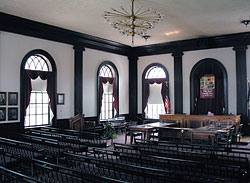
Aesthetics: The city did not want any system to detract from the visual appeal or compromise the historical integrity of City Hall. Here again, the geothermal system came out ahead. Unlike a chiller, it has no visible external components and generates no external noise.
Impressed with these advantages, Auburn elected to go ahead with a geothermal system.
Piping Details
A critical factor in the performance and cost-effectiveness of a geothermal system is getting the right number and depth of pipes in the loop field. "One reason for the misperception about cost is that engineers unfamiliar with geoexchange systems often over-design, putting in more piping capacity than is needed," said Manning.Engineering tests showed that a series of 35 holes six inches in diameter should be bored 400 feet below the parking lot behind City Hall. Each pipe was connected at the bottom using a U-bend fitting, so that water could be sent down one pipe, cooled (or heated) by the constant 54 degree temperature in the ground, and come up the other pipe.
In addition, a series of horizontal pipes were laid several feet under the surface to connect the vertical pipes. These horizontal pipes run to a valve manifold in the basement of the building. From there, small pipes carry the heated or cooled water to multiple McQuay® water-source heat pumps in the offices and other areas of the building.
The Installation
During installation, contractors were able to take advantage of the building's features to hide the geothermal system. For example, the original radiators on the first floor were covered with ornate grillwork. After the radiators were removed, the covers were reused to house the McQuay heat pumps.The entire installation was a study in how to minimize disruption to the original architecture. On the second and third floors, engineers considered where to put the pipes that would carry the heated or cooled water to 72 heat pumps installed in individual offices.
Running pipes along the ceiling would have required cutting through some of the steel beams, so engineers elected to run the vertical pipes alongside the beams, enclosing them and the beams in drywall. The horizontal pipes were run along the floor and enclosed in 6- by 22-inch kneewalls. The walls were then capped with Corian® material that looks very much like the marble windowsills above them.
The installation team started at the top - the hottest area - and worked its way down. Additional floors became operational every two weeks. Installing the full control system completed the installation. This control system gives occupants more flexibility with temperature control compared to other cooling systems. The set temperature of the control system is 68 degrees and City Hall employees can vary this by three degrees up or down.
"The units distributed throughout the building give us an economical system with the added advantage of individual controls," said Salomone. "Our employees like that kind of flexibility."
Auburn's Memorial City Hall now has a working environment to match its visual appeal and historical character. The reaction among employees has been overwhelmingly positive. There is also a side benefit: "We're on a busy highway," Salomone said. "In the summer the offices are much quieter now."
Publication date: 10/04/2004
Looking for a reprint of this article?
From high-res PDFs to custom plaques, order your copy today!