ACHR News
search
Ask ACHR NEWS AI
cart
facebook twitter instagram linkedin youtube
  • Sign In
  • Subscribe
  • Sign Out
  • My Account
ACHR News
  • NEWS
    • Breaking News
    • New HVAC Products
    • Featured Products
    • Manufacturer Reports
    • HVAC Data
    • Legislation
    • ACHR NEWS Centennial
  • RESIDENTIAL
    • Air Conditioners
    • Furnaces
    • Residential Heat Pumps
    • Ductless
    • Residential IAQ
    • Testing, Monitoring, Tools
    • Components & Accessories
  • COMMERCIAL
    • Air Handlers
    • Rooftop Units
    • Chillers and Cooling Towers
    • Commercial Heat Pumps
    • Boilers and Hydronics
    • VRF/Ductless
    • Commercial IAQ
  • REFRIGERATION
    • Refrigerants
    • Refrigerant Regulations
    • Leak Management
  • CONTRACTOR PRO
    • Geothermal
    • Homeowner Study
    • VRF and VRV Ductless
    • Unitary Trends
  • EDUCATION
    • Training and Education
    • Business Management
    • Service and Maintenance
    • Continuing Education
    • Market Research >
      • HVAC Brand Awareness Report
      • VRV, VRF, VRVZ Report
      • Unitary Trends Report
      • Water Heat Professionals Report
    • Webinars
    • Sponsor Insights
    • eProducts Info
    • White Papers
  • EVENTS
    • HVAC Contractor Forum
    • Industry Events and Webinars
  • MEDIA
    • Videos
    • AHR Expo 2025 Videos
    • Podcasts >
      • ACHR News Podcast
      • HARDI Podcasts
      • AHR Expo Podcasts
      • ACCA Podcasts
    • Interactive Spotlights
    • Quizzes
    • eBooks
    • HVAC Talkback
  • HVAC GROUP
    • ACHR NEWS >
      • Current Issue
      • Digital Edition
      • Subscribe
    • Distribution Trends
    • SNIPS NEWS >
      • Join SNIPS NEWS
    • Engineered Systems News >
      • Join ES News
    • HVACR Directory
    • Contests
    • Newsletters
    • Contact
    • Advertise
    • My Account
HVAC ContractingTechnical

What Happens When a Building Turns Green?

June 26, 2006
The Solaire, the nation’s first green residential high-rise, is located in New York’s Battery Park City. View of the western facade of The Solaire showing photovoltaic panels.
During the 1920s, the visionary Buckminster Fuller conceived of a building that featured, among other things, a self-contained power source, a shape that minimized heat loss and the amount of materials needed to build it, a cistern that shunted water via a system of gutters, a toilet that didn't use water, and a shower that washed with hot water vapor.

A scale model of his idea is now an exhibit at the Henry Ford Museum in Dearborn, Mich. Clearly, Fuller was on to something. Fast forward 80 years and that something is the "green building."

Technically, these edifices conform to a set of environmental design and performance guidelines established by the U.S. Green Building Council, and they come in various shades of green as arrived at by the council's Leadership in Energy and Environmental Design (LEED) rating system. What they all have in common is an astonishingly low impact on the environment.

Typically, they save close to 30 percent of the energy and 50 percent of the water that buildings of comparable size waste. Turning a building green might entail hardening the interior walls with insulation, applying special glazing to windows and installing high-efficiency lighting, heating, cooling, and ventilation systems. It might also involve new plumbing fixtures emphasizing water conservation. Then, to ensure clean ambient air and water quality, contractors typically agree to avoid using toxic paints, sealants, cleansers, and floor coverings, and use special filters and monitoring equipment to reach clean-room levels of air and water purity.

The New York Power Authority’s green corporate office building in White Plains, N.Y.
Those occupying these buildings claim improved health and lower utility bills, not to mention a clear conscience, as even the building materials themselves are recycled.

Three years ago, I led a team that created the nation's first "green" residential high-rise building: The Solaire, at 20 River Terrace in New York's Battery Park City, which achieved levels of energy efficiency 35 percent greater than prescribed by the state's energy code. The Solaire consumes 65 percent less energy during peak summer periods than buildings of comparable size and relies on solar energy for 5 percent of the building's base electrical load. The building even includes its own wastewater treatment facility - the first in the nation inside a multi-family residential building - alongside another innovative system that re-uses storm water.

The impetus behind The Solaire was Gov. George Pataki, who has been advancing a pragmatic environmentalism since assuming the governorship more than 11 years ago. The governor spearheaded legislation to provide significant tax relief to developers of green buildings. He also mandated a 35 percent cut in energy use at state buildings by 2010 - in effect, ordering state buildings to turn green as well.
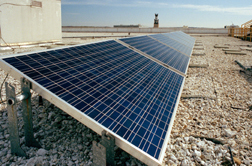
The solar array at the New York Power Authority’s corporate office building.
The governor turned the latter initiative over to the New York Power Authority, which over the last decade has invested more than $900 million in energy-efficient refrigerators, lighting, heating and ventilation, and energy control systems in public buildings throughout the state.

Today, state office buildings, the state university system, housing projects, schools, libraries - even police precincts and fire houses - are astonishingly energy efficient, despite the majority of these structures having been built in an era when energy was cheap and plentiful. These green enhancements save taxpayers $92 million through reduced energy and maintenance costs and avoid the importation of more than 1.5 million barrels of foreign oil every year.
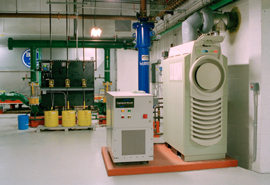
The corporate office building of the New York Power Authority is also powered by an on-site microturbine.
At the Power Authority's corporate office building in White Plains, N.Y., which houses some 600 employees and a number of private tenants, we took some of our own medicine, making more than $3.5 million in energy-efficiency investments. This cut the annual energy use in our building not by 35 percent, but by more than 50 percent. That's a saving of more than 5 million kilowatt hours annually. Since the Power Authority is self-supporting, the benefit to taxpayers is indirect, though these savings will allow us to take on more projects, improving energy efficiency not just for public buildings but for private ones that use our low-cost electricity to retain jobs in New York state.

Down the road, we plan to achieve a LEED-certified rating on our corporate office building in White Plains, as we improve water efficiency, air purity, and the other attributes of building performance.

Looking for quick answers on air conditioning, heating and refrigeration topics? Try Ask ACHR NEWS, our new smart AI search tool. Ask ACHR NEWS →

Timothy S. Carey is president and chief executive officer of the New York Power Authority. Among his former positions was that of president and chief executive officer of the Hugh L. Carey Battery Park City Authority.

Publication date: 06/26/2006

Share This Story

Looking for a reprint of this article?
From high-res PDFs to custom plaques, order your copy today!


Recommended Content

JOIN TODAY
To unlock your recommendations.

Already have an account? Sign In

  • HVAC-enrollment

    The Trades Are Back: HVACR Programs See Nearly 30% Enrollment Spike

    A new wave of future technicians is entering the pipeline.  
    Training and Education
    By: Matt Jachman
  • 2025 Top 40 Under 40

    2025 Top 40 Under 40 HVACR Professionals List

    The 11th annual Top 40 Under 40 list highlights those...
    News
    By: Hannah Belloli-Oster
  • LG Ductless Mini-Split Systems

    The 9 Types of Heat Pumps

    As the U.S. moves toward electrification, heat pumps are...
    HVAC Commercial Market
    By: Joanna R. Turpin
Subscription Center
  • Create an Account
  • Start a Subscription
  • Manage My Account
  • Sign Up for Newsletters
  • Visit Customer Service
  • Update Preferences

More Videos

Sponsored Content

Sponsored Content is a special paid section where industry companies provide high quality, objective, non-commercial content around topics of interest to The News audience. All Sponsored Content is supplied by the advertising company and any opinions expressed in this article are those of the author and not necessarily reflect the views of The News or its parent company, BNP Media. Interested in participating in our Sponsored Content section? Contact your local rep!

close
  • Piggy Bank
    Sponsored byWatercress Financial

    Energy Prices, Inflation, and HVAC: What Today’s Homeowners Care About

  • Refrigerated Food
    Sponsored bySolstice Advanced Materials

    R-455A Refrigeration: A Cold Storage Solution for the Future

  • Airex Rooftop Units
    Sponsored byAirex Manufacturing Inc

    Consolidating Roof Penetrations: A Growing Trend in Multifamily HVAC Design

Popular Stories

HVAC-Price-Increase-graphic

HVAC Price Increase List: June 2026

Trump-Section-232.jpg

Trump Reduces Section 232 Tariffs on HVAC Equipment to 15%

R410A-Refrigerant-Cylinder.jpg

Refrigerant Recovery is a Revenue Opportunity

Heat-pump-cutaway.jpg

PFAS Rules and A2L Building Codes Continue to Evolve

Kroger.jpg

Kroger to Spend $100 Million to Reduce Refrigerant Leaks

View The ACHR NEWS
Centennial Anniversary Timeline

The ACHR News Timeline Chart
Submit a Letter
Submit a letter to our editors.

Events

November 6, 2025

Next-Gen Data Center Cooling: HVAC Innovation and Real-World Solutions

On Demand As AI workloads and high-density computing push traditional cooling methods to their limits, the data center industry is accelerating the adoption of next-generation HVAC technologies.

June 9, 2026

Before You Go All In on AI: Set Up Your Business to Actually Win

In this webinar, we'll walk you through exactly what to get in place before you add AI to your business. You'll leave with a clear picture of where you stand today and a practical action plan to set yourself up for real results.

View All Submit An Event

Poll

Summer Staff

Are you fully staffed for the summer season?
View Results Poll Archive

Products

BNI Mechanical/Electrical Square Foot Costbook, 2026 Edition

BNI Mechanical/Electrical Square Foot Costbook, 2026 Edition

See More Products
A2L Refrigerants - Free Webinar - May 21, 2026

Related Articles

  • What happens when a power plant needs temporary equipment? Good question!

    See More
  • What Happens When the Phone Rings?

    See More
  • What Happens When Customers Can't Afford 13 SEER?

    See More

Related Products

See More Products
  • Green Tips for Building Maintenance Engineers

  • Building Information Modeling: Planning and Managing Construction Projects with 4D CAD and Simulations

See More Products

Related Directories

  • Gustave A. Larson Co. (Green Bay, WI)

×

Sign Up. Stay Informed.

The #1 trusted source for the HVACR industry since 1926

SUBSCRIBE
  • RESOURCES
    • Advertise
    • Contact Us
    • Advisory Board
    • Classifieds
    • Submit a Letter
    • Directories
    • Store
  • ACCOUNT CENTER
    • Create an Account
    • Start a Subscription
    • Manage My Account
    • Sign Up for Newsletters
    • Visit Customer Service
    • Update Preferences
  • SERVICES
    • Marketing Services
    • Reprints
    • Market Research
    • List Rental
    • Survey/Respondent Access
  • STAY CONNECTED
    • LinkedIn
    • Facebook
    • Instagram
    • YouTube
    • X (Twitter)
  • PRIVACY
    • PRIVACY POLICY
    • TERMS & CONDITIONS
    • DO NOT SELL MY PERSONAL INFORMATION
    • PRIVACY REQUEST
    • ACCESSIBILITY

Copyright ©2026. All Rights Reserved BNP Media, Inc. and BNP Media II, LLC.

Design, CMS, Hosting & Web Development :: ePublishing