ACHR News
search
Ask ACHR NEWS AI
cart
facebook twitter instagram linkedin youtube
  • Sign In
  • Subscribe
  • Sign Out
  • My Account
ACHR News
  • NEWS
    • Breaking News
    • New HVAC Products
    • Featured Products
    • Manufacturer Reports
    • HVAC Data
    • Legislation
    • ACHR NEWS Centennial
  • RESIDENTIAL
    • Air Conditioners
    • Furnaces
    • Residential Heat Pumps
    • Ductless
    • Residential IAQ
    • Testing, Monitoring, Tools
    • Components & Accessories
  • COMMERCIAL
    • Air Handlers
    • Rooftop Units
    • Chillers and Cooling Towers
    • Commercial Heat Pumps
    • Boilers and Hydronics
    • VRF/Ductless
    • Commercial IAQ
  • REFRIGERATION
    • Refrigerants
    • Refrigerant Regulations
    • Leak Management
  • CONTRACTOR PRO
    • Geothermal
    • Homeowner Study
    • VRF and VRV Ductless
    • Unitary Trends
  • EDUCATION
    • Training and Education
    • Business Management
    • Service and Maintenance
    • Continuing Education
    • Market Research >
      • HVAC Brand Awareness Report
      • VRV, VRF, VRVZ Report
      • Unitary Trends Report
      • Water Heat Professionals Report
    • Webinars
    • Sponsor Insights
    • eProducts Info
    • White Papers
  • EVENTS
    • HVAC Contractor Forum
    • Industry Events and Webinars
  • MEDIA
    • Videos
    • AHR Expo 2025 Videos
    • Podcasts >
      • ACHR News Podcast
      • HARDI Podcasts
      • AHR Expo Podcasts
      • ACCA Podcasts
    • Interactive Spotlights
    • Quizzes
    • eBooks
    • HVAC Talkback
  • HVAC GROUP
    • ACHR NEWS >
      • Current Issue
      • Digital Edition
      • Subscribe
    • Distribution Trends
    • SNIPS NEWS >
      • Join SNIPS NEWS
    • Engineered Systems News >
      • Join ES News
    • HVACR Directory
    • Contests
    • Newsletters
    • Contact
    • Advertise
    • My Account

The Fundamentals Of Fan Selection

By James J. Siegel
December 19, 2002
An HVAC system is only as good as the sum of its parts. If one component of the system is malfunctioning, the entire efficiency can be thrown off. The same can be said if the system has been designed with components that are wrong for the job.

For example, the effectiveness of a system, whether it is for residential, commercial, or industrial use, can be significantly altered if the incorrect fan is chosen.

According to one fan manufacturer, choosing the right fan for the job does not have to be difficult. In fact, the company says that the choice is all about the process of elimination.

VAST ARRAY OF VARIABLES

Since every HVAC installation is unique, there are thousands of different pieces of equipment and components to consider. There are fan models for almost every scenario. The key is knowing what variables to take into account when designing a system.

“There are so many variables involved in selecting a fan that if it’s not done properly, it can impact performance and price,” said Jay Haferbecker, senior application engineer for Greenheck Fan Corporation (Schofield, WI).

Although there are a number of things to consider when selecting a fan, Haferbecker explained that the most important things to think about could be summed up in six questions.

  • What is the application?

  • What is the cfm and static pressure of the system?

  • Where will the fan be mounted?

  • What are the sound constraints?

  • What is going through the airstream? (Does it include clean air, grease from kitchens, fumes from fume hoods, or air at high temperatures?)

  • What are the price constraints?

    When they answer these questions, designers can begin to narrow down fan choices.

    THE BASIC APPLICATION

    According to Greenheck, the basic purpose of ventilation is to replace stale air with clean, fresh air. The process of ventilating a building or space can change depending on the situation, but the fundamentals of proper airflow do not change. They include cfm and static pressure.

    Haferbecker explained that once you find out these two variables, the decision becomes much easier. First, the amount of cfm and static pressure will help determine the type of fan that will be used, including whether one chooses a propeller fan over a centrifugal fan or a direct-drive fan over a belt-drive fan.

    Systems that require moving large volumes of air (5,000-plus cfm) at low static pressures (0.50 inches or less) will benefit from the use of a propeller fan, said Haferbecker; centrifugal fans, on the other hand, are more efficient with higher static pressures.

    Haferbecker said that direct drives require less maintenance because they do not have pulleys, belts, or bearings that need to be greased. For lower air volumes and static pressures, Greenheck recommends a direct-drive fan. Belt drives can be better suited for larger amounts of cfm and static pressure.
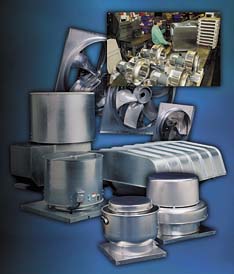
    Fan selection can have a tremendous impact on system efficiency. (Photo courtesy of Greenheck Fan Corporation.)

    MORE TO THINK ABOUT

    Once the basic issues have been dealt with, a designer can begin to think of other issues that will help in fan selection. Cfm and static pressure will greatly dictate the fan choice, but other factors will come into play that will help in selecting a specific model.

    The demands of the application and the needs of the end user will help in making a better fan decision. Some of these other demands will include the sound level, price, maintenance, system setup, and fan access location.

    Some fans take sound into account more than others. In some applications, such as warehouses or other industrial situations, quieter fans are not a necessity. But for applications such as office buildings, libraries, and museums, fans with low noise levels are a must. Centrifugal fans are considered to be quieter than propeller fans.

    Price and maintenance will also have an impact on fan selection. For example, designers need to think about the initial cost of the fans. How much will it cost to purchase and install them? How much will these fans cost the end user over time? A larger horsepower fan can consume many times the original price of the fan in energy costs over its lifetime.

    It is also beneficial to think about the reliability of the fan. Maintenance can be more costly on some fans than on others. When fans do need to be repaired, how accessible are new replacement parts? If a fan does need to be replaced or repaired, how much downtime will occur?

    Haferbecker said that direct-drive fans can help to eliminate issues of maintenance and price. These fans need little to no maintenance, are easier to install, and are less expensive, but the belt-drive performance adjustability is sacrificed, unless a variable-frequency drive (VFD) is used.

    If price is an issue and applications need more high-end equipment and need to move larger volumes of air, it is possible to use more than one fan.

    But Haferbecker warns against oversizing fans. He said that some people believe that oversizing the fan will enhance efficiency, but in reality this will make the system less efficient.

    Designers must also think about what kind of air will be moved. Some industrial and commercial applications will require a system to move heated air or air with fumes. In applications that require the ventilation of a kitchen space, the exhaust air will have grease in it. Some production facilities may have dirtier air, which will require a special fan.

    In the majority of propeller fans, the motors are mounted in the airstream. This means that these fans work best when the indoor air is relatively clean. It also means that these fans cannot handle temperatures over 120 degrees F.

    But many centrifugal fans have motors that are out of the air-stream. This enables them to deal with more contaminated air and higher temperatures.

    Finally, fan location is very important. The most common locations to place fans include the roof, in a wall, or in a duct. The basic components will not change, but the fan housings will.

    TECHNOLOGY CAN HELP

    “The industry is somewhat changing,” said Haferbecker. “And the process of selecting equipment has changed.”

    He explained that in recent years technology has had an enormous impact when it comes to selecting the equipment and units used in a particular application, including fans.

    Haferbecker said that there are software programs that can help in planning and designing systems. Some programs can greatly reduce the amount of time it takes to select fans. They can also help in making recommendations for the fans that will be the wisest choice for particular applications.

    Haferbecker also said that while technology keeps changing, the fundamentals of physics do not. He said that the key factors that help in determining the selection of components will always remain the same, and designers should familiarize themselves with these issues.

    Publication date: 12/23/2002

  • Looking for quick answers on air conditioning, heating and refrigeration topics? Try Ask ACHR NEWS, our new smart AI search tool. Ask ACHR NEWS →

    Share This Story

    Looking for a reprint of this article?
    From high-res PDFs to custom plaques, order your copy today!


    Jay

    James J Siegel is the associate editor of SNIPS magazine. He has been with the magazine for eight years and is based in San Francisco.

    Recommended Content

    JOIN TODAY
    To unlock your recommendations.

    Already have an account? Sign In

    • HVAC-enrollment

      The Trades Are Back: HVACR Programs See Nearly 30% Enrollment Spike

      A new wave of future technicians is entering the pipeline.  
      Training and Education
      By: Matt Jachman
    • 2025 Top 40 Under 40

      2025 Top 40 Under 40 HVACR Professionals List

      The 11th annual Top 40 Under 40 list highlights those...
      HVAC Residential Market
      By: Hannah Belloli-Oster
    • LG Ductless Mini-Split Systems

      The 9 Types of Heat Pumps

      As the U.S. moves toward electrification, heat pumps are...
      Heat Pumps
      By: Joanna R. Turpin
    Subscription Center
    • Create an Account
    • Start a Subscription
    • Manage My Account
    • Sign Up for Newsletters
    • Visit Customer Service
    • Update Preferences

    More Videos

    Sponsored Content

    Sponsored Content is a special paid section where industry companies provide high quality, objective, non-commercial content around topics of interest to The News audience. All Sponsored Content is supplied by the advertising company and any opinions expressed in this article are those of the author and not necessarily reflect the views of The News or its parent company, BNP Media. Interested in participating in our Sponsored Content section? Contact your local rep!

    close
    • Piggy Bank
      Sponsored byWatercress Financial

      Energy Prices, Inflation, and HVAC: What Today’s Homeowners Care About

    • Refrigerated Food
      Sponsored bySolstice Advanced Materials

      R-455A Refrigeration: A Cold Storage Solution for the Future

    • Airex Rooftop Units
      Sponsored byAirex Manufacturing Inc

      Consolidating Roof Penetrations: A Growing Trend in Multifamily HVAC Design

    Popular Stories

    HVAC-Price-Increase-graphic

    HVAC Price Increase List: June 2026

    Trump-Section-232.jpg

    Trump Reduces Section 232 Tariffs on HVAC Equipment to 15%

    ACHR NEWS Editor Chris Gray Presenting HVAC Minute 5-18-2026

    HVAC Manufacturers Fight Pricing Lawsuits

    R410A-Refrigerant-Cylinder.jpg

    Refrigerant Recovery is a Revenue Opportunity

    Heat-pump-cutaway.jpg

    PFAS Rules and A2L Building Codes Continue to Evolve

    View The ACHR NEWS
    Centennial Anniversary Timeline

    The ACHR News Timeline Chart
    Submit a Letter
    Submit a letter to our editors.

    Events

    November 6, 2025

    Next-Gen Data Center Cooling: HVAC Innovation and Real-World Solutions

    On Demand As AI workloads and high-density computing push traditional cooling methods to their limits, the data center industry is accelerating the adoption of next-generation HVAC technologies.

    June 9, 2026

    Before You Go All In on AI: Set Up Your Business to Actually Win

    In this webinar, we'll walk you through exactly what to get in place before you add AI to your business. You'll leave with a clear picture of where you stand today and a practical action plan to set yourself up for real results.

    View All Submit An Event

    Poll

    Summer Staff

    Are you fully staffed for the summer season?
    View Results Poll Archive

    Products

    BNI Mechanical/Electrical Square Foot Costbook, 2026 Edition

    BNI Mechanical/Electrical Square Foot Costbook, 2026 Edition

    See More Products
    A2L Refrigerants - Free Webinar - May 21, 2026

    Related Articles

    • Joe Marchese

      Understanding the Fundamentals of Temperature Controls in Reach-ins

      See More
    • The Fundamentals Of Pressure Controls

      See More
    • Kitchen range hood

      New Book Introduces Homeowners to the Fundamentals of Mechanical and Ventilation Systems

      See More

    Related Products

    See More Products
    • Electrical Fundamentals for HVAC/R Technicians

    • Refrigeration Fundamentals for HVAC/R Technicians DVD

    • HVACR Troubleshooting Fundamentals  Electrical Book Cover Image.jpg

      HVACR Troubleshooting Fundamentals: Electricity and Wiring Diagrams

    See More Products

    Related Directories

    • ZOO Fans

      Destratification fans for open ceilings and drop ceilings, HVLS fans, Garage transfer fans. ZOO Fans save energy and increase comfort for efficiency and performance.
    • Big Ass Fans

      The preeminent designer and manufacturer of ceiling and vertical fans developed to provide significant energy savings and improve occupant comfort year-round.
    ×

    Sign Up. Stay Informed.

    The #1 trusted source for the HVACR industry since 1926

    SUBSCRIBE
    • RESOURCES
      • Advertise
      • Contact Us
      • Advisory Board
      • Classifieds
      • Submit a Letter
      • Directories
      • Store
    • ACCOUNT CENTER
      • Create an Account
      • Start a Subscription
      • Manage My Account
      • Sign Up for Newsletters
      • Visit Customer Service
      • Update Preferences
    • SERVICES
      • Marketing Services
      • Reprints
      • Market Research
      • List Rental
      • Survey/Respondent Access
    • STAY CONNECTED
      • LinkedIn
      • Facebook
      • Instagram
      • YouTube
      • X (Twitter)
    • PRIVACY
      • PRIVACY POLICY
      • TERMS & CONDITIONS
      • DO NOT SELL MY PERSONAL INFORMATION
      • PRIVACY REQUEST
      • ACCESSIBILITY

    Copyright ©2026. All Rights Reserved BNP Media, Inc. and BNP Media II, LLC.

    Design, CMS, Hosting & Web Development :: ePublishing