ACHR News
search
Ask ACHR NEWS AI
cart
facebook twitter instagram linkedin youtube
  • Sign In
  • Subscribe
  • Sign Out
  • My Account
ACHR News
  • NEWS
    • Breaking News
    • New HVAC Products
    • Featured Products
    • Manufacturer Reports
    • HVAC Data
    • Legislation
    • ACHR NEWS Centennial
  • RESIDENTIAL
    • Air Conditioners
    • Furnaces
    • Residential Heat Pumps
    • Ductless
    • Residential IAQ
    • Testing, Monitoring, Tools
    • Components & Accessories
  • COMMERCIAL
    • Air Handlers
    • Rooftop Units
    • Chillers and Cooling Towers
    • Commercial Heat Pumps
    • Boilers and Hydronics
    • VRF/Ductless
    • Commercial IAQ
  • REFRIGERATION
    • Refrigerants
    • Refrigerant Regulations
    • Leak Management
  • CONTRACTOR PRO
    • Geothermal
    • Homeowner Study
    • VRF and VRV Ductless
    • Unitary Trends
  • EDUCATION
    • Training and Education
    • Business Management
    • Service and Maintenance
    • Continuing Education
    • Market Research >
      • HVAC Brand Awareness Report
      • VRV, VRF, VRVZ Report
      • Unitary Trends Report
      • Water Heat Professionals Report
    • Webinars
    • Sponsor Insights
    • eProducts Info
    • White Papers
  • EVENTS
    • HVAC Contractor Forum
    • Industry Events and Webinars
  • MEDIA
    • Videos
    • AHR Expo 2025 Videos
    • Podcasts >
      • ACHR News Podcast
      • HARDI Podcasts
      • AHR Expo Podcasts
      • ACCA Podcasts
    • Interactive Spotlights
    • Quizzes
    • eBooks
    • HVAC Talkback
  • HVAC GROUP
    • ACHR NEWS >
      • Current Issue
      • Digital Edition
      • Subscribe
    • Distribution Trends
    • SNIPS NEWS >
      • Join SNIPS NEWS
    • Engineered Systems News >
      • Join ES News
    • HVACR Directory
    • Contests
    • Newsletters
    • Contact
    • Advertise
    • My Account
HVAC ContractingTechnical

Fabric Duct Can Help Win Projects, Increase Profit Margins
October 20, 2003
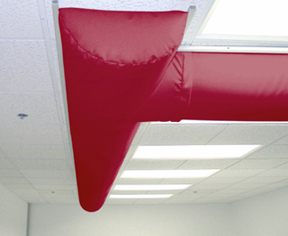
Shown is the D-shape, a surface-mount system that transform fabric duct into a low profile, half-round HVAC air distribution solution for low-ceiling applications. The D-shape system, which can be installed onto drop ceilings as well as sheet rock surfaces, is used for offices, retail stores, production equipment areas with low clearance, and other low-profile spaces. (All photos courtesy of DuctSox.)
Fabric duct has been used in Europe for over 30 years, but many American contractors have yet to install their first fabric duct project. However, the number of contractors with no fabric duct experience is diminishing rapidly as it gains acceptance among the country's best and most progressive architects.

In the last five years, there have been thousands of American projects ranging from mammoth applications such as the 350,000-square-foot David L. Lawrence Convention Center in Pittsburgh, down to more routine applications such as retail stores, churches, offices, gymnasiums, indoor swimming pools, warehouses, and industrial plants. Fabric duct is ideal for any application with exposed architectural ceilings. It's never used when ductwork is hidden in ceilings.

The main lure of fabric duct is the cost savings. Time and material differences between using fabric duct versus round spiral or rectangular metal duct can range anywhere from 10 to 60 percent depending on the diameter specified for the job. Simply put, fabric duct is hung from a suspension cable or anchored track system and installed similar to the way a shower curtain is installed. The time and labor savings can either be passed on to the owner or used to raise profit margins on design/build projects.

But there are more advantages to fabric duct than reduced time and labor. Other selling points are:

1. Lightweight - Fabric duct is approximately 90 percent lighter than its metal counterpart. This boils down to easier installation by smaller crews. It also could determine whether a project comes to fruition, especially in HVAC retrofit applications with roofs that wouldn?t be able to bear extra weight. In new construction, such as Star Precision's $6.2 million, 108,000-square-foot Longwood, Colo.-based metal fabrication factory, fabric duct's light weight saved the firm about $500,000 in labor, materials, and elimination of the need to put up a stronger supported metal building to accommodate hung metal ductwork.

Snow, rain, and wind loads can flex the suspended cable roof of Pittsburgh¿s David L. Lawrence Convention Center as much as 3 feet. Consequently, ceiling-hung metal air ducts would have necessitated hundreds of expansion joints, which would have raised costs and detracted from the aesthetics. Instead, the project architect specified polyester-based fabric air dispersion, which not only floats with the roof¿s random flexing, but also saves the project an estimated $250,000 versus other duct materials.
2. Acoustical control - It's a proven fact that fabric duct's acoustical qualities absorb more air handling equipment and air movement noise than metal duct, which tends to reverberate it. At Western Kentucky University, Bowling Green, Ky., the 720 linear feet of 36-inch-diameter fabric duct installed in the Hilltoppers' 42-year-old, 10,000-seat basketball arena during a $26 million retrofit was found to reduce air handling equipment noise significantly versus the original system.

3. Superior air distribution - It's no contest when comparing metal duct and registers to the linear diffusers of fabric duct. Metal duct registers located every five to 10 feet can't deliver the gentle and more evenly distributed airflow of linear diffusers that typically run the entire length of the duct. Diffusion can be custom-engineered at the factory to satisfy most throws and velocities. While a gentle air disbursement is preferred for occupied spaces, it's a critical factor in many applications such as sanding, painting, and coating areas. At Karges Furniture, Evansville, Ind., the gentle airflow of fabric duct's linear diffusers actually aids the varnishing and curing process of high-end handmade furniture. Metal duct would not have been feasible in this application.

4. Aesthetics - Fabric duct looks equally as aesthetic, if not better, as round spiral duct. At Rush Fitness Centers, Knoxville, Tenn., for example, fabric duct was chosen for its aesthetics at these high-tech health clubs and the benefits of even airflow and proper IAQ were added bonuses.

5. Maintenance - Metal duct can require painting while fabric duct is colored at the factory in standard or custom colors to match corporate colors or interior design motifs. Metal duct requires special duct cleaning equipment, whereas fabric duct can be disassembled, laundered at a dry cleaner or laundromat, and then reinstalled. At Dickinson College, Carlisle, Penn., fabric duct hanging above its indoor swimming pool would be difficult to paint periodically. The fact that the fabric duct was factory dyed to match school colors and even sport the Dickinson school logo, plus its non-corrosive features in humid and chemical environments, was part of the reason for choosing fabric.

6. Reduced labor - Fabric duct installations typically are installed with smaller crews and in 20 to 80 percent less man-hours than metal duct due to the ease of handling and simpler installation techniques. At Barney's Motorcycles, St. Petersburg, Fla., the air conditioning duct installation labor in the new showroom was reduced by weeks in this fast-track project because fabric was chosen over metal.There are many fabric duct types and most are offered by a variety of manufacturers. Typically, today's fabric duct is a blend of polyester fabrics. However, each model can vary by shape, function, price, color, and appearance, depending upon the application.

  • Industrial grades: Typically industrial-grade fabric duct is heavy duty and simply serves as a channel for airflow in warehouses, industrial plants, factories, food processing plants, etc. It can be factory engineered for airflow velocities and throws, but is not as aesthetic in appearance as higher-end fabrics.

  • Airflow variances: Surprisingly, some fabrics are designed to allow approximately 15 percent of the air to flow through the fabric. This further enhances the even and gentle air disbursement, especially in occupied spaces. Additionally, these flow-through models eliminate any duct condensation in humid environments and limit the amount of dust that typically collects on top of ductwork. Other types of airflow include high-throw models that can project air over long distances through specially engineered orifices. There are also low-throw models where air is delivered through fabric porosity, which is especially beneficial for food processing applications.

  • High-grade models: Higher-end fabrics are used when interior design is critical. While many of the industry's cheaper models are shiny, these fabrics are not unlike the material of a fine suit.

  • D-shape: A newcomer to the industry is the D-shape and corner shape ducts that are designed for limited ceiling clearance. In office applications, the D-shape lies flat against the ceiling and is round on the bottom. The corner type of duct works similarly, but in the 90-degree angle created by the wall and ceiling.

  • Specialty applications: Fabrics treated with an antimicrobial agent are available as are fabrics that dissipate static buildup and discharge in high-tech or electronic rooms.

  • Accessories: Like metal ductwork, fabric duct includes elbows, tees, and end caps. For transitions from metal plenums and ductwork, fabric duct manufacturers offer adaptors and fastening devices.

    Blue fabric air ducts help provide draft-less cooling and an aesthetic appeal for Rush Fitness Complex, Knoxville, Tenn.

    Duct Selection

    By the time a fabric duct project reaches the installing contractor, the specifying, engineering, and selection of size, airflow, color, and shape has been determined by the architect or consulting engineer. The industry's top fabric duct manufacturers have representatives that either help with system design or act as liaisons with factory engineers who provide the technical engineering assistance.

    On design/build projects where a contractor is required to specify size and airflow characteristics, the manufacturer's representative is a vital part of the engineering team.

    Incidentally, fabric duct is good for HVAC contractors that find themselves subcontracting the sheet metal portion of a design/build project. Instead of subcontracting, a contractor can install fabric duct with on-staff workers and make additional profits on a project.

    The H-Track hanging system can be surface mounted or hung to the proper height by attaching cables in the top of the track to ceiling supports via hanging cables. Once installed, clips are attached to the fabric duct slide into the bottom track and are tightened to eliminate movement.

    Installation

    Before installation, manufacturers can deliver the factory-engineered fabric duct to the jobsite or HVAC contractor's headquarters via UPS or other shippers. A large installation can involve dozens of lengths. Since all jobs are factory-engineered, all pieces arrive on-site numbered as to where and what sequence they should be installed.

    Sections can vary by length depending on the diameter of the duct. Smaller size lengths can range from 20 to 40 feet long, while larger diameters have shorter lengths for easier handling.

    While putting up a 30-foot section of 40-inch-round spiral metal duct would necessitate a large installation crew to handle the weight and bulk, a similar length of fabric duct requires only two handlers because the fabric is approximately 90 percent lighter. On smaller projects, a contractor might save money by supplying only ladders instead of erecting scaffolding systems.

    Tools to use for installation are no different than the tools needed for hanging metal duct: power drills, screwdrivers, pliers, and anchors for all types of building materials. Fabric duct needs no on-site cutting and typically is zippered together with factory-sewn industrial zippers. But don't throw away those tin snips. Metal plenums and metal duct (in enclosed ceilings) may still be needed to deliver the air from the air handler to the room(s) where fabric duct is applied. Remember, fabric duct is never concealed and is only suitable for open architectural ceilings.

    Support systems are similar among all major fabric duct manufacturers and they consist of either a cable system or an H-track system. The majority of projects that utilize fabric duct as their air distribution system consist of exposed steel truss roof structures (roof girder, purlin, rafter, beam). These support systems will be used in most cases for supporting the duct system.
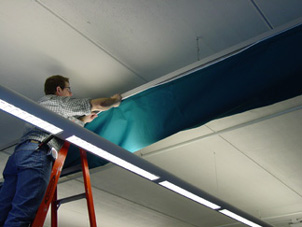
    A 30-inch-diameter length of round spiral metal duct would require at least two men and a scaffold. Here, one installer demonstrates the ease of installing fabric duct that¿s the same size.
    Cable systems consist of aircraft-grade steel cable and turnbuckles for tightening. Typically a cable system is anchored from wall-to-wall with conventional anchors found at any hardware store.

    Long cable runs will most likely need support(s) in the middle sections. This is accomplished no differently than supporting piping or other types of ductwork. Threaded rod anchored to ceiling joists is the most common hanging method. However, recent innovations have included the popular Gripple fitting that contractors use for hanging electrical conduit, lighting fixtures, piping, sheet metal duct, sprinkler systems, and other utility supplies that require leveling and on-site adjustments. The Gripple system is a faster method than C-clamps and threaded rod.

    In this situation an installer takes a small length of aircraft cable and loops it over the bottom of the ceiling joist and under the fabric duct cable system. Both ends of the cable are easily strung through the fitting which can be tightened when the proper length is achieved (once it levels the sagging of the main fabric duct cable system run). The locking grip on the fitting can be easily reversed, thus freeing the cable for readjustment or disassembly.

    Once the cable system has been suspended, hanging the fabric duct is no different than stringing a shower curtain onto a rod. The top of the duct comes with small clips that the cable is strung through. For larger diameters of 24 inches or more, a two-row cable system is recommended for aesthetics, but is not mandatory. With two cable systems holding the duct at 10 o'clock and 2 o'clock, potential sagging is eliminated and it enhances the aesthetics of the duct run.

    At Karges Furniture, Evansville, Ind., a 32-inch-diameter fabric duct is suspended from a cable hanging system and disburses air evenly and gently through a linear diffuser that runs the length of the ductwork.
    An alternative to the cable suspension system is the aluminum H-track system. This is not anchored into walls, but relies totally on support from the ceiling structure above. Once again the previously mentioned Gripple system supports the H-track from a ceiling support. Each vertical support cable has a special hub that slides through the top of the H.

    A snap tab that's connected to the fabric has a hub as well that slides through the bottom of the H. Some manufacturers offer a locking nut for the top hub that prevents it from sliding in the H-track once it has been set in position. Like the cable system, a two-run H-track will eliminate possible sagging on larger diameter runs.

    The H-track also comes in a surface-mount style for low-clearance situations.

    Usually it takes only a few hours to become proficient at hanging either the cable or H-track systems. In addition, most major manufacturers offer factory consultation for installation.

    Any HVAC contracting company looking to add another dimension to its services should look into fabric duct as an alternative to metal duct.

    Cary Pinkalla is an industrial engineer and president of DuctSox, Dubuque, Iowa. For more information, contact the company at 866-382-8769, ext. 6055, or visit www.ductsox.com.

    Publication date: 10/20/2003

  • Looking for quick answers on air conditioning, heating and refrigeration topics? Try Ask ACHR NEWS, our new smart AI search tool. Ask ACHR NEWS →

    Share This Story

    Looking for a reprint of this article?
    From high-res PDFs to custom plaques, order your copy today!


    Recommended Content

    JOIN TODAY
    To unlock your recommendations.

    Already have an account? Sign In

    • HVAC-enrollment

      The Trades Are Back: HVACR Programs See Nearly 30% Enrollment Spike

      A new wave of future technicians is entering the pipeline.  
      Training and Education
      By: Matt Jachman
    • 2025 Top 40 Under 40

      2025 Top 40 Under 40 HVACR Professionals List

      The 11th annual Top 40 Under 40 list highlights those...
      HVAC Light Commercial Market
      By: Hannah Belloli-Oster
    • LG Ductless Mini-Split Systems

      The 9 Types of Heat Pumps

      As the U.S. moves toward electrification, heat pumps are...
      Ground Source Heat Pumps
      By: Joanna R. Turpin
    Subscription Center
    • Create an Account
    • Start a Subscription
    • Manage My Account
    • Sign Up for Newsletters
    • Visit Customer Service
    • Update Preferences

    More Videos

    Sponsored Content

    Sponsored Content is a special paid section where industry companies provide high quality, objective, non-commercial content around topics of interest to The News audience. All Sponsored Content is supplied by the advertising company and any opinions expressed in this article are those of the author and not necessarily reflect the views of The News or its parent company, BNP Media. Interested in participating in our Sponsored Content section? Contact your local rep!

    close
    • Piggy Bank
      Sponsored byWatercress Financial

      Energy Prices, Inflation, and HVAC: What Today’s Homeowners Care About

    • Refrigerated Food
      Sponsored bySolstice Advanced Materials

      R-455A Refrigeration: A Cold Storage Solution for the Future

    • Airex Rooftop Units
      Sponsored byAirex Manufacturing Inc

      Consolidating Roof Penetrations: A Growing Trend in Multifamily HVAC Design

    Popular Stories

    HVAC-Price-Increase-graphic

    HVAC Price Increase List: June 2026

    Trump-Section-232.jpg

    Trump Reduces Section 232 Tariffs on HVAC Equipment to 15%

    R410A-Refrigerant-Cylinder.jpg

    Refrigerant Recovery is a Revenue Opportunity

    Heat-pump-cutaway.jpg

    PFAS Rules and A2L Building Codes Continue to Evolve

    Kroger.jpg

    Kroger to Spend $100 Million to Reduce Refrigerant Leaks

    View The ACHR NEWS
    Centennial Anniversary Timeline

    The ACHR News Timeline Chart
    Submit a Letter
    Submit a letter to our editors.

    Events

    November 6, 2025

    Next-Gen Data Center Cooling: HVAC Innovation and Real-World Solutions

    On Demand As AI workloads and high-density computing push traditional cooling methods to their limits, the data center industry is accelerating the adoption of next-generation HVAC technologies.

    June 9, 2026

    Before You Go All In on AI: Set Up Your Business to Actually Win

    In this webinar, we'll walk you through exactly what to get in place before you add AI to your business. You'll leave with a clear picture of where you stand today and a practical action plan to set yourself up for real results.

    View All Submit An Event

    Poll

    Summer Staff

    Are you fully staffed for the summer season?
    View Results Poll Archive

    Products

    BNI Mechanical/Electrical Square Foot Costbook, 2026 Edition

    BNI Mechanical/Electrical Square Foot Costbook, 2026 Edition

    See More Products
    A2L Refrigerants - Free Webinar - May 21, 2026

    Related Articles

    • Leadership

      How Servant Leadership Can Help Contractors Win More Moments

      See More
    • Duct Fabrication sheet metal

      Tariffs Cut into Sheet Metal Shop Profit Margins, Add Volatility

      See More
    • Hvacr Wholesalers’ Profit Margins Slipping, Says Expert

      See More

    Related Products

    See More Products
    • new cover.jpg

      Profit is An Attitude: The Strategies You Need to Optimize Profits

    • Building Information Modeling: Planning and Managing Construction Projects with 4D CAD and Simulations

    • The ACHR News - March 2, 2026

      ACHR NEWS March 2, 2026, Issue

    See More Products

    Related Directories

    • Prihoda Fabric Duct

      Prihoda fabric duct diffusers are custom UL/ULC approved air diffusion devices. Lay-in laminar flow diffusers, custom graphics/colors, hold open tensioning, nozzles, antimicrobial and spot heating/cooling.
    • Fabric Duct Systems Inc.

      Engineers and manufacturers Q-SOX brand fabric duct for HVAC/R air distribution. Q-SOX is a proven solution for better Indoor Air Quality (IAQ) and warm or cool air circulation.
    ×

    Sign Up. Stay Informed.

    The #1 trusted source for the HVACR industry since 1926

    SUBSCRIBE
    • RESOURCES
      • Advertise
      • Contact Us
      • Advisory Board
      • Classifieds
      • Submit a Letter
      • Directories
      • Store
    • ACCOUNT CENTER
      • Create an Account
      • Start a Subscription
      • Manage My Account
      • Sign Up for Newsletters
      • Visit Customer Service
      • Update Preferences
    • SERVICES
      • Marketing Services
      • Reprints
      • Market Research
      • List Rental
      • Survey/Respondent Access
    • STAY CONNECTED
      • LinkedIn
      • Facebook
      • Instagram
      • YouTube
      • X (Twitter)
    • PRIVACY
      • PRIVACY POLICY
      • TERMS & CONDITIONS
      • DO NOT SELL MY PERSONAL INFORMATION
      • PRIVACY REQUEST
      • ACCESSIBILITY

    Copyright ©2026. All Rights Reserved BNP Media, Inc. and BNP Media II, LLC.

    Design, CMS, Hosting & Web Development :: ePublishing