Why Get Certified? 'It’s Common Sense'

Certification is a touchy subject. Industry still debates the need for one nationally recognized certification — or rather, which organization should provide it. In the meantime, many HVACR contractors and technicians are already realizing the benefits that certification offers.
The News spoke with members of the industry to find out how certification has benefited them professionally. They said it is only a matter of time before certification really takes off, and no contractor will want to be left behind.
THE TECHNICIAN’S PERSPECTIVE
Dave Paceley has been in the industry for the past 20 years. He is currently working on industrial systems for a Fortune 500 company. He has been an active member with the Refrigeration Service Engineers Society (RSES) and holds Certificate Member (CM) certification through the society. He also has Testing, Adjusting and Balancing (TAB) certification, which is available through the Testing, Adjusting, and Balancing Bureau (TABB).Paceley credits his professional advancement to his involvement with industry organizations, especially his certifications. “Without a doubt, the jobs I applied for I got because of my certification,” he said. “I’m amazed how many people know what RSES is.”
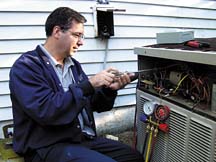
“The people who go out for the training and the certification are the ones that are more competent,” said Paceley.
A man who has been proving his competence for many years now is 70-year-old Frank Prah. He says he has been in the industry since he was a teenager. He got his start helping his father (who was a maintenance supervisor). For most of his HVACR career, Prah was primarily a service guy and performed a bit of installation work on the side. Currently the veteran technician is a regional director for RSES, covering the states of Ohio, Kentucky, Indiana, and West Virginia.
Prah also earned a CM and has two Certificate Member Specialist (CMS) certifications: one in air conditioning and refrigeration, and the other in controls. He also has each of the certifications through North American Technician Excellence (NATE).
“From a personal standpoint, [certification] has helped me a lot. It helped me put a lot into my retirement fund,” said Prah. For each new certification he earned, his employer would up his pay. These raises all went towards Prah’s retirement.
Looking for quick answers on air conditioning, heating and refrigeration topics? Try Ask ACHR NEWS, our new smart AI search tool. Ask ACHR NEWS
Besides monetary gain, Prah says certification helped him prove his level of knowledge. The veteran technician says there have been times in the field when his work has been questioned, but training and certification helped him to work through projects and explain why the job was done correctly.
Certification can also take technicians down other paths in the industry, according to Prah. “Service is really a young man’s job,” he said. By earning certification, men and women can move to other sectors of the industry when service work gets too demanding.
Certification isn’t just a benefit for technicians. Prah says everyone wins when certification is added to the industry equation.
Manufacturers want technicians who can properly install their equipment. Prah says that oftentimes, equipment is replaced or sent back to a manufacturer because a technician thinks it is faulty. In reality, the part was not installed correctly.
Consumers benefit because, “The customer is the person who pays for everything, he wants his system served as well as possible,” stated Prah. He says that if a technician can install or service a piece of equipment without having to make a return visit, this will build trust among customers.
Finally, he asserts that certification is a benefit to contractors.
“A person with certification shows he has taken the time to be better,” said Prah. He said that contractors should advertise the fact that they have certified technicians in order to put consumers at ease.

THE CONTRACTOR’S PERSPECTIVE
Many contractors are realizing the benefits of hiring certified technicians. Some are even committed to taking their current technicians and putting them through the certification process.Two contractors doing that now have been supporters of NATE certification since its inception.
Mitchell Cropp of Cropp-Metcalfe Air-Conditioning & Heating in Fairfax, VA, currently has 20 of his technicians NATE certified. That’s close to half of his service department. Cropp says he has been a NATE supporter since he was president of the Air Conditioning Contractors of America (ACCA). At that time, ACCA had its own certification, Air Conditioning Excellence (ACE). When NATE was launched, it merged with ACCA’s ACE certification to form one certification program.
“We are very big into training,” said Cropp. He explains that his technicians are required to take 40 hours of training a year, either through the company or through an outside source. “When certification came about, we decided that should be a major focus.”
The contractor pays for each technician to take the NATE exam. If they do not pass, the tech must pay to take it the second time.
Cropp says that so far all of his technicians who have taken the test have passed. He also says that while the technicians found some of the questions on the NATE exam to be questionable, they all found the testing to be fair.
Cropp says his techs have taken a great deal of pride from passing the exam. “They have the gratitude of knowing they have trained well and that they understand the industry.”
The contractor has started using the NATE logo in direct mail promotions as well as other company advertisements.
Richard Dean of Environmental Systems Associates in Columbia, MD, is also trying to get the word out on his NATE-certified technicians. Ten of the contractor’s 13 technicians are already certified through NATE, and the rest will try for it after they gain more experience in the field. A few of Dean’s technicians are already coming up again for recertification.
“We thought it was of value,” Dean said. “Some of our customers have recognized [NATE] and it gives them a certain level of comfort. And it give us comfort that our technicians are very experienced.”
Both Dean and Cropp believe certification is a long-term investment. They add that the benefits associated with employing a certified technician will not happen right away, and this may keep some contractors away.
“Some companies are just not at the point where they feel the expense of certification is worth the benefit,” said Cropp.
MANUFACTURER PRESSURE
Cropp explains that the acceptance of certification will not happen overnight. But when industry begins to push for certification, more companies will get on board. He says manufacturers in particular can drive the exposure of NATE to consumers by placing the NATE logo on product literature. Or, manufacturers can put some pressure on contractors to get technicians certified.“The main issue is, manufacturers need to start stating that technicians need to be certified to service their equipment,” said Cropp.
This is part of the reason why Dean decided to go with NATE certification — he believes NATE has manufacturer support because manufacturers have a vested interest in making sure their products are properly installed and diagnosed. This reduces the number of products that are labeled defective.
This kind of competence is also beneficial to contractors, Dean says, because certified technicians help reduce the number of callbacks.
Cropp believes that the time will come when consumers and manufacturers will demand certified technicians. “This is a long-term investment,” he said. “When the time comes, our technicians will be prepared.”
Dean says he, too, will be prepared to better service the industry and strengthen his company. To do that, Dean says he will continue to train his technicians and get them certified.
“We intend to be in business for the foreseeable future,” said Dean. “We are in it for the long run.”
Sidebar: Go Online To Prepare For NATE
A common complaint among technicians seeking certification is that there is no place to get training or prepare for an exam. Listen up: There is a new option that can help techs prepare for the North American Technician Excellence (NATE) test.HVACREducation.net is one of the first online resources for HVACR training. Chris Compton, HVACR instructor at North Idaho College (NIC), developed a website to provide distance learning to fill a void in industry training. The website was launched last year. According to Compton, the endeavor has been successful.
HVACREducation.net currently provides five courses in HVACR fundamentals and HVACR electrical. Each course requires 18 hours of study and consists of six training modules.
Compton says more courses will be launched in the coming months and into next year. While online learning is helping technicians and students get their start in the industry, Compton believes the website can help those looking for a refresher course in order to pass the NATE exam. He says that the current course offerings at the website are in line with NATE’s Knowledge Areas of Technician Expertise (KATE). KATEs are guides put together by NATE to give educators an idea of what they should teach in order to help their students to pass the NATE exam.
Compton says that the online content is the same as any classroom, maybe even better. “The option now is an online educational program from any place at any time,” he said.
In the last two months, the website posted a Pre-Certification Assessment (PCA) program. It offers a free 100-question test similar to the core NATE exam. After completing the practice test, participants can submit their answers to the website and get instant results.
A performance report will be available to test takers and is broken down by subjects offered at HVACREducation.net. This allows participants to find out where their strengths are and what subjects they need to study.
For more information, visit the website, www.hvacreducation.net.
— by J.J. Siegel
Publication date: 09/30/2002
Looking for a reprint of this article?
From high-res PDFs to custom plaques, order your copy today!


